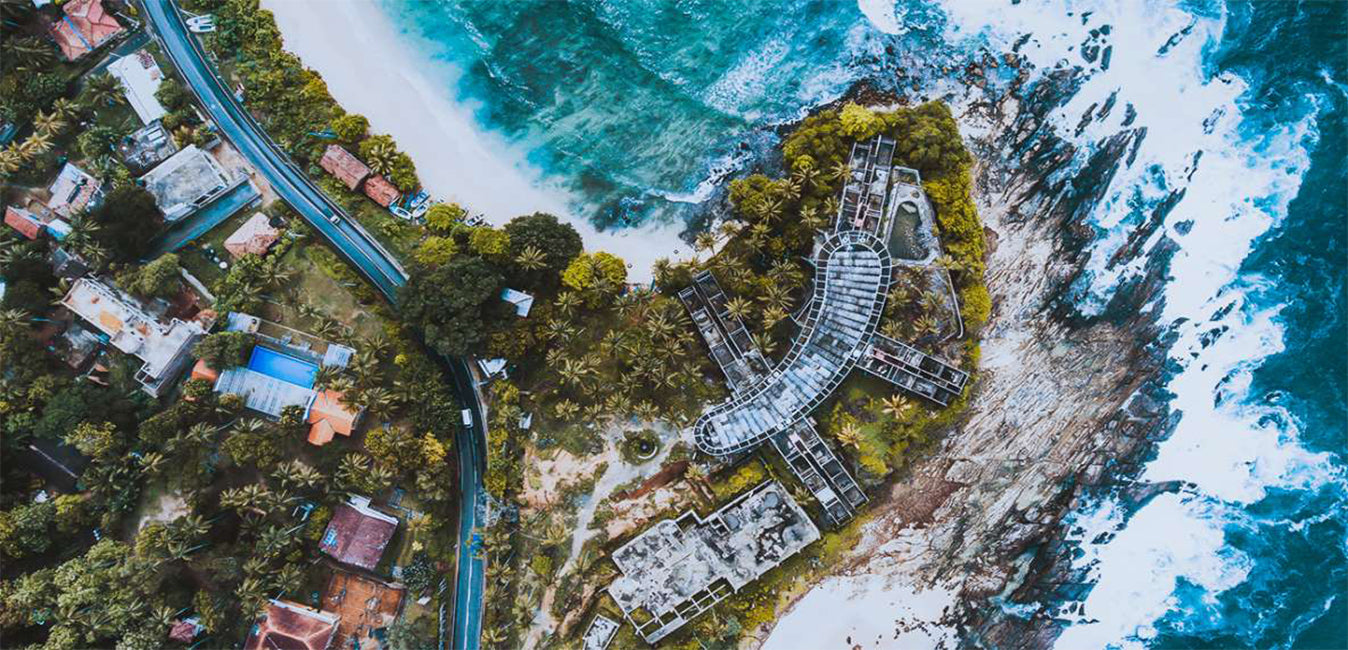
Hummanaya Blow Hole

Hummanaya Blow Hole Hummanaya Blow Hole Hummanaya Blow Hole

A blowhole is a geological feature sometimes found along coastal regions. The phenomenon occurs when the tide fills underwater caverns with seawater. The caverns are caused by a geological process of shoreline erosion. This can happen through ‘hydraulic action’ where the waves cause pressure on the airpockets within the little cracks in the cliff, widening them further; ‘abrasion’ or ‘corrasion’ caused by the waves bashing rocks, pebbles, sand and other material into the cliff; chemical weathering caused by the acid content in seawater, especially lethal to rock compositions such as limestone; and ‘attrition’, a sandpapering effect caused by small loose circular rock debris. If the caverns have an aboveground opening; the pressure causes the water to push out periodically in a fountain, or ‘blow’. The timing and height of the water fountains from these blowholes are dependent on the tides and wave formations.

Whilst there are many blowholes all over the world, and especially along the European coast; Sri Lanka only has one known blowhole. It’s near Kudawella, a small fishing village in the Southern Province. Hummanaya can be reached by crossing over a tombolo; a piece of land that is created when deposition of sand or gravel occurs, connecting an island to the mainland. This blowhole has achieved fame amongst visitors to the island, as it is believed to the second largest blowhole around the world. Named after the strong humming sound that it produces while active; Hummanaya Blowhole can shoot up to a height between 25 ~ 30m.

Hummanaya Blow Hole Hummanaya Blow Hole Hummanaya Blow Hole

À propos du district d'Hambantota

Hambantota est une ville rurale située sur la côte sud-est du Sri Lanka. Elle est également la capitale du district d'Hambantota, dans la province du Sud. À environ 240 km de Colombo, Hambantota est en pleine transformation pour devenir un port stratégique et un centre commercial, grâce à d'importants travaux de développement des infrastructures. Bordée de vastes plages de sable fin, Hambantota est un point de départ idéal pour visiter les sites touristiques environnants.

Le parc national de Bundala se trouve à 20 km à l'est d'Hambantota et le sanctuaire de Weerawila un peu plus loin. Le parc national de Ruhuna et le temple de Kataragama sont d'autres attractions facilement accessibles depuis la ville.

À propos de la province du Sud

La province du Sud du Sri Lanka est une petite région géographique qui comprend les districts de Galle, Matara et Hambantota. L'agriculture de subsistance et la pêche constituent la principale source de revenus pour la grande majorité des habitants de cette région.

Parmi les sites importants de la province du Sud figurent les sanctuaires fauniques des parcs nationaux de Yala et d'Udawalawe, la ville sainte de Kataragama et les anciennes cités de Tissamaharama, Kirinda et Galle. (Bien que Galle soit une ville ancienne, il ne reste presque rien d'avant l'invasion portugaise.) Durant la période portugaise, deux célèbres poètes cinghalais, Andare, originaire de Dickwella, et Gajaman Nona, originaire de Denipitiya dans le district de Matara, composaient des poèmes sur le peuple.