Maldive fish — known in Sinhala as umbalakada — is cured, smoked, and sun-dried tuna that has shaped the flavour of Sri Lankan cooking for centuries. Produced traditionally in the Maldives from Indian Ocean skipjack and yellowfin tuna, it crosses culinary borders with ease: the same ingredient sits at the heart of Maldivian, Sri Lankan, and South Indian kitchens alike. Hard as a block of wood when whole, and intensely savoury when ground, it is Sri Lanka's closest equivalent to the fish sauces and shrimp pastes of Southeast Asia.
Where does Maldive fish come from?
The ingredient takes its name from the Maldive Islands, where the surrounding Indian Ocean has long yielded abundant catches of pelagic fish — skipjack tuna, yellowfin tuna, little tunny (known locally as laṭṭi), and frigate mackerel. For Maldivian fishing communities, processing this catch was both a source of daily food and, historically, one of the country's main export trades, with Sri Lanka as the primary destination.
The islands of Lakshadweep in India share a similar tradition, and the finished product features prominently in the cuisines of Kerala and Tamil Nadu as well. Along the Sri Lankan coast, trade in cured tuna has been documented for well over a thousand years.
How is Maldive fish processed?
The process is labour-intensive and unchanged in its essentials for generations. On a productive night, using simple bamboo poles to fish from shoals of bonito, a skilled crew can land 600 to 1,000 fish in two or three hours.
Each fish is handled individually in a strict sequence:
- The fish is gutted and skinned; gills and most innards are discarded.
- The head and backbone are removed, and the belly piece separated.
- The remaining flesh is cut lengthwise into four pieces called ari (large yellowfin may be cut further into smaller sections called foti).
- The pieces are boiled, then smoked, then laid out to dry in the sun until they turn dark and wood-hard.
This combination of boiling, smoking, and sun-drying effectively eliminates moisture, allowing the cured fish to be stored for an extended period without refrigeration — a critical quality in tropical islands before modern cold-chain logistics existed.
What by-products does the process create?
The stock left after the initial boiling of the fish is not discarded. Reduced and concentrated, it becomes rihaakuru, a thick, dark paste used extensively in Maldivian cooking as a condiment and flavour base. Pieces of Maldive fish that are too small or misshapen for sale as whole ari are pounded in a large mortar and pestle until they break down into fine, brittle splinters — a form traditionally used to flavour dishes such as the Maldivian breakfast staple mas huni.
How is Maldive fish used in Sri Lankan cuisine?
In Sri Lanka, Maldive fish functions simultaneously as a thickener, a protein source, and a deep umami seasoning. Its role in Sri Lankan kitchens is so fundamental that most cooks keep a jar of it alongside salt and chilli.
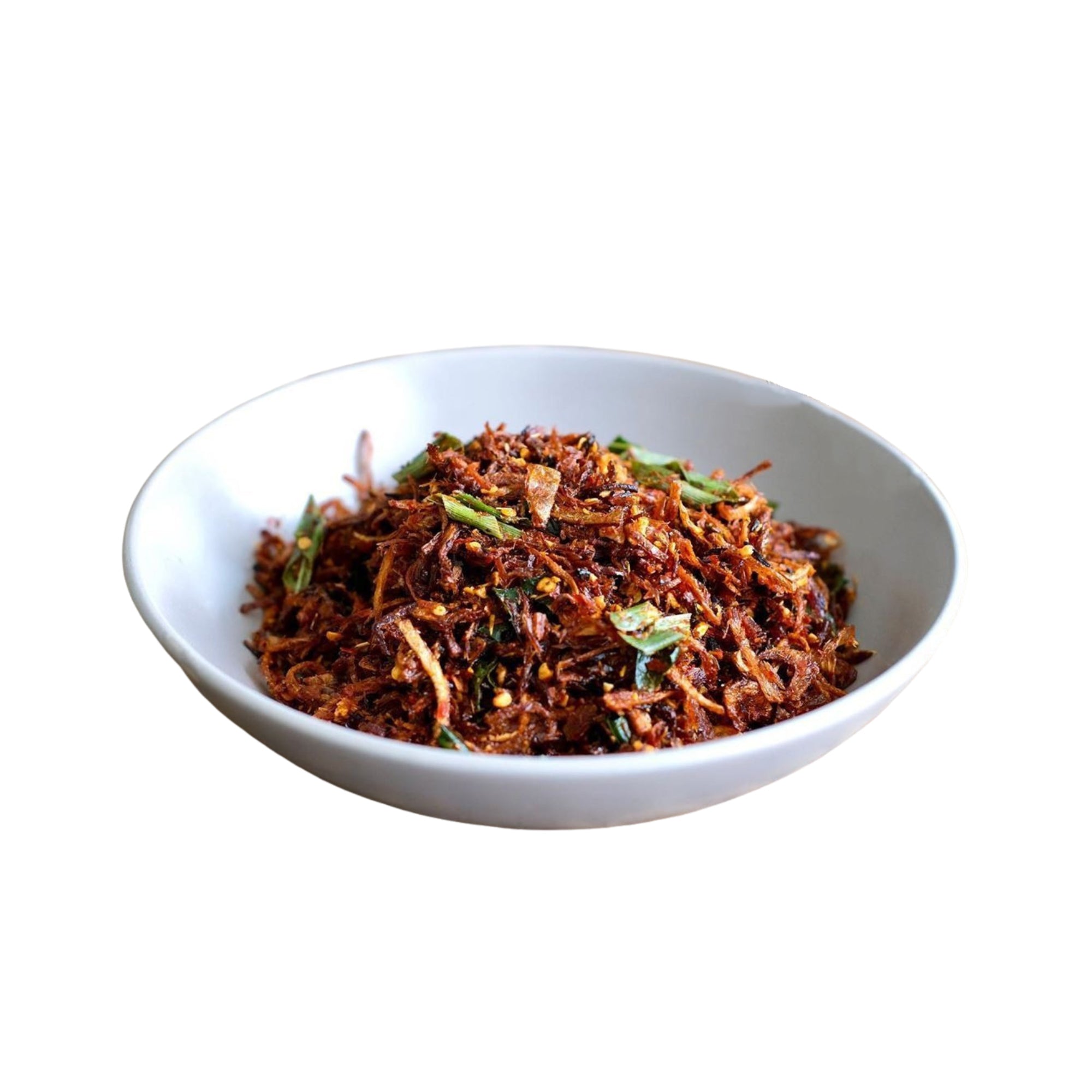
The most iconic application is coconut sambol (pol sambol): freshly scraped coconut is mixed with ground Maldive fish, red onion, lime, and chilli to produce the condiment served at almost every Sri Lankan meal. Without Maldive fish, pol sambol loses much of its savoury depth.
Other common uses include:
- Vegetable curries — a small quantity added early in cooking enriches the sauce without making the dish taste overtly of fish.
- Sini sambal — a preserved relish in which Maldive fish is the dominant flavour; it keeps indefinitely in a sealed jar.
- Dhal and lentil preparations — where it adds body and a background savoriness.
- Maldivian dishes such as gulha (stuffed fish dumplings) and bokiba (a coconut-and-tuna cake).
The quantity used varies widely by dish. In some recipes a single tablespoon of ground Maldive fish is sufficient to season a curry for four people; in sini sambal it is the centrepiece. The flavour profile — rich, smoky, and intensely savoury — is often described as a natural source of umami, elevating even the plainest vegetables.
What forms of Maldive fish are available today?
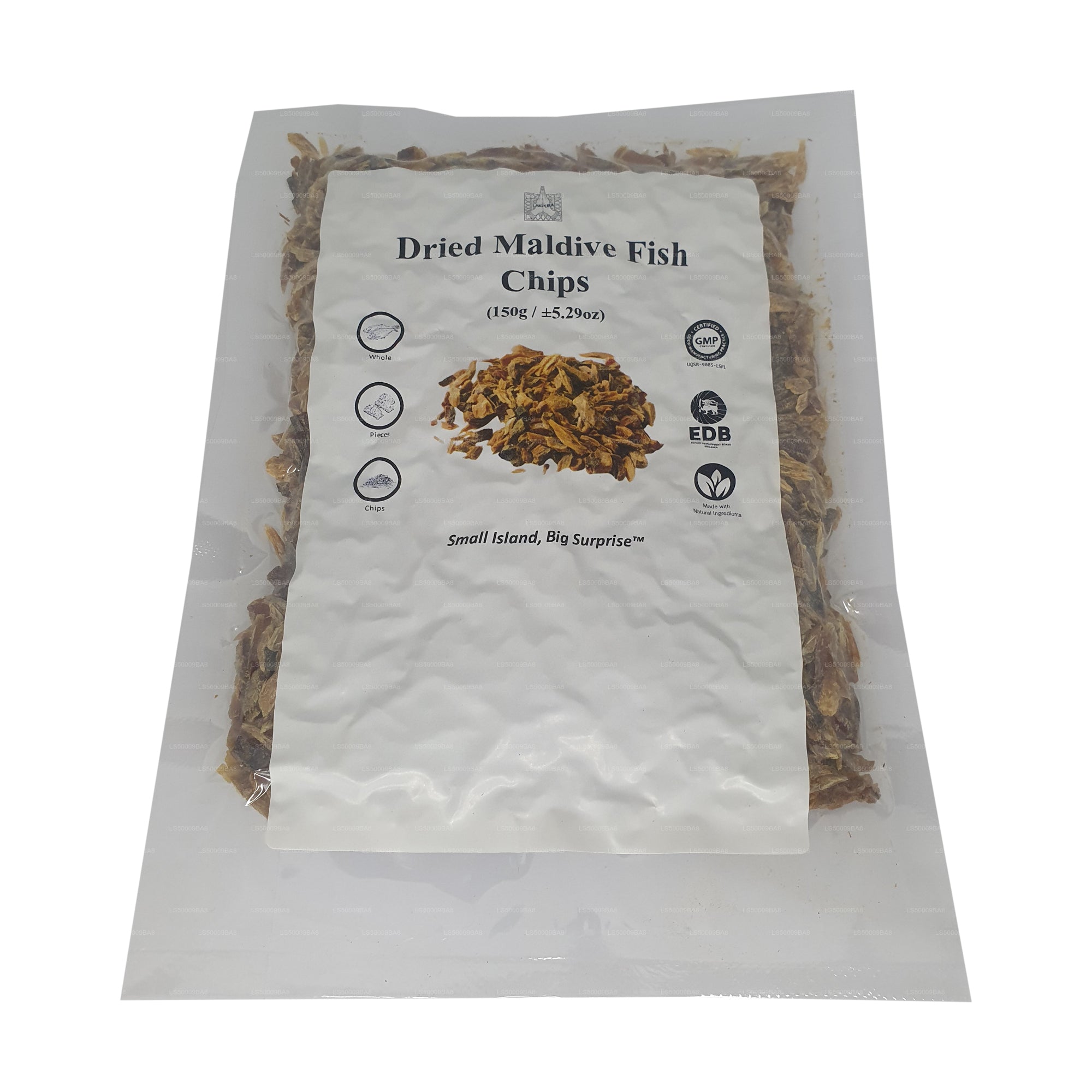
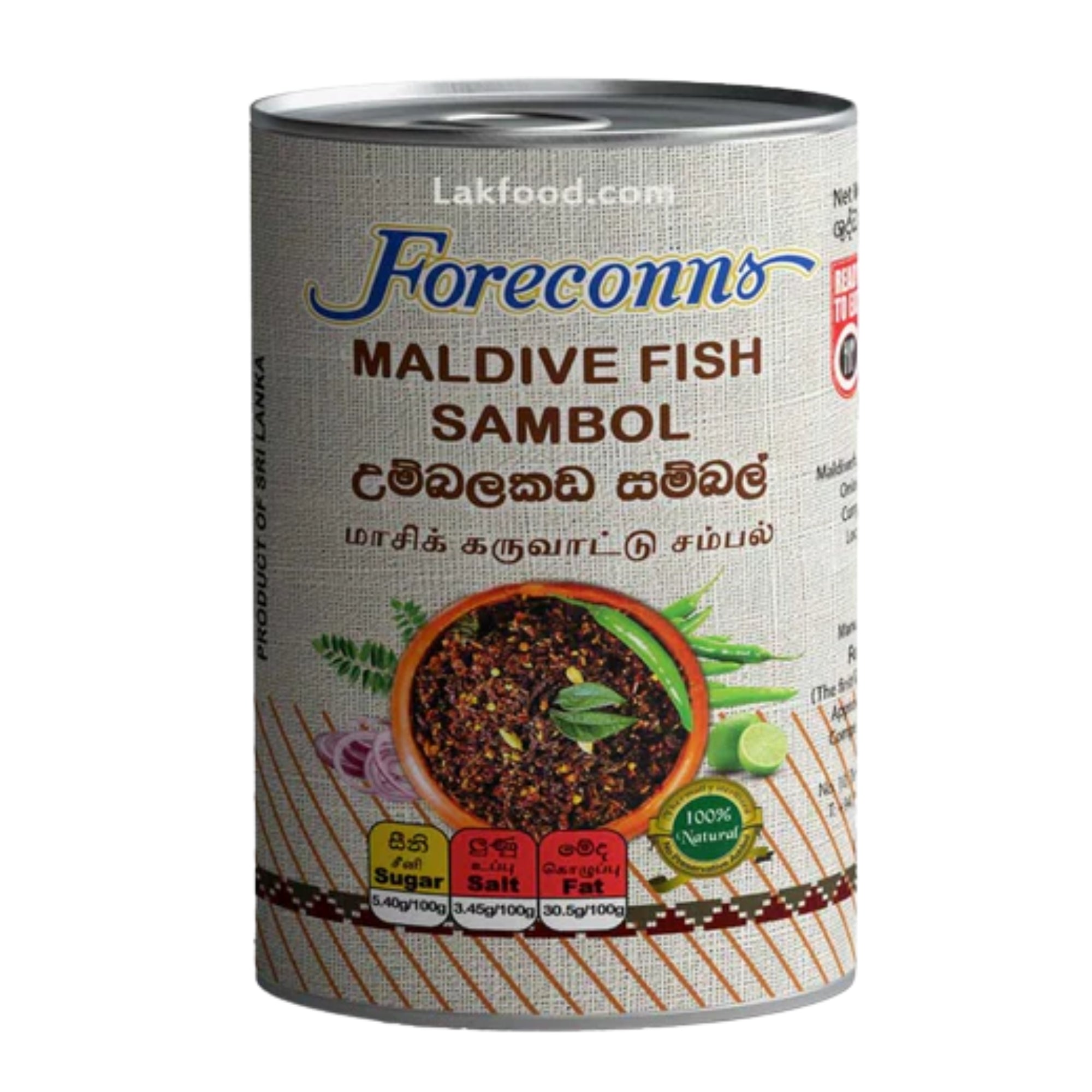
Historically the product was sold as whole ari — long, rock-hard fillets that the buyer would break or pound at home. Today, most retailers sell Maldive fish in pre-crushed or chipped form, sealed in small plastic packets or glass jars for convenience. Three main formats are found in Sri Lankan shops and supermarkets:
| Format | Typical use | Notes |
|---|---|---|
| Whole pieces (ari) | Long-cooked curries, stock making | Strongest flavour; requires pounding or grating |
| Chips / flakes | Sambols, stir-fries, quick curries | Ready to use; widely available in packets |
| Pre-made sambol | Direct use as a condiment | Blended with chilli, onion, and spices |
Quality varies by brand and source. Fish that is pale, crumbly, or smells predominantly of salt rather than smoke has usually been under-processed. Well-made Maldive fish is very dark, almost mahogany in colour, and carries a clean, intensely savoury aroma.
How does Maldive fish compare to similar ingredients in other cuisines?
Across Southeast Asia, fermented shrimp paste (belacan), fish sauce (nam pla), and dried anchovies (ikan bilis) serve broadly comparable flavour roles. Maldive fish is distinct in that it relies on smoking and drying rather than fermentation or liquid extraction, which gives it a less pungent, more rounded quality. It also holds its shape during cooking in a way that fish sauce cannot, making it useful in both wet and dry preparations.
Within Sri Lanka, Maldive fish is sometimes used alongside Ceylon black pepper and other aromatic spices to build complex, layered sauces — a combination that reflects the island's long history as a spice-trade hub.
Can travellers buy authentic Maldive fish in Sri Lanka?
Maldive fish is widely available across Sri Lanka, from large Colombo supermarkets to small roadside shops in coastal villages. Visitors who want to take it home will find pre-packaged chips and sambol products easiest to carry, as whole pieces require extra wrapping to prevent their aroma from permeating luggage. Most formats are shelf-stable for many months when stored away from heat and moisture. Lakpura ships a curated selection of Maldive fish products internationally for those who want to continue cooking with it after returning home.