Lakpura
Lakpura®

Serendib Scops Owl

The Serendib Scops Owl (Otus thilohoffmanni) holds a remarkable place in ornithological history as one of the most recently confirmed bird species in Asia. Formally described to science in 2004, this small, rufous owl had been heard for years in Sri Lanka's lowland rainforests before researchers finally observed it at the Sinharaja Forest Reserve in 2001 — its distinctive call having been mistaken for a forest frog for much of that time. Endemic to Sri Lanka and confined to a narrow ecological zone, it ranks among the most sought-after sightings for serious birdwatchers visiting the island.

What does the Serendib Scops Owl look like?

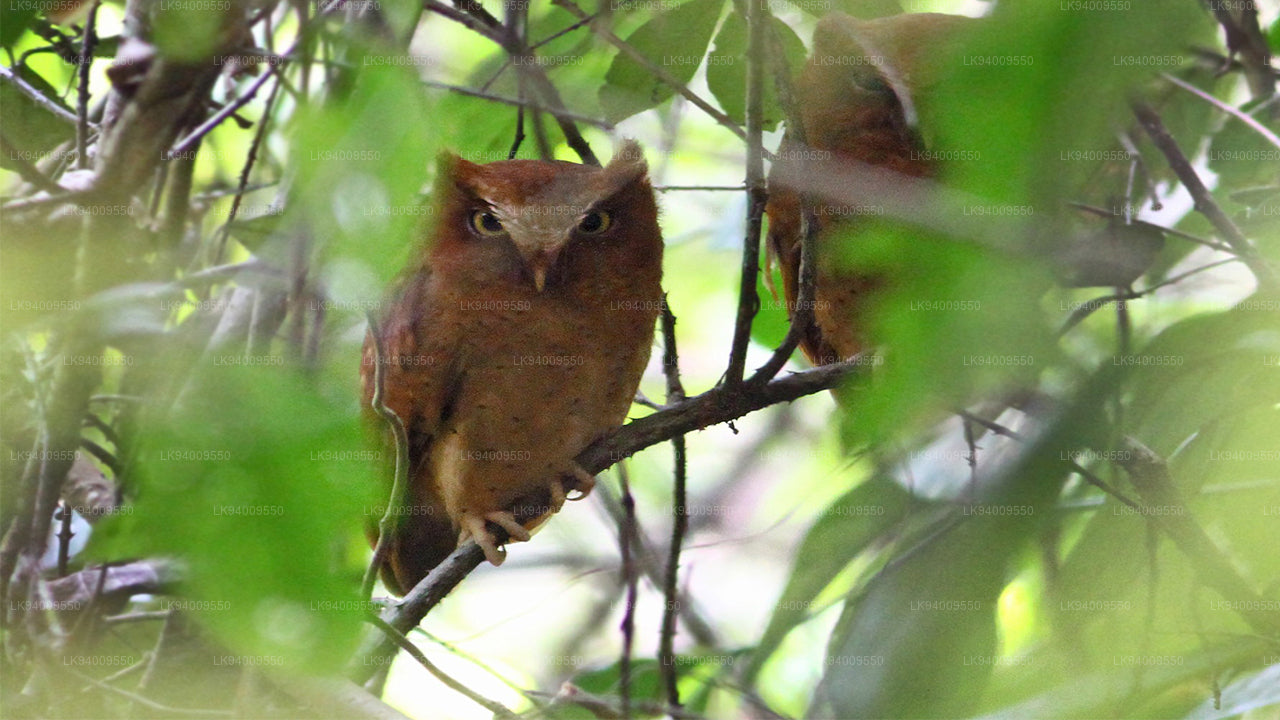
This is a compact, short-tailed scops owl with an overall rufescent appearance. Unlike many owl species, it lacks noticeable ear tufts and has a relatively indistinct facial disc, which makes it harder to spot against the bark and dense foliage of its rainforest home. Key identification features include:

  • Upperparts almost entirely rufous brown, marked with darker streaks and vermiculations
  • Underparts paler rufous with dark triangular spots arranged along the breast and flanks
  • Iris colour differs by sex — yellowish in females, orangish in males — a useful field mark when a perched bird can be observed closely
  • Small overall body size, broadly similar to other scops owls in the region

Its plumage provides excellent camouflage within dense lowland forest understorey, and a daylight encounter is largely a matter of patience and local knowledge of regular roost sites.

Where is the Serendib Scops Owl found in Sri Lanka?

The species is restricted to the lowland wet zone forests of Sri Lanka's south-west, a region that supports the island's richest assemblage of endemic wildlife. Since the initial confirmation at Sinharaja, surveys have established its presence across several other low-country rainforest patches with limited human disturbance. Known or likely localities include:

  • Sinharaja Forest Reserve — the type locality and the most reliably productive site
  • Kithulgala and the surrounding forests of the Kelani valley
  • Makandawa Rainforest and other fragmented wet-zone patches in Sabaragamuwa Province
  • Selected lowland forest blocks in the Galle and Ratnapura districts

The owl is not recorded in the dry zone, the central highlands, or the northern and eastern parts of the island. Its entire known range sits within Sri Lanka, making it a strict endemic with no population elsewhere in the world.

When is the best time to see the Serendib Scops Owl?

Because the species is nocturnal and detected primarily by call, visits after dark — ideally with a local naturalist guide who knows the owl's territories — offer the best chances. The owl can be heard throughout the year at established sites, though activity often peaks during the inter-monsoon periods when forests are quieter and calling behaviour intensifies. For birdwatchers planning a broader rainforest itinerary, the months of January to April and August to September generally combine drier walking conditions with good wildlife activity across the wet zone.

Arriving at Sinharaja during the north-east monsoon (roughly December to January) can make forest paths muddy and difficult, though sightings are still possible for those prepared for wet conditions.

How is the Serendib Scops Owl identified by call?

The owl's vocalisation is the primary means by which it was tracked, and the reason its true identity remained unconfirmed for so long. The call is a soft, repetitive note that bears a close resemblance to the advertisement call of certain forest frogs native to the same habitat — an extraordinary convergence that fooled naturalists for decades. Once learned, however, the call is consistent and distinctive enough to detect at night from a forest trail or lodge veranda adjacent to good habitat. Experienced guides in the Sinharaja area are familiar with the difference and can locate calling birds reliably.

What do we know about the Serendib Scops Owl's behaviour and breeding?

Relatively little has been published on the species' biology, partly because it was recognised so recently and partly because nocturnal rainforest research is logistically demanding. During daylight hours, the owl roosts in low branches deep within very dense vegetation, pressing against branches to minimise its profile. Its diet is presumed to follow the pattern of related scops owls — invertebrates and small vertebrates — but detailed dietary studies have not yet been conducted. Breeding biology remains largely undocumented; nest sites, clutch size, and incubation periods are still to be formally described in the scientific literature.

Why is the Serendib Scops Owl important for conservation?

The species qualifies as Endangered on the IUCN Red List, reflecting the severe and continuing reduction of Sri Lanka's lowland rainforest. The wet-zone forests that support it cover only a small fraction of the island's land area, and ongoing pressures from agriculture, logging, and settlement mean that suitable habitat continues to contract. Sinharaja, as a UNESCO World Heritage Site and the largest remaining block of primary lowland rainforest in Sri Lanka, is critical to the owl's survival. Conservation of smaller satellite forest patches and wildlife-friendly buffer zones around reserves is equally important for maintaining population connectivity.

For visiting birdwatchers, responsible tourism — staying on marked trails, avoiding playback calls near roost sites, and choosing guides committed to low-impact wildlife watching — directly contributes to the long-term future of this species.

How can I plan a birdwatching trip to see the Serendib Scops Owl?

Most itineraries focus on one or two nights at a lodge within or adjacent to the Sinharaja buffer zone. Martin's Simple Lodge, located at the forest edge near Deniyaya, is a well-regarded base with experienced local guides. The Makandawa Rainforest near Kithulgala offers an alternative setting that also supports a rich ensemble of wet-zone endemics and can be combined with a broader south-west circuit. Transfers from Colombo to Sinharaja typically take around three to four hours depending on the route taken.

A combined wet-zone birdwatching and wildlife itinerary might also include the Elephant Transit Home at Udawalawe, allowing visitors to pair endemic bird species with the island's megafauna in a single loop through the south.

Ask Lakpura® Agent