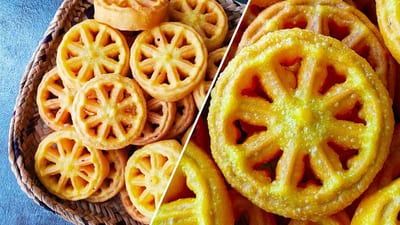
Kokis (කොකිස්) is the crisp, lacy, flower-shaped snack that sits on almost every Sri Lankan New Year table at the Sinhala and Tamil New Year in April. It is made from a simple batter of rice flour, egg and coconut milk, coloured pale gold with a little turmeric, which is picked up on a hot metal mould and deep-fried. The flavour is mild and lightly salted rather than sweet, so kokis is equally at home beside sweetmeats and with a cup of Ceylon tea.
The only special equipment is the mould, known in Sinhala as the kokis achchuwa: a patterned iron or non-stick head on a long handle. For the story of the dish, its likely Dutch-era name and how it is sold today, see the page on kokis and its place in Sri Lankan culture.
How to make kokis
- Makes about 25 kokis
- Prep: 10 minutes (+ 10 minutes resting)
- Cook: 40 minutes
- Difficulty: Moderate
Ingredients
- 250 g fine white rice flour (not glutinous rice flour)
- 1 egg
- 300 ml thick coconut milk, plus up to 100 ml extra to adjust the batter
- 1/2 tsp ground turmeric
- 1/2 tsp salt
- 1 tsp sugar
- 1 tsp white sesame seeds (optional)
- About 1 litre coconut oil or vegetable oil, for deep frying
Method
- Mix the batter. Whisk the egg with the sugar, salt and turmeric, then whisk in the coconut milk. Add the rice flour a little at a time, whisking until smooth. Stir in the sesame seeds if using.
- Check the thickness. The batter should be slightly thicker than double cream and coat the back of a spoon. If it is stiffer, whisk in some of the extra coconut milk a spoonful at a time. Leave it to rest for 10 minutes.
- Heat the oil. Pour the oil into a deep, heavy pan or wok, at least 8 cm deep, and heat over a medium heat to about 170°C, until a drop of batter sizzles and rises at once.
- Heat the mould. Lower the mould into the hot oil and leave it for about 30 seconds so it is thoroughly hot. Lift it out and let the excess oil drip off.
- Dip the mould. Lower the hot mould into the batter for 2 to 3 seconds, so the batter comes about three-quarters of the way up its sides. Never let the batter run over the top, or the kokis will lock onto the mould.
- Fry and release. Plunge the coated mould straight into the oil and hold it there for 30 to 60 seconds, until the batter sets and starts to pull away. Shake the mould gently, or ease the kokis off with a wooden skewer.
- Finish frying. Fry the loose kokis for 1 to 2 minutes more, turning once, until crisp and pale golden. Lift out and drain on kitchen paper.
- Repeat. Reheat the mould in the oil before every piece and stir the batter each time, as the flour settles. Add a spoonful of coconut milk if the batter thickens as you work.
- Cool and store. Let the kokis cool completely, then pack them into an airtight tin or jar.
Why does kokis stick to the mould?
Almost always because the mould was not hot enough, or because the batter covered its top. A cool mould lets the batter soak in rather than set, so the kokis tears when you try to shake it off; reheat the mould in the oil before every dip. A new iron mould also needs seasoning first: leave it in hot oil for a few minutes, cool it and wipe it clean before its first use.
How do you get the batter right?
- Too thick gives heavy, doughy kokis with a pale, uncooked centre. Thin it with coconut milk.
- Too thin slides off the mould and gives broken, patchy pieces. Whisk in a tablespoon of rice flour.
- Oil too cool makes greasy kokis that soak up oil. Oil too hot browns them before they are crisp. Aim for a steady medium heat and fry a test piece first.
Can you make kokis without egg?
Yes. The egg helps the batter cling to the mould and gives a sturdier piece, but many cooks leave it out. Adjust the batter to the same thickness with a little of the extra coconut milk and expect a slightly more fragile kokis that needs gentler handling when you release it.
What variations are there?
Sesame seeds in the batter are a common addition. Miris kokis is a spicy version with red chilli added to the batter. Some cooks replace part of the rice flour with plain wheat flour for a slightly less brittle bite, although that version is no longer gluten-free. Moulds come in several patterns, from flowers to wheels, and the shape changes nothing about the method.
How long does kokis keep?
Kept in an airtight container at room temperature, kokis stays crisp for about 3 to 5 days. Do not refrigerate it, as it absorbs moisture and softens. This keeping quality is why families fry large batches a few days before the New Year, which begins at the auspicious time fixed each year in the Avurudu nakath, and serve them alongside kavum, aluwa and mung kavum through the festival.
Related reading
5 pages on closely related subjects.