Nalanda Gedige


Nalanda Gedige is an ancient and mysterious edifice near Matale that has confounded researchers with its strange mix of Hindu and Buddhist architecture. Believed to be at least a thousand years old the structure; the structure was rediscovered in 1893 by the Archaeological Commissioner of Sri Lanka at the time, H. C. P. Bell.
History
According to what historians and archaeologists have discovered about Nalanda Gedige; the structure was created between the 8th and 10th century AD. This was a turbulent period for olden day Ceylon, with South Indian kings establishing themselves in the wake of the declining Sinhalese monarchy. Some historians conjecture that Nalanda Gedige was a bold attempt at a fusion of Tamil and Sinhalese cultures; while others say the structure started out as a Hindu Temple constructed in the Pallava style, which was later used by Buddhists. Either way, at an unknown point in time, Nalanda Gedige was abandoned and forgotten; its mystery unsolved. The forest took over the region, swallowing the sanctum into its deep, dark embrace.
Many centuries later in 1893, while the British were trying to discover the mysteries of tropical Ceylon; H. C. P. Bell, who was the Archaeological Commissioner at the time, found the edifice in a patch of deep jungle close to a village. Realising its historical importance; he then made a concentrated effort to research it, and acquired the surrounding land for that sole purpose. One of his journals stated the following:
"land was acquired round this little-known and solitary shrine of granite construction, popularly styled gedige. It is situated on raised ground in paddy fields, picturesquely surrounded by low hills and wooded hamlets. In 1911 a small gang was detached from the labor force at Sigiriya to thoroughly root out all the jungle growth upon and around the ruin besides cutting still further back the earth silt hiding the bold stylites upon which the fane stands. Very special importance attaches to this unique temple, as it is the sole example yet discovered in Ceylon of composite styles of architecture judiciously blended to form a delightfully homogeneous edifice."
Bell also had plans to dismantle and relocate the entire structure to a more viable location. He felt that the temple was in a precarious location; an elevated area that might become unstable at any moment, causing Nalanda Gedige irretrievable damage. However his plans did not achieve fruition until many years later, when he had long since moved on from the position of Archaeological Commissioner.
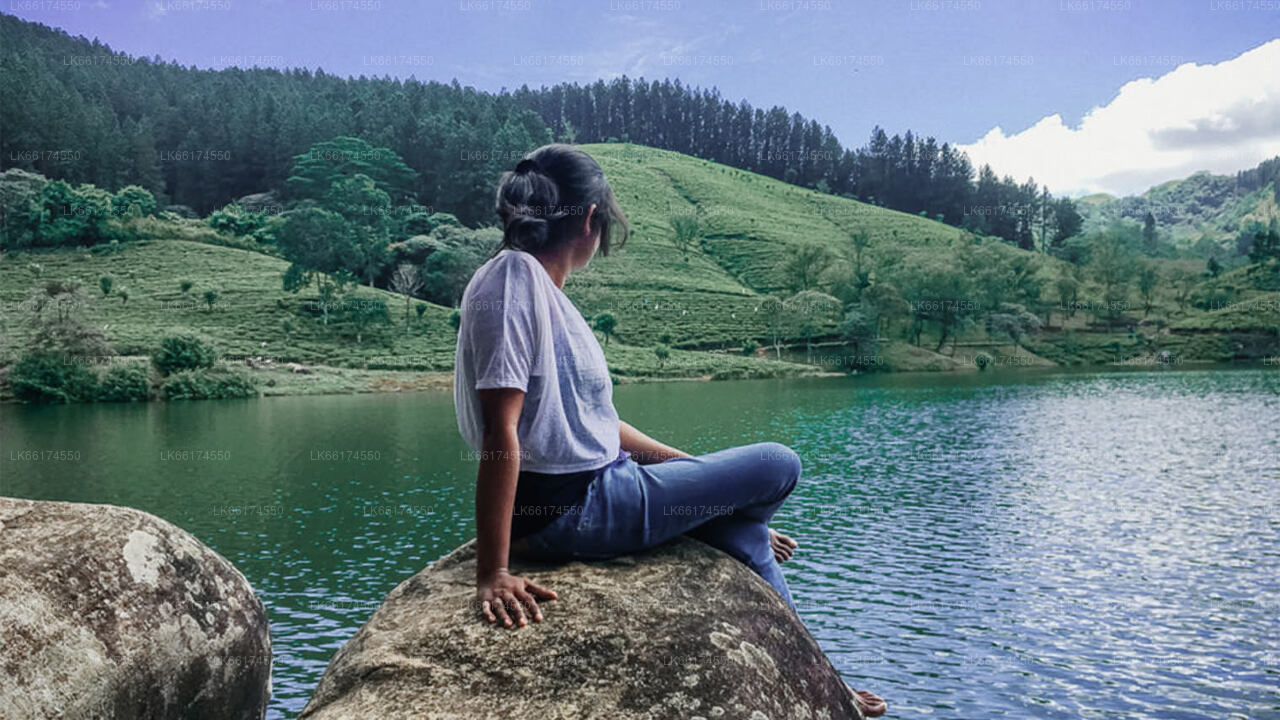
In the 1980s, the waters of the newly created Bowatenne Tank threatened to flood the shrine. Therefore, researchers took the opportunity to dismantle the ruin and rebuild it on the retaining wall of the tank, high above the waters. It was reconstructed beside the tank, and can now be approached by a flower-edged causeway with a magnificent backdrop of tree-clad hills.
Architecture
Nalanda Gedige was designed in the standard framework of a Hindu temple; with a mandapams or halls used for events, an entrance passage which was origi