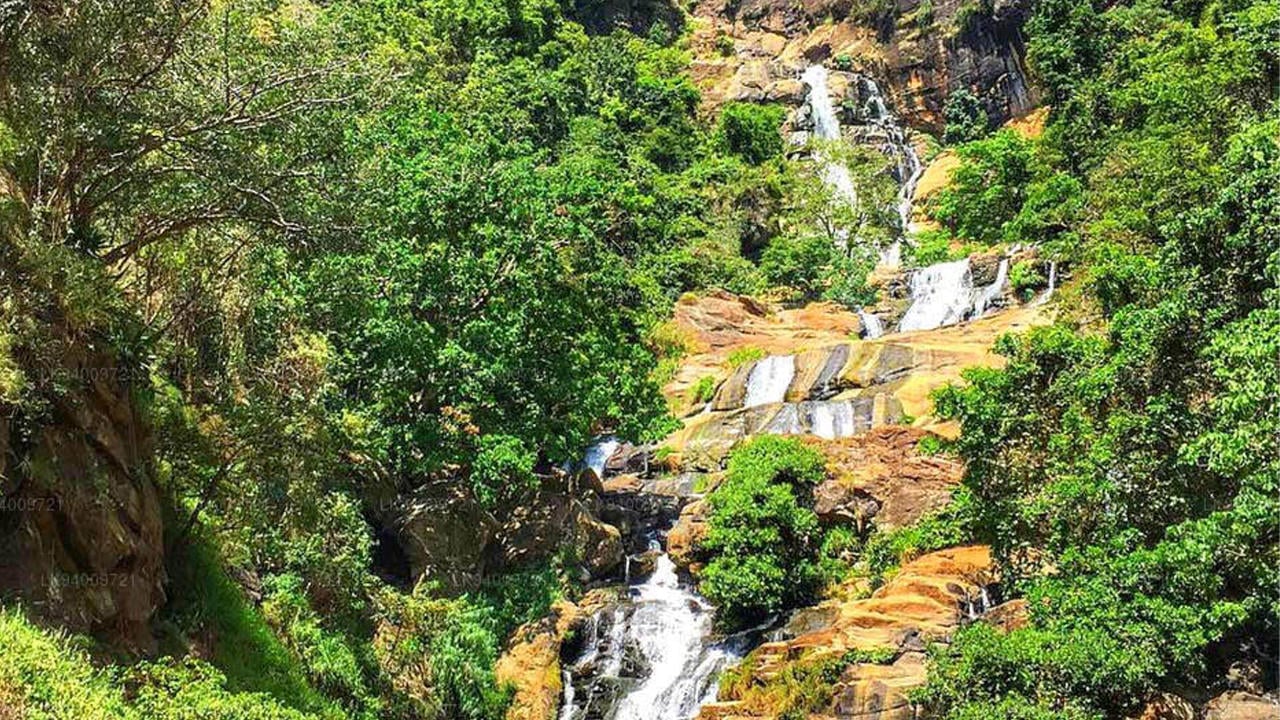
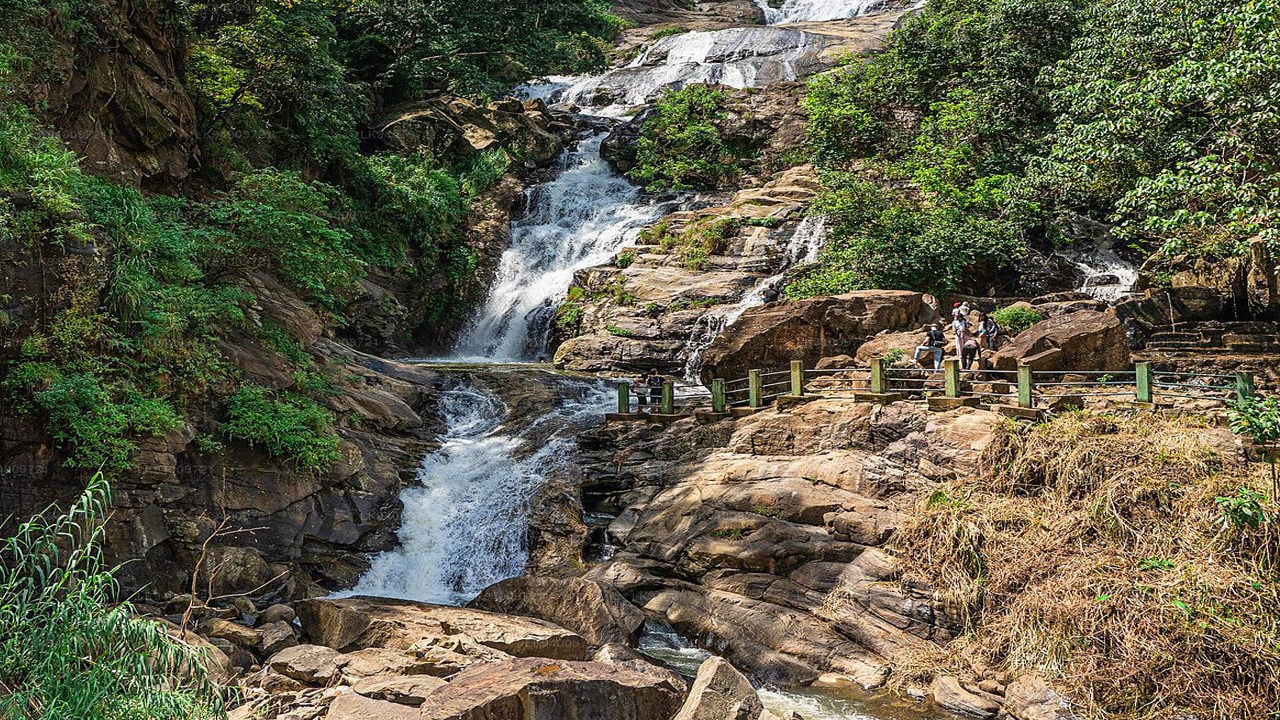
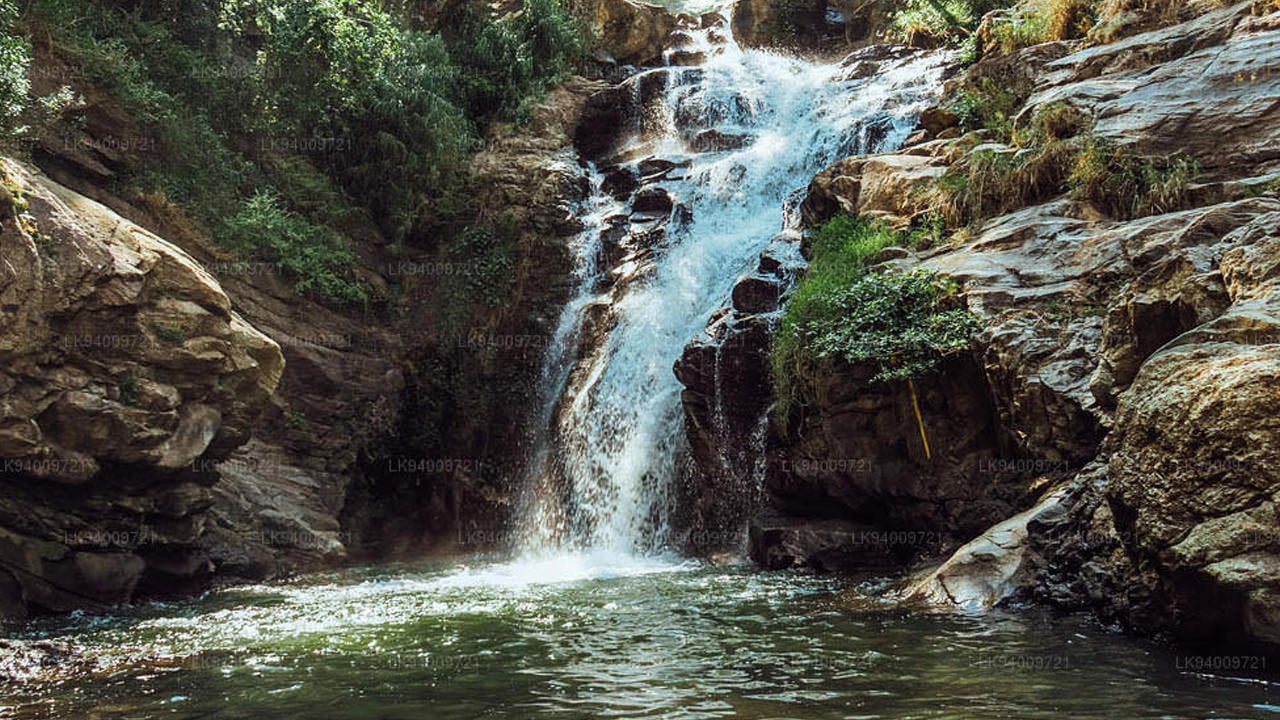
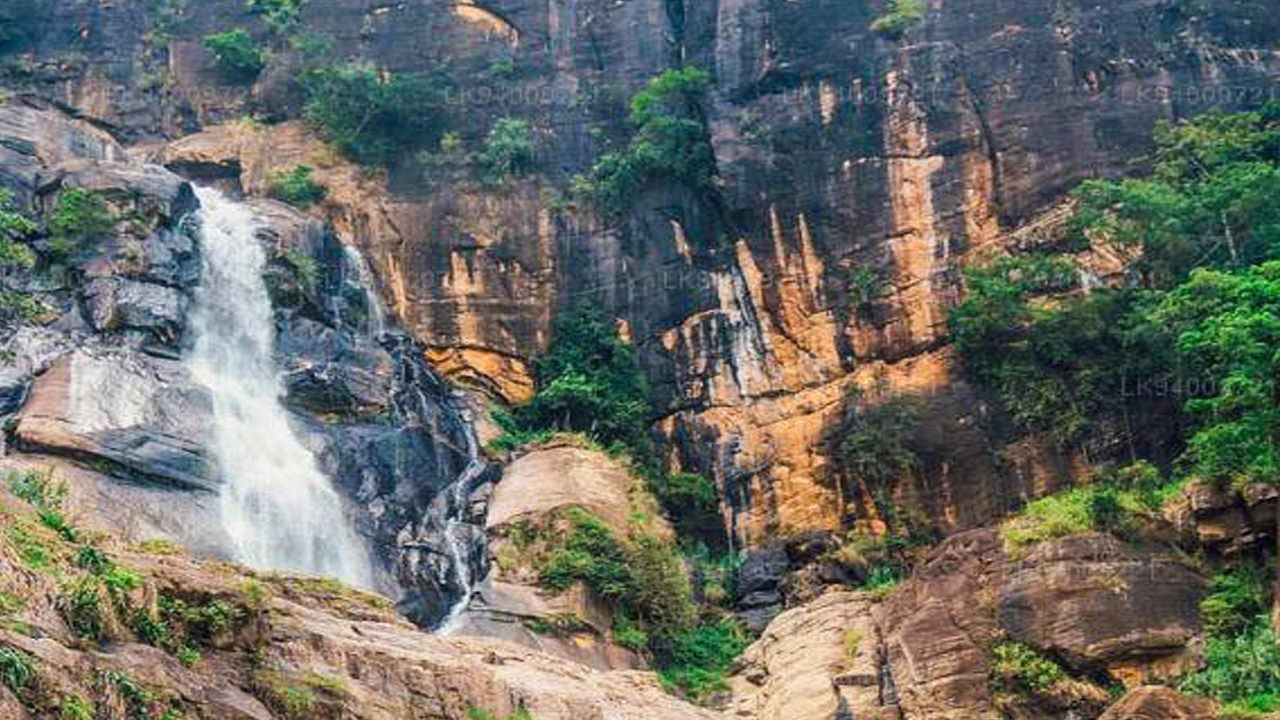
Ravana Falls sits beside the Ella–Wellawaya road, roughly 6 km from Ella, cascading down a broad oval concave rock face to a pool below. Locally it is known as Ravana Ella (රාවණා ඇල්ල), and it consistently ranks among the widest waterfalls in Sri Lanka. Few waterfalls in the country carry as much cultural weight — the site weaves together geology, wildlife and one of the subcontinent's most enduring epics.
What does Ravana Falls look like, and how big is it?
The waterfall drops approximately 25 metres (82 ft) from a concave rock outcrop shaped like a shallow bowl. In the wet season — broadly May to July and October to January in this part of Uva Province — the volume of water fans out across the full width of the rock, and observers have long compared the silhouette to an areca palm flower with spreading petals. In the dry months the flow narrows considerably, revealing more of the dark rock face beneath. The visual difference between seasons is dramatic enough to make the waterfall look like two entirely different places.
The falls are part of the Ravana Ella Wildlife Sanctuary, a small protected area that buffers the broader hill-country ecosystem. The surrounding slopes are covered in secondary forest and tea estate land, and the roadside viewpoint is busy throughout the day with passing traffic on the A23 highway.
What is the legend behind Ravana Falls?
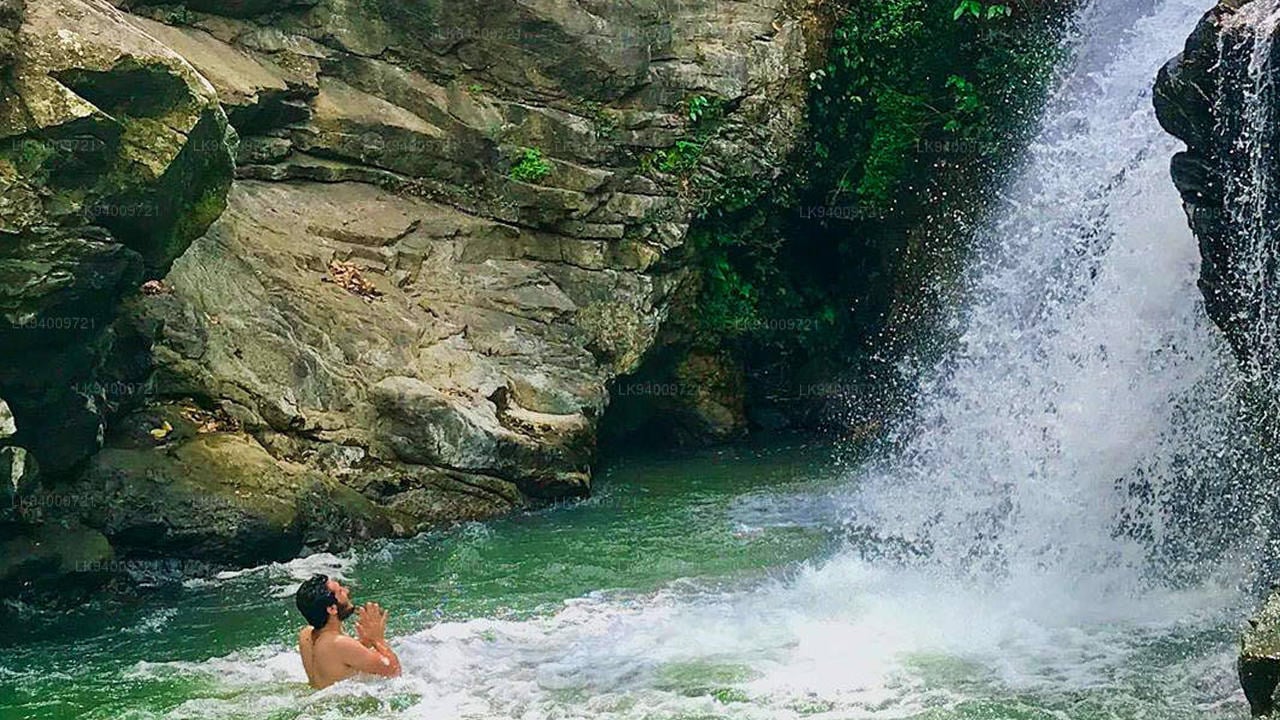
The waterfall takes its name from Ravana, the king who features in the Indian epic the Ramayana. According to the narrative, Ravana — depicted as the sovereign of ancient Lanka — abducted Princess Sita, consort of Prince Rama, and concealed her in a series of caves in the hill country. The most frequently cited of these is the Ravana Ella Cave, situated directly above the falls. Tradition holds that Sita was held there while Ravana sought to negotiate, and that she bathed in the pool formed at the base of the waterfall.
A second strand of legend credits Ravana with playing the ravanahatha, an ancient bowed instrument, near this site — a detail that has helped establish the falls as a point of cultural pilgrimage for visitors from India as well as Sri Lankans.
For those interested in the broader mythology, Rawanagala — a dramatic rock formation visible from the lowlands — is another site associated with the Ravana tradition and makes a logical addition to any itinerary centred on this legend.
Is there archaeological evidence connected to the Ravana story?
The Ravana Ella Cave sits at around 1,370 m (4,490 ft) above sea level on the face of a cliff approximately 11 km from Bandarawela. Archaeological excavations inside the cave have uncovered evidence of human habitation stretching back roughly 25,000 years, placing it firmly in the same category as other significant prehistoric shelters found across Sri Lanka's interior highlands.
The Ramayana's status as history rather than mythology remains debated among scholars, but the physical geography it describes — caves, gardens, elevated terrain in the hill country — does correspond to real locations. Several sites across Sri Lanka are formally recognised as Ramayana heritage points, and they collectively attract a substantial stream of visitors from South India every year. Whether one reads the story as myth, legend or a distant echo of actual events, the landscape around the falls is genuinely ancient and worthy of the attention it receives.
What is the Ravana Ella Wildlife Sanctuary?
The falls lie within the Ravana Ella Wildlife Sanctuary, a relatively compact protected zone in Uva Province. The sanctuary is not a safari destination in the conventional sense, but it does shelter a range of bird species common to Sri Lanka's mid-elevation forests, as well as smaller mammals and reptiles. The riparian vegetation around the pool at the base of the falls provides a noticeably cooler microclimate compared with the surrounding road and farmland.
Visitors who want a more extensive wildlife experience in the hill-country region often combine a stop at Ravana Falls with a visit to Horton Plains National Park, which lies within a two-hour drive and offers a very different landscape of montane grassland and cloud forest.
How do I get to Ravana Falls from Ella?
The falls are straightforward to reach from Ella. The most common approach is a short tuk-tuk or taxi ride along the A23 highway toward Wellawaya — the waterfall is clearly visible from the road and hard to miss. Walking from Ella town is possible in around 30–45 minutes depending on pace, though the road shoulder is narrow in places.
- By road from Ella: approximately 6 km south-west on the A23; most tuk-tuk drivers in Ella know the stop.
- By rail: the nearest station is Ella, around 6 km away. Trains on the Colombo–Badulla line stop here; the falls are not walkable from the station without using a connecting vehicle.
- From Bandarawela: roughly 11 km by road; Bandarawela is a larger town with wider transport connections.
- From Nuwara Eliya: typically around 60–70 km via the A5 and A23 highways, usually under two hours by private vehicle.
There is a small roadside parking area, and local vendors operate near the viewpoint. Entry to view the falls from the roadside is generally free; access closer to the pool or the cave above may involve a nominal local fee.
When is the best time to visit Ravana Falls?
The waterfall is at its most impressive during and just after the south-west monsoon (typically May to August) and the north-east monsoon (October to January), when rainfall in the Uva highlands is at its highest. If you want to see the full-width fan effect that gives the falls its areca-flower comparison, plan around these wetter months.
The dry season — broadly February to April and August to September — still offers a visit worth making, though the flow can reduce to a narrow central stream. Morning visits are recommended to avoid the peak of midday coach traffic on the Ella–Wellawaya road.
What else can I see near Ravana Falls?
The falls fit naturally into a half-day or full-day loop from Ella that also takes in the Nine Arches Bridge, Little Adam's Peak, and the tea-growing slopes around town. The Hakgedi Ella Waterfall is another lesser-known cascade in the broader Ella area that rewards visitors willing to walk a short trail.
For those building a longer hill-country itinerary, the Sinharaja Forest Reserve — a UNESCO World Heritage Site — lies to the south-west and can be reached in roughly three hours by private vehicle, making it a viable add-on for nature-focused travellers.