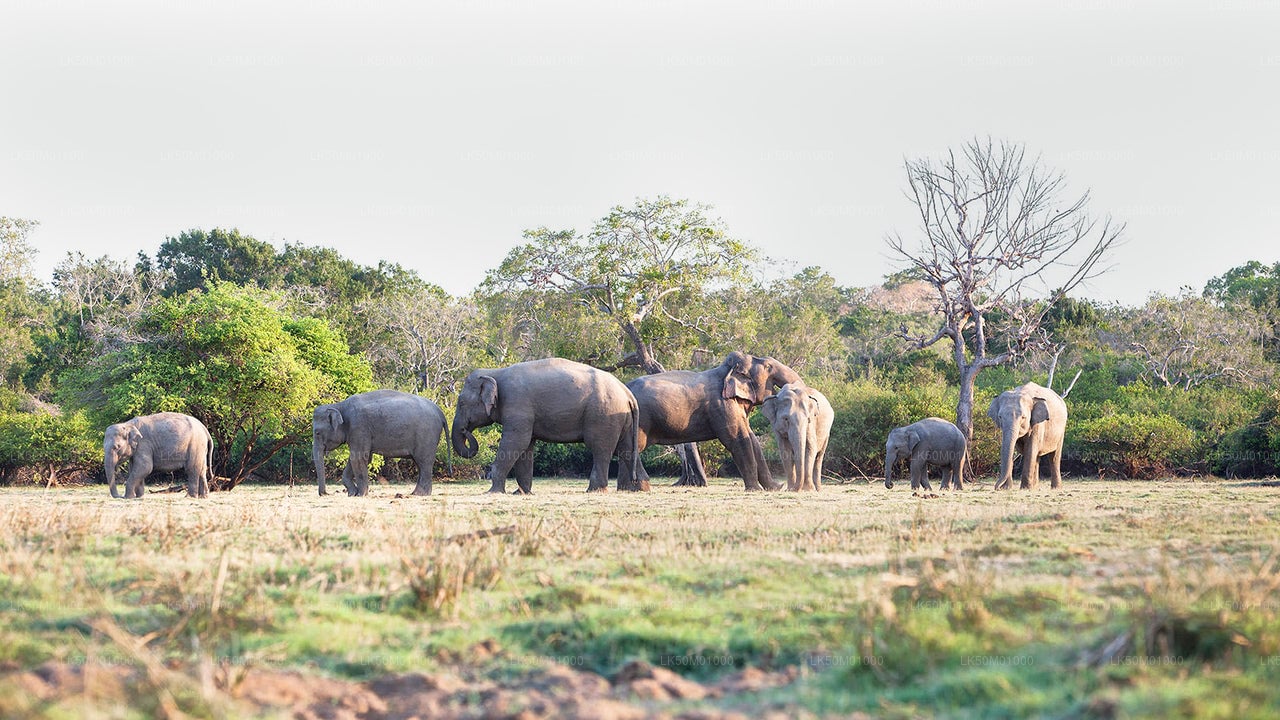
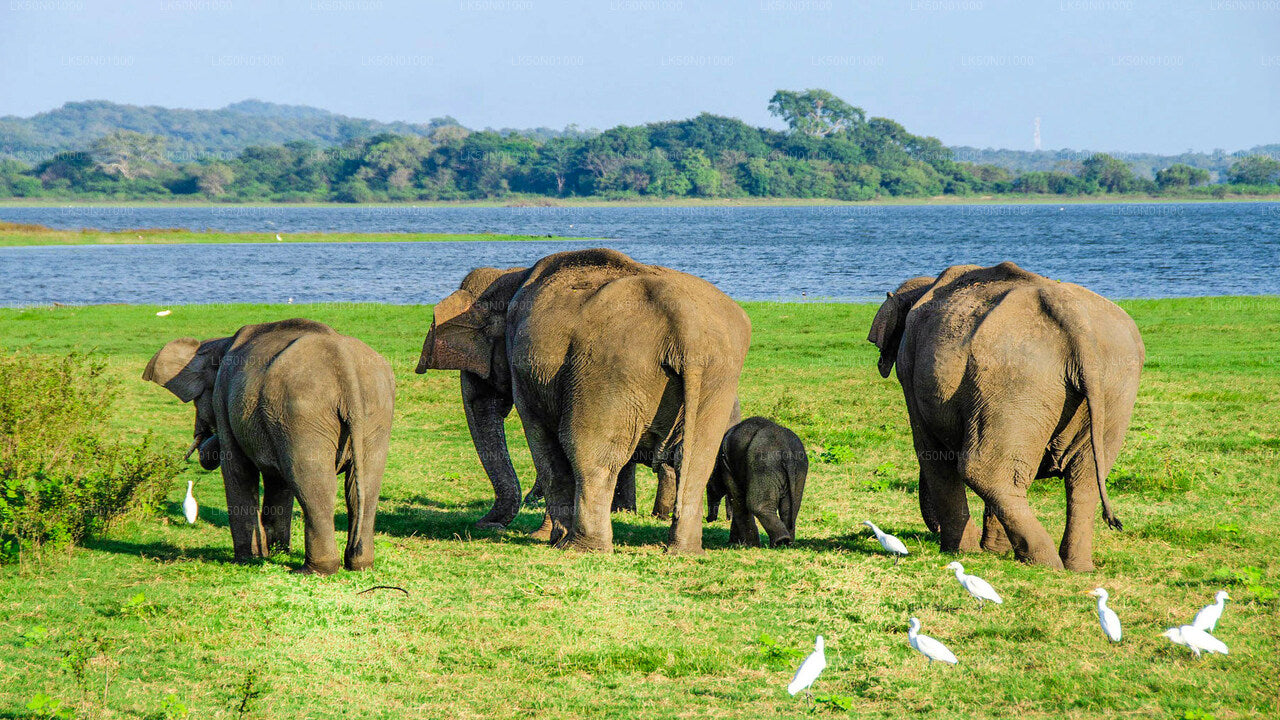
Gal Oya National Park is one of Sri Lanka's least-visited yet most rewarding wilderness areas. Centred on the vast Senanayake Samudra reservoir in the island's southeastern dry zone, it offers a safari experience fundamentally unlike any other in the country — quiet, uncrowded, and punctuated by the remarkable sight of Asian elephants swimming between islands. If you travel Sri Lanka beyond the well-worn southern circuit, Gal Oya deserves serious consideration.
Where is Gal Oya National Park?
The park straddles the Badulla and Ampara districts, roughly 376 km northeast of Colombo. The main entrance is at Inginiyagala, around 20 km west of Ampara town. Together with three adjoining wildlife sanctuaries — Senanayake Samudra Sanctuary, Gal Oya Valley North-East Sanctuary, and Gal Oya Valley South-West Sanctuary — the broader Gal Oya conservation complex covers approximately 62,937 hectares, making it one of the largest protected areas in Sri Lanka.
The core national park itself spans 25,900 hectares. Elevation ranges from around 30 metres near the reservoir to roughly 900 metres at the highland peaks of Danigala, Nilgala, and Ulpotha, giving the park a varied terrain that supports diverse habitats.
How do I get to Gal Oya National Park from Colombo?
The most practical overland route from Colombo runs south through Ratnapura and Pelmadulla, then east via Udawalawe, Thanamalwila, Wellawaya, and Moneragala, before heading north from Siyambalanduwa to Inginiyagala. The drive takes around seven to eight hours depending on conditions. Alternatively, Ampara has a domestic airport, which can reduce travel time considerably if flights are operating on your dates.
Most visitors base themselves in Ampara or at accommodation near Inginiyagala, then enter the park from the western gate at dawn for the best wildlife activity.
What makes the Gal Oya boat safari unique?
The boat safari on Senanayake Samudra reservoir is the defining experience of any Gal Oya visit — and one of the very few boat-based wildlife safaris in Sri Lanka. Flat-bottomed motorised boats glide across the water in near silence, allowing close approaches to wildlife that would scatter at the sound of a jeep engine.
The reservoir's shoreline and scattered islands attract large herds of elephants, particularly between March and July when water levels drop and the animals cross between islands. Watching a herd of Asian elephants swim trunk-above-water across open stretches of reservoir is an experience that draws wildlife photographers from around the world. Guides can also navigate to Bird Island, an islet within the reservoir that supports a concentrated roosting and nesting colony of waterbirds.
When is the best time to visit Gal Oya National Park?
The dry season from March to July is widely considered the best period. Water levels in Senanayake Samudra fall during these months, concentrating elephants at the reservoir's edge and increasing the frequency of inter-island swimming crossings. Wildlife viewing from the boat becomes especially productive in April, May, and June.
The park receives most of its rainfall from the northeastern monsoon, which affects the eastern coast from roughly October through January. Roads and tracks can become difficult during heavy rain periods, and boat access may be restricted. The park is generally open year-round, but visiting during the dry season maximises both access and sightings.
| Season | Months | Conditions |
|---|---|---|
| Best (dry) | March – July | Elephant crossings frequent; boat safaris fully operational |
| Shoulder | August – September | Warm and drier; good jeep safari conditions |
| Wet (NE monsoon) | October – January | Heavy rainfall possible; some tracks may close |
| Transitional | February | Improving conditions; quieter crowds |
What wildlife can I see at Gal Oya National Park?
The park supports 32 species of terrestrial mammals. Asian elephants (Elephas maximus) are the headline attraction, but leopards (Panthera pardus kotiya), sloth bears, water buffalo, wild boar, and three species of deer are all recorded regularly. Among primates, the endemic toque macaque and the common grey langur are frequently spotted along the jeep tracks.
Around 150 bird species have been recorded within the park out of Sri Lanka's total of over 450. Notable species include the Lesser Adjutant stork, Spot-billed Pelican, and the Red-faced Malkoha, a forest species restricted to the island. Common waterbirds on the reservoir include the Indian Cormorant, Oriental Darter, Grey Heron, and Lesser Whistling Duck. The White-bellied Sea Eagle and Grey-headed Fish Eagle are the most conspicuous raptors. Among butterflies, the endemic Lesser Albatross has been recorded in the park.
What jeep safari tracks are available?
Two jeep safari circuits operate within the park. A shorter 5 km track suits visitors with limited time and offers a reliable chance of elephant and deer sightings in the early morning. A longer 13 km track covers more terrain, passing through a mix of evergreen forest, savanna grassland, and scrub, which broadens the chances of encountering leopards and sloth bears. Both tracks are best driven in the first two hours after sunrise or the final two hours before sunset when wildlife activity peaks.
What vegetation and ecosystems does Gal Oya protect?
Approximately 45% of the park is covered by tropical dry evergreen forest, dominated by species including Artocarpus sp., Halmilla (Berrya cordifolia), Etamba (Mangifera zeylanica), and Ebony (Diospyros ebenum). A further 33% consists of savanna-like grasslands, with montane grasslands covering around 9% of the higher-elevation zones. Water bodies, including the reservoir, account for roughly 10% of the park's area. The forest also harbours several rare medicinal plant species, some with significance to traditional Ayurvedic practice.
Why was Gal Oya National Park established?
The park was gazetted in 1954, primarily to protect the catchment area of the Senanayake Samudra reservoir, which had been constructed in 1948 by damming the Gal Oya river. The reservoir was central to a major postwar irrigation and agricultural development scheme that opened up large areas of the eastern dry zone. Designating the surrounding forest as a national park safeguarded both the watershed and the wildlife populations that had retreated as surrounding land was cleared.
Where can I stay near Gal Oya National Park?
There is no accommodation inside the park itself. Rest houses and bungalows are available at Inginiyagala, immediately adjacent to the park entrance. A circuit bungalow at Eekgal Aru, roughly 23 km from the park office, provides a more remote option for those seeking a wilderness stay. Ampara town, about 20 km east, has a wider range of guesthouses and hotels if you prefer a base with more amenities. Booking accommodation well in advance is advisable during the March-to-July peak season, as options near the park are limited.