Lakpura
Lakpura®

Rankoth Vehera Stupa

Rankoth Vehera is one of the largest and most impressive stupas of the Polonnaruwa period, rising from a vast square terrace in the heart of the ancient city. Commissioned by King Nissanka Malla between 1187 and 1196 CE, it stands as a lasting expression of royal devotion and the architectural ambition of medieval Sri Lanka. Its name translates as "Stupa with the Golden Pinnacle," a reference to the gilded finial that once crowned its summit.

What makes Rankoth Vehera architecturally significant?

The stupa is constructed entirely of brick and follows a hemispherical design closely related to the great stupas of Polonnaruwa's predecessor city, Anuradhapura. In its present state it stands approximately 108 feet tall, while its base has a circumference of around 550 feet — dimensions that place it among the four largest stupas on the island.

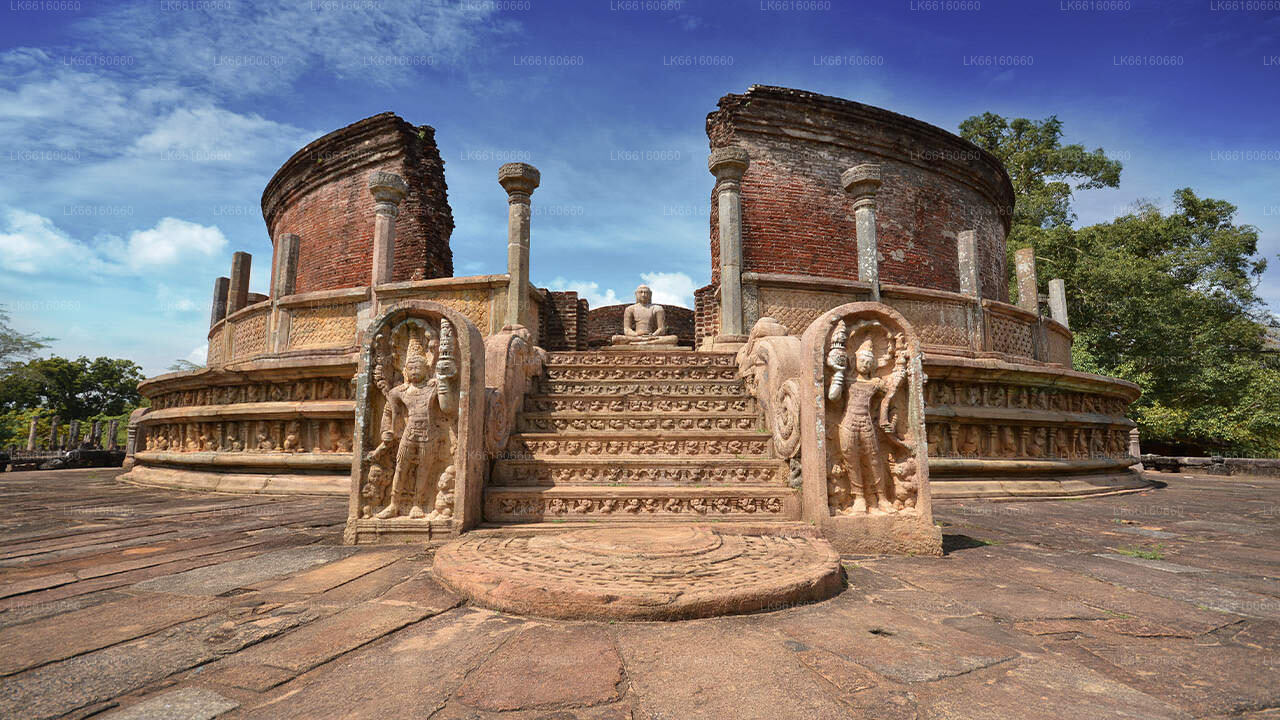
One of its most distinctive features is the set of four vahalkadas — ornate ritual platforms projecting outward at the cardinal points of the compass. Each vahalkada is elaborately carved and would originally have been decorated with sculpted figures, pillar stones, and elephant friezes. This design mirrors the layout of the Ruwanwelisaya in Anuradhapura, suggesting that Nissanka Malla deliberately evoked the grandeur of the earlier Anuradhapura kingdom to legitimise his own reign.

The stupa sits on a large raised terrace with four axial stairways leading to the base, giving the monument a formal, processional quality. Walking the terrace perimeter reveals the scale of the brickwork and the precision with which the structure was laid out — a remarkable feat given the tools and techniques available in the 12th century.

What is the historical and religious context of Rankoth Vehera?

King Nissanka Malla ruled the Polonnaruwa kingdom during a relatively brief but culturally productive period. He was a prolific builder and left inscriptions at numerous sites across Sri Lanka, several of which record his religious patronage. Rankoth Vehera was likely intended to house sacred relics and to serve as a focal point for Buddhist worship and merit-making within the city.

Stupas in Sri Lanka function not merely as architectural landmarks but as living objects of veneration. Pilgrims circumambulate them clockwise, offer flowers, and light oil lamps at the vahalkadas. Rankoth Vehera continues to draw both pilgrims and scholars. You can read more about the broader tradition on the Stupas page.

The stupa forms part of the Polonnaruwa Archaeological Museum complex and the wider Sacred City of Polonnaruwa, which has been a UNESCO World Heritage Site since 1982. Its inclusion reflects the outstanding universal value of the ancient city as a whole.

What can visitors see and do at Rankoth Vehera?

A visit to the site typically involves a slow walk around the terrace perimeter, pausing at each vahalkada to observe the carved details that have survived weathering and historical neglect. The scale of the stupa becomes fully apparent only from ground level — photographs rarely convey the sheer mass of brick rising overhead.

  • The vahalkadas: Look for surviving carvings of dwarfs (yaksha figures), elephants, and decorative mouldings on the altar frontages.
  • Terrace stairways: Four axial staircases lead toward the base and offer slightly elevated vantage points across the surrounding parkland.
  • Surrounding landscape: The stupa sits within an open archaeological park; on a clear day the surrounding scrub forest and distant tank (reservoir) create a quietly atmospheric setting.
  • Nearby Kiri Vehera: A short walk away stands Kiri Vehera, another well-preserved Polonnaruwa stupa often visited in the same circuit.

Guided commentary — available through licensed guides at the park entrance — adds considerable depth to the visit, covering the epigraphic evidence for the stupa's construction and the religious practices associated with it.

When is the best time to visit Rankoth Vehera?

The site is accessible year-round, but the dry season — broadly May to September and again December to February — offers the most comfortable conditions. Paths across the terrace are firm, the air is clearer, and the morning light between roughly 7 am and 10 am falls at a low angle that accentuates the texture of the brickwork. Midday heat in the North Central Province can be intense, particularly between April and August, so an early-morning start is advisable.

Poya (full-moon) days see higher numbers of pilgrims and a more ceremonial atmosphere, which some visitors find rewarding. Weekday mornings are the quietest.

How do I get to Rankoth Vehera from Colombo?

Polonnaruwa lies roughly 215 kilometres north-east of Colombo. The most straightforward route by road follows the A6 via Kurunegala and Dambulla, with a journey time of around four to five hours depending on traffic. A private transfer is the most convenient option and allows stops at Dambulla Cave Temple or Sigiriya en route.

Polonnaruwa is also served by the main-line railway from Colombo Fort, with the journey taking approximately five to six hours to Polonnaruwa station. From the station, the archaeological park is accessible by tuk-tuk or bicycle — cycling is a popular and practical way to cover the widely spaced monuments within the ancient city.

What are the entry fees and opening hours?

Rankoth Vehera falls within the Polonnaruwa Archaeological Reserve, which charges a combined admission fee for all monuments in the ancient city. Entry is managed by the Central Cultural Fund; fees are subject to revision and current rates should be confirmed with the fund or your tour operator before travel. The park is generally open during daylight hours throughout the year.

How does Rankoth Vehera compare with other Sri Lankan stupas?

In terms of scale, Rankoth Vehera ranks behind the great Anuradhapura stupas — Jetavanaramaya, Abhayagiri, and Ruwanwelisaya — but surpasses most other monuments of the Polonnaruwa period. Its deliberate stylistic echo of Ruwanwelisaya makes direct comparison between the two sites rewarding for anyone with an interest in the evolution of Sinhalese religious architecture. Where the Anuradhapura examples benefit from ongoing restoration and whitewashing, Rankoth Vehera retains more of the raw, weathered brick surface that communicates its age honestly.

Within Polonnaruwa itself, Rankoth Vehera and Kiri Vehera together form the southern stupa group of the ancient city, distinct from the northern monastic complex around the Alahana Parivena monastery to which they both belong.

Book this experience with Lakpura

Curated by our local team. Direct booking, instant confirmation.

Ask Lakpura® Agent