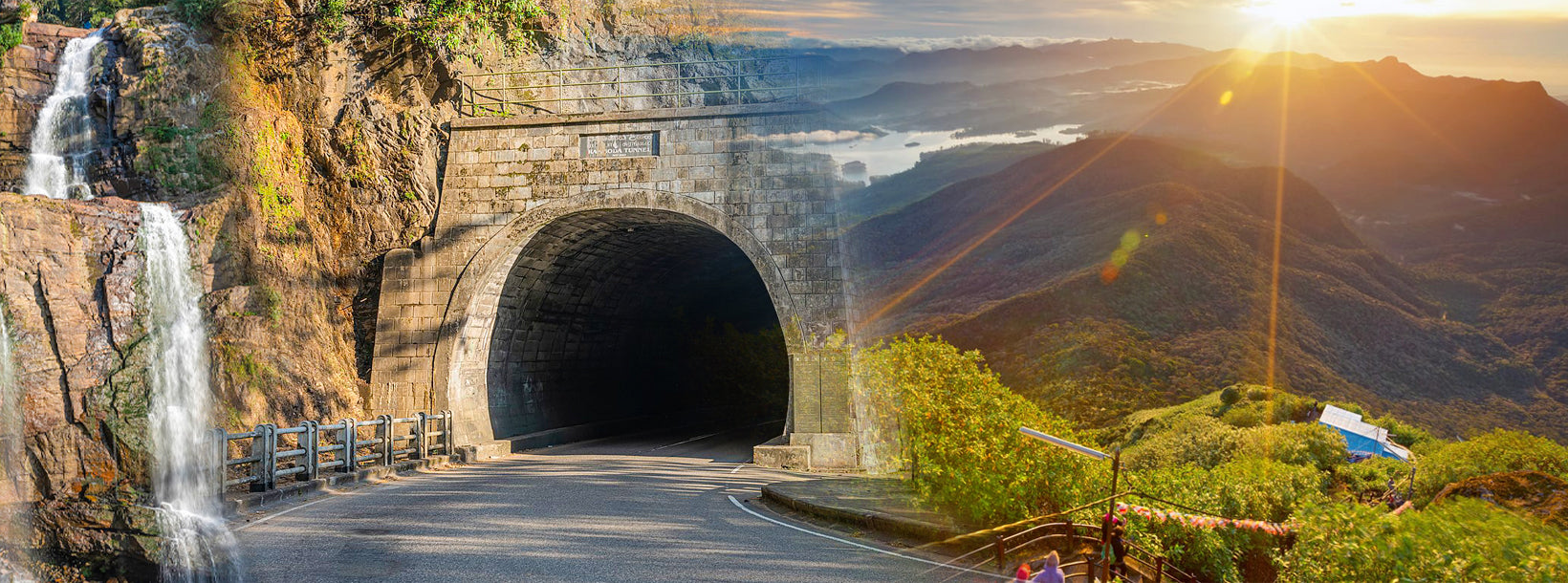
Ramboda sits at around 1,200 metres above sea level in Sri Lanka's Central Province, straddling the A5 highway that connects Peradeniya to Nuwara Eliya. For most travellers, it appears as a brief but scenic pause on the road up to the hill country — a roadside waterfall, a tunnel carved through a ridge, and rows of tea bushes climbing the valley walls. Look more closely, and Ramboda repays the attention.
What is Ramboda known for?
The village is best known for three things: Ramboda Falls, the Ramboda Road Tunnel, and its surrounding tea estates. The falls drop in two main tiers, with the combined descent making it one of the more impressive roadside waterfalls in the Central Highlands. A short footpath from the road brings visitors to viewpoints at different heights, and a small suspension bridge crosses the gorge near the base.
Tea cultivation defines the landscape around Ramboda just as it does across this part of the hill country. The estates here produce mid-grown Ceylon Tea, harvested at elevations that yield a balanced, full-bodied cup distinct from the high-grown teas of Nuwara Eliya a short drive further up the road. Several estates in the area welcome visitors for guided walks and basic factory tours.
What is the Ramboda Road Tunnel?
The Ramboda Road Tunnel is currently the longest road tunnel in Sri Lanka. It runs for 225 metres (738 ft), stands 5.6 metres (18 ft) high, and is 7 metres (23 ft) wide. The tunnel was bored through the rocky ridge adjacent to Ramboda Falls along the A5 highway, eliminating a difficult and often dangerous section of the old mountain road.
Construction began in 2006 and the tunnel opened in February 2008. The project cost approximately Rs. 2,000 million and was substantially funded by the Japanese Government. Its significance to Sri Lanka's infrastructure was underscored in 2011 when the Central Bank issued a 1,000-rupee banknote featuring an artist's impression of the tunnel alongside the rock face that existed at the site before construction.
Is Ramboda historically significant?
Ramboda has a modest but genuine historical footnote. The Wavenden Estate within the village is recorded as the birthplace of Admiral of the Fleet John Arbuthnot Fisher — Lord Fisher — who served the British Royal Navy and is widely credited with modernising it in the late nineteenth and early twentieth centuries. The estate itself predates the tunnel era, a reminder that Ramboda was part of the colonial plantation economy well before it became a point of engineering interest.
How do I get to Ramboda from Colombo or Kandy?
From Colombo, Ramboda is typically reached in around four to five hours by road, depending on traffic through the lowlands. The most common route runs via Kandy and then follows the A5 toward Nuwara Eliya — Ramboda lies roughly midway between Kandy and Nuwara Eliya on that road. From Kandy, the drive is around one and a half to two hours.
The road climbs steadily from Kandy through Peradeniya and Gampola, gaining altitude quickly once it enters the highland terrain. The section through Ramboda is scenic but narrow in places; a private transfer is usually more comfortable than public bus travel for visitors with luggage. Lakpura can arrange transfers directly from Colombo Bandaranaike International Airport to accommodation in Ramboda.
What can I do near Ramboda?
Beyond the falls and the tunnel, the Ramboda area offers a handful of worthwhile stops for travellers with time to linger.
- Tea estate walks: The Bluefield Tea Gardens nearby offer a structured introduction to tea plucking and processing, suitable for all ages.
- Waterfall viewpoints: The path to the base of Ramboda Falls is short but steep; wear shoes with grip and allow around 30–45 minutes for a relaxed visit.
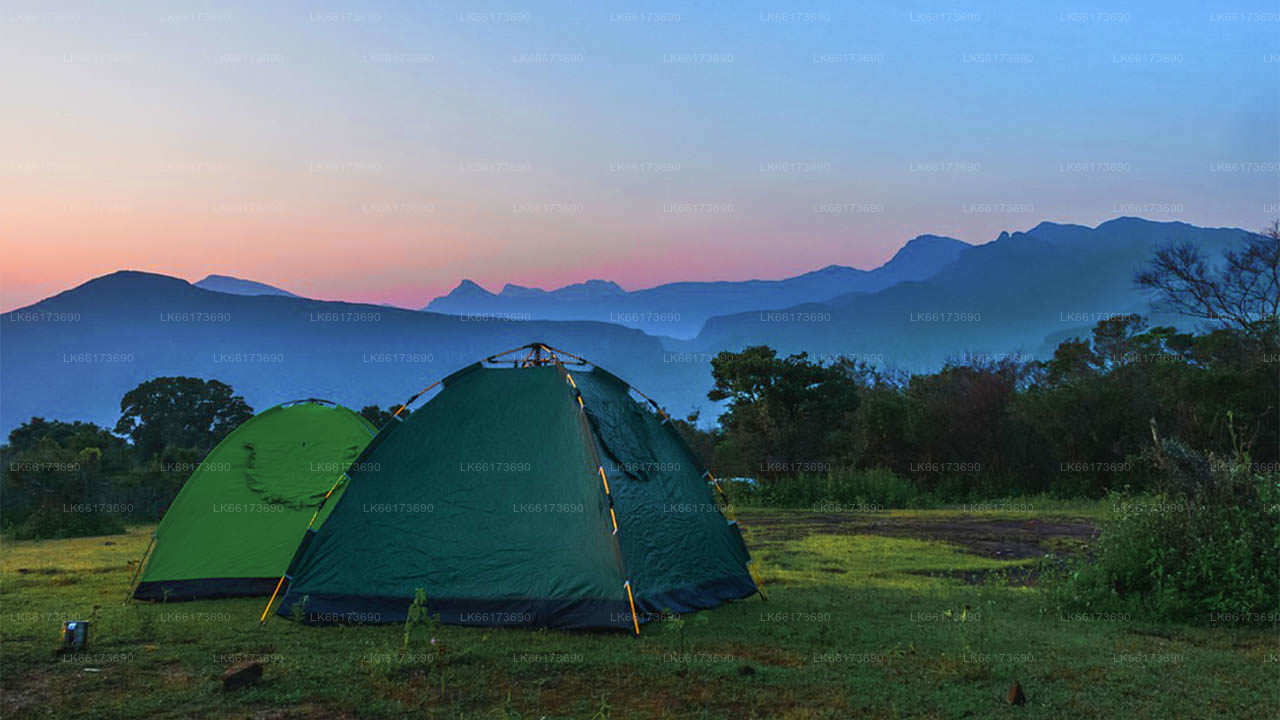
- Camping and trekking: The surrounding highlands support multi-day camping itineraries, including routes that pass through cloud-forest terrain.
- Horton Plains: Horton Plains National Park, with its famous World's End escarpment, is within driving distance and makes a logical day trip from a Ramboda base.
- Nuwara Eliya: The colonial hill station of Nuwara Eliya is under an hour further up the A5 and pairs naturally with a Ramboda stop.
When is the best time to visit Ramboda?
The Central Highlands receive rainfall from both monsoon systems, so the timing of a visit matters. The drier, more settled months for this region typically run from January through April and again from July into September. During these periods, the sky clears between showers and the views across the tea valleys are at their best.
That said, Ramboda is worthwhile in any season. The waterfall runs with more volume and drama after heavy rain, and the mist that rolls across the hillsides in the wetter months gives the landscape a particular character. Temperatures at this elevation are noticeably cooler than the lowlands year-round; light layers are advisable even in the dry season.
Where can I stay in Ramboda?
Accommodation options in Ramboda are limited but well-suited to the location. The Ramboda Falls Hotel sits adjacent to the waterfall itself and is the most established property in the village, offering views directly over the gorge. Several smaller guesthouses and boutique lodge options have opened in recent years as the hill-country circuit has grown in popularity. For travellers seeking a more immersive experience, camping options in the surrounding highlands are available through Lakpura.