Lakpura
Lakpura®

Maligawila Buddha Statue

Rising nearly 38 feet from a limestone pedestal in the quiet Moneragala District, the Maligawila Buddha Statue is the tallest free-standing ancient Buddha image in Sri Lanka. Carved from a single block of limestone during the 7th century, it has endured centuries of neglect, intentional damage, and a painstaking modern restoration — and today draws Buddhist pilgrims and heritage travellers from across the island and beyond.

What makes the Maligawila Buddha Statue historically significant?

Historical accounts attribute the statue's creation to Prince Agrabodhi, who is believed to have commissioned the work during the 7th century CE. Scholars place the Maligawila statue alongside the Kiri Vehera Stupa tradition of the Uva region as part of a broader flowering of Buddhist art in ancient Sri Lanka.

The statue depicts the Asisa Mudra, a variation of the Abhaya Mudra. In this posture, the Buddha's left hand clutches the robe at the left shoulder while the right hand is raised toward the right shoulder — a gesture conveying protection and blessing. This iconographic detail closely parallels the Avukana statue in the North Central Province, suggesting a shared artistic tradition across early medieval Sri Lanka.

Archaeological evidence around the site points to a substantial image house, approximately 80 feet in length and breadth, with walls around 4 feet thick and an estimated height of about 65 feet. The existence of such an enclosure indicates that the statue was once the centrepiece of a significant monastic complex.

What is the story behind the statue's discovery and restoration?

By the time the statue was rediscovered in 1951, it had collapsed from its pedestal and lay broken in several pieces, damaged further by treasure hunters who had probed its base over the centuries. An initial attempt to re-erect the statue in 1974 was unsuccessful.

A second, more carefully planned effort in 1980, carried out under the direction of President Ranasinghe Premadasa, proved successful. Before re-erection, conservators repaired several critically damaged sections — including the right hand, the face, and the feet — to ensure the statue's structural integrity. The restoration is widely regarded as one of the more significant heritage conservation undertakings in post-independence Sri Lanka.

How does the Maligawila statue compare to other ancient Buddha images in Sri Lanka?

Sri Lanka's ancient sculptors produced a remarkable number of large-scale Buddha images, and Maligawila sits at the top of that tradition in terms of scale. A brief comparison helps contextualise its importance:

Statue Approximate Height Posture Material
Maligawila Buddha ~37 ft 10 in (11.5 m) Standing (Asisa Mudra) Limestone
Avukana Buddha ~39 ft (12 m) including pedestal Standing (Abhaya Mudra) Granite
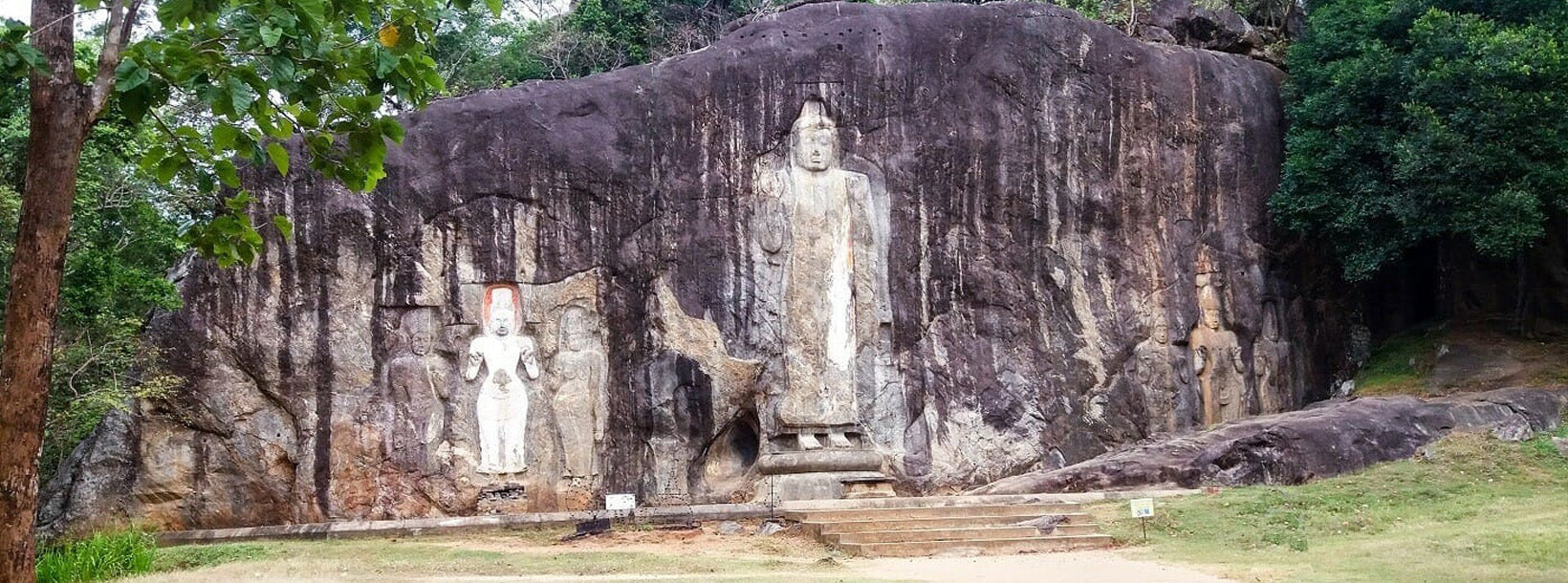
Buduruwagala Figures ~46 ft (main figure, carved in relief) Standing (rock relief) Granite rock face

Unlike the Buduruwagala images — which are carved directly into a granite rock face — and the Avukana statue — which is partially backed by its rock of origin — the Maligawila statue is fully free-standing, which makes its survival across more than thirteen centuries all the more remarkable. Together, these three sites are considered the finest examples of monumental standing Buddha imagery from ancient Sri Lanka.

Where exactly is the Maligawila Buddha Statue located?

The statue stands near the village of Maligawila in the Moneragala District, Uva Province — a region of Sri Lanka that sees far fewer tourists than the Cultural Triangle to the north or the southern coast. The nearest town of any size is Buttala, from which the site is accessible by local road. Travellers combining Maligawila with a visit to Ella or the Udawalawe National Park will find the routing manageable in a single day with private transport.

When is the best time to visit Maligawila?

The site is accessible year-round and remains open daily as an active place of pilgrimage. The Uva Province experiences its drier season roughly from May through September, making travel on the area's rural roads more predictable during those months. Early mornings are generally quieter and cooler, which is preferable both for the walk to the statue and for photography. Poya (full moon) days attract larger numbers of pilgrims and lend the site a particularly atmospheric quality for visitors interested in living Buddhist practice.

What else can visitors see at or near the site?

The immediate grounds contain the ruins of the ancient image house that once enclosed the statue, and a smaller Bodhisattva figure — believed to represent Maitreya — stands in the same compound. This secondary statue, also carved from limestone, reinforces the site's importance as a 7th-century monastic centre rather than a lone monument.

  • Dematamal Viharaya: A functioning Buddhist temple a short distance away, associated with the legendary figure of King Mayadunne and significant in its own right.
  • Buduruwagala: The rock-cut Buddha figures at Buduruwagala, roughly 20 km from Wellawaya, are a natural complement to a Maligawila visit for anyone interested in ancient Buddhist sculpture.
  • Udawalawe National Park: For travellers combining heritage and wildlife, Udawalawe's elephant herds are within reasonable driving distance of Maligawila.

How do I get to the Maligawila Buddha Statue from Colombo?

The most practical way to reach Maligawila is by private vehicle. The journey from Colombo takes around four to five hours via the Southern Expressway (E01) and then inland through Wellawaya or Buttala. Public transport exists but is slow and infrequent on the final stretch to the statue. Travellers using a Lakpura private driver can combine the site with other Uva Province attractions on a multi-day itinerary, avoiding the logistical challenges of rural bus connections.

Is there an entrance fee for the Maligawila Buddha Statue?

The site is managed as an active place of Buddhist worship and archaeological heritage. Entry is generally free for pilgrims, though donations are welcomed. Foreign visitors may be asked to contribute a nominal amount; it is advisable to check current arrangements with your guide or driver before visiting, as policies at smaller heritage sites in Sri Lanka can vary.

Book this experience with Lakpura

Curated by our local team. Direct booking, instant confirmation.

Ask Lakpura® Agent