
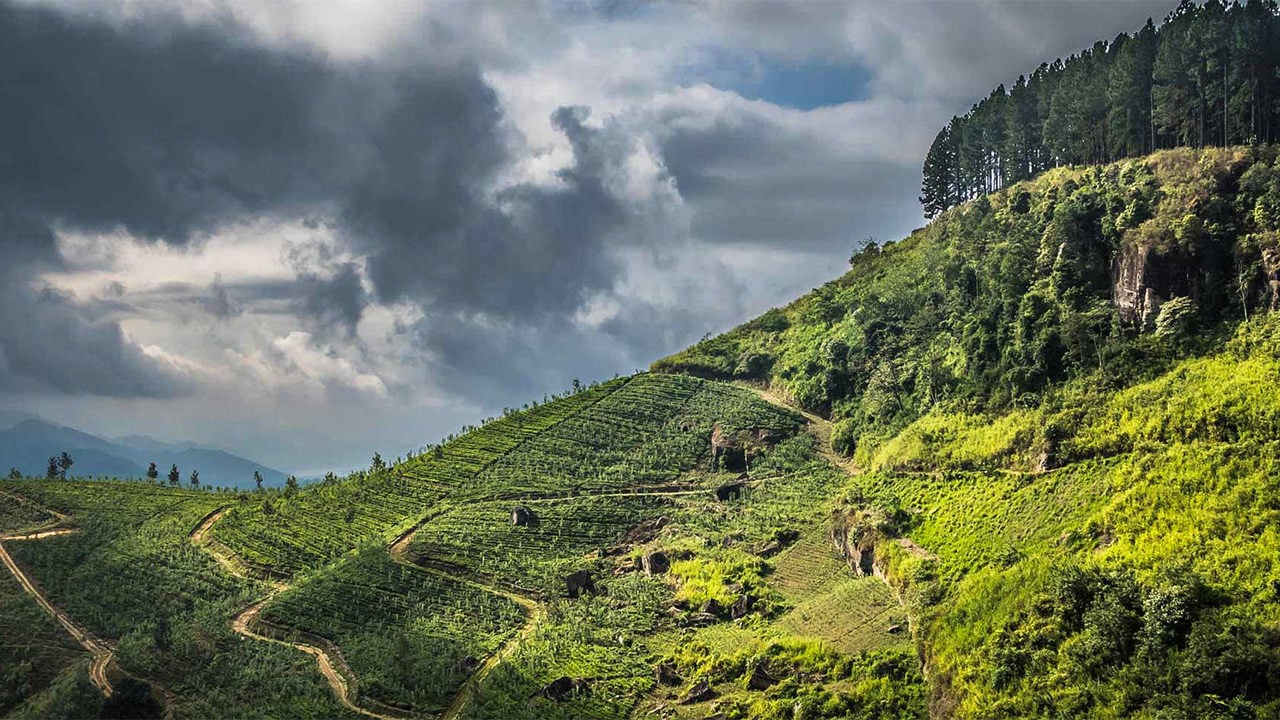
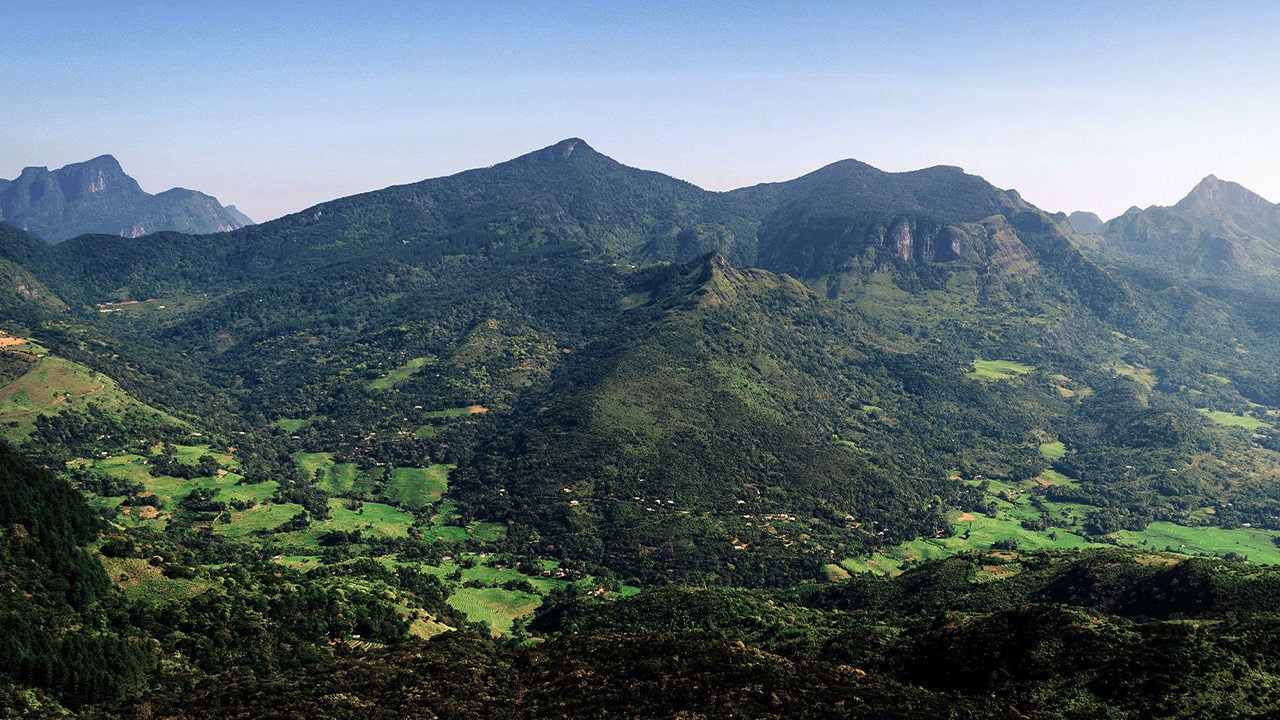
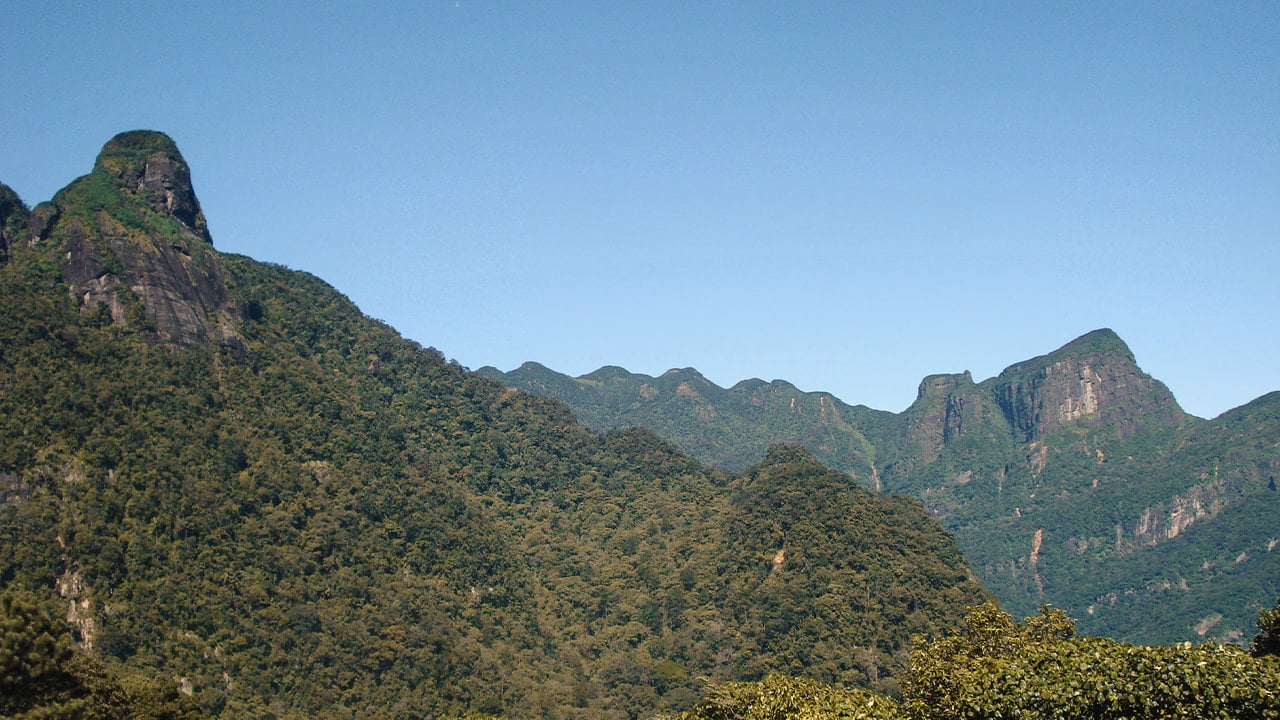
The Knuckles Mountain Range — known in Sinhala as the Dumbara Hills — rises sharply at the northern edge of Sri Lanka's Central Highlands, roughly 25 km northeast of Kandy. The range takes its English name from the visual similarity of its five prominent peaks to the knuckles of a clenched fist, an observation made by British surveyors during the colonial era. In 2010, the Knuckles Conservation Forest became part of the UNESCO Central Highlands World Heritage Site, recognition of its exceptional biodiversity and cloud-forest ecosystems.
Bounded to the south and east by the Mahaweli River basin and to the west by the Matale plains, the range covers around 18,512 hectares of protected forest. The main Knuckles peak reaches 1,863 m, making it the sixth highest point in Sri Lanka, while the range as a whole features 34 peaks between 900 m and 1,900 m in elevation.
How do I get to the Knuckles Range from Kandy?
Most visitors approach via the A26 highway running east from Kandy toward Hunnasgiriya. At Hunnasgiriya, a B-grade road climbs to Corbett's Gap, a mountain pass that opens to sweeping views of the peaks. From Corbett's Gap, a rough road continues to the remote village of Meemure — passable only by vehicles with good ground clearance.
Two alternative entry points are also popular with trekkers:
- From Matale via Rattota and Riverston — a scenic route with good road access to Riverston Peak viewpoints.
- From Wattegama via Panwila — favoured by those beginning hikes in the lower foothills.
If you are organising transport from Kandy, a private driver who knows the mountain roads can save considerable time and uncertainty. The Kandy Tourist Information Center can also advise on local conditions before you set out.
What trekking trails are available at Knuckles Range?
The Knuckles Range is Sri Lanka's premier trekking destination. The terrain shifts constantly — open grasslands, dense montane forest, rocky ridges, and valley streams — across a relatively compact area. Serious hikers take on a 40+ km, three-day circuit with an overnight guide; day-trippers can complete rewarding out-and-back walks in three to five hours.
The most frequently walked trails include:
- Mini World's End from Deanston — an easy 1.1 km return walk from the Knuckles Conservation Centre to a 1,192 m escarpment with panoramic views of the range and surrounding villages, completable in about one hour.
- Dothalugala from Deanston — a moderate trail leading to one of the range's prominent peaks.
- Nitro Caves from Corbett's Gap — a cave exploration route through dense forest.
- Augallena Cave via Thangappuwa from Corbett's Gap — a longer trail passing through several micro-habitats.
- Kalupahana from Meemure village — a challenging full-day walk through remote terrain.
All trails inside the conservation zone require a guide registered with the Department of Wildlife Conservation. Guides can typically be arranged at Corbett's Gap or through the Knuckles Conservation Centre at Deanston. The Makandawa Rainforest near Kithulgala offers a comparable forest-immersion experience for those wanting an alternative to the Knuckles circuit.
When is the best time to trek Knuckles Mountain Range?
Weather in the Knuckles Range is notoriously changeable. A clear ridge can disappear into thick mist within minutes, and isolated rain showers can occur at any time of year. That said, seasonal patterns do exist:
| Period | Conditions | Trekking suitability |
|---|---|---|
| June – September | Lowest rainfall overall | Best |
| December – February | Moderate rain possible | Good |
| March – May | Lower chance of rain than Oct–Nov | Good |
| October – November | Higher rainfall, trails can be slippery | Less suitable |
Annual rainfall across the range averages between 3,000 mm and 5,000 mm, delivered largely by the Southwest Monsoon through gaps in the mountain ridges. Temperatures range from around 5.5 °C on cold nights at high elevation to 35 °C in the lower valleys, so layering is essential regardless of season.
What wildlife can I see at Knuckles Range?
The Knuckles Conservation Forest holds an extraordinary density of endemic species relative to its size. Mammal sightings on quiet mornings or evenings include wild boar, spotted deer, barking deer, giant squirrel, purple-faced leaf monkey, mongoose, and porcupine.
The range is particularly remarkable for its reptile endemism. Four lizard species of special note are:
- Crestless Lizard (Calotes liocephalus)
- Pygmy Lizard (Cophotis ceylonica)
- Kangaroo Lizard (Otocryptus wiegmanni)
- Leaf-nosed Lizard (Ceratophora tennentii) — found only within this forest
Over 200 bird species have been recorded here, 15 of which are endemic to Sri Lanka. Reliable sightings include the Sri Lanka Blue Magpie, Yellow-eared Bulbul, Spot-winged Thrush, Dull-blue Flycatcher, Sri Lanka Warbler, and Layard's Parakeet. Birders often combine a Knuckles visit with Sinharaja Forest Reserve, the other great endemic-bird destination on the island.
What forest types and plant life exist in the Knuckles Range?
The Knuckles Range compresses an unusual variety of forest types into a small geographic area. Moving from the lowlands upward, the vegetation transitions through dry evergreen forest, sub-montane forest, montane forest, cloud forest, and open grassland communities known locally as patana. Isolated pockets of savanna-like dry vegetation occur on rain-shadowed slopes.
Around 20 percent of the plant species recorded in the range are endemic to Sri Lanka. Hardwood trees, medicinal herbs, and a rich understorey of ferns and mosses make the area of significant interest to botanists and conservation researchers.
What traditional villages are found inside or near the Knuckles Range?
The forest buffer zone encompasses around 37 ancient villages whose communities have lived alongside the mountains for generations. Notable settlements include Meemure, Kaikawala, and Galamuduna. Livelihoods centre on rice cultivation, chena (shifting) cultivation, and cardamom farming. Produce is transported along mountain trails using pack oxen called Thawalama — a practice unchanged for centuries.
Meemure is the most frequently visited of these villages and remained largely without modern infrastructure until electricity arrived in 2008. Staying overnight with a local family or at a basic guesthouse in Meemure provides a genuine sense of how mountain communities live, and the walk in from the end of the vehicle track is itself a rewarding experience.
Is the Knuckles Range suitable for adventure activities beyond trekking?
The range's river valleys and steep gradients attract mountain bikers, wild swimmers, and nature photographers in addition to hikers. The Riverston area, accessible from Matale, offers wide viewpoints that require minimal walking and are popular with visitors who want panoramic scenery without a full trek. Birdwatching before dawn along the Corbett's Gap road is particularly productive for endemic forest species.
For those combining Knuckles with a broader hill-country itinerary, the Horton Plains National Park lies further south in the Central Highlands and offers a contrasting high-altitude grassland environment. The Adventure Tours page on Lakpura lists guided options that can be incorporated into a customised highland circuit.
Nearby places
9 places within about 25 km, nearest first.
- Hunnasgiriyaunder 1 km
- Heen Ganga4 km
- Thelgamu Oya4 km
- Hunnasgiriya Mountain4 km
- Heeloya Village5 km
- Hulu Ganga6 km
- Knuckles Viewpoint6 km
- Gommolliya Peak6 km
- Meemure7 km