Kathaluwa Poorwarama Viharaya

Kathaluwa Poorwarama Viharaya Kathaluwa Poorwarama Viharaya Kathaluwa Poorwarama Viharaya

Kathaluwa Poorwarama Viharaya ist ein buddhistischer Tempel im Dorf Kathaluwa im Distrikt Galle in Sri Lanka . Während lokale Traditionen darauf schließen lassen, dass seine Ursprünge bis in die Anuradhapura -Zeit zurückreichen, deuten Beweise darauf hin, dass der Tempel 1840 von Kathaluwe Gunarathana Thera gegründet wurde.

Der Tempel ist für seine kunstvollen Wandmalereien im Bildhaus bekannt. Obwohl über dem Eingang die Jahreszahl 1886 eingraviert ist, deuten Stil und Details der Malereien darauf hin, dass sie früher entstanden sind. Das Bildhaus verfügt über eine erhöhte Plattform, mit Kalkmörtel verputzte Kabok-Wände (Laterit) und besteht aus einer inneren, mittleren und äußeren Kammer. Ein bemerkenswertes Merkmal über dem Haupteingang ist das britische Wappen mit einem Porträt von Königin Victoria und der Jahreszahl 1886, was möglicherweise auf einen späteren Anbau oder eine Renovierung hindeutet.

Der Poorwarama-Tempel ist bei Besuchern wegen seiner wertvollen Wandmalereien im Bilderhaus beliebt. Obwohl über der Eingangstür zum Bilderhaus das Jahr 1886 n. Chr. angegeben ist, deuten Technik und Details der Malereien im Inneren darauf hin, dass sie deutlich früher als 1886 entstanden sind.

Der Tempelkomplex ist in zwei Terrassen unterteilt: Auf der oberen Terrasse befinden sich die Stupa, das Statuenhaus, der Bodhi-Baum, der Glockenturm und die Bibliothek, während auf der unteren Terrasse die Wohnungen der Mönche liegen.

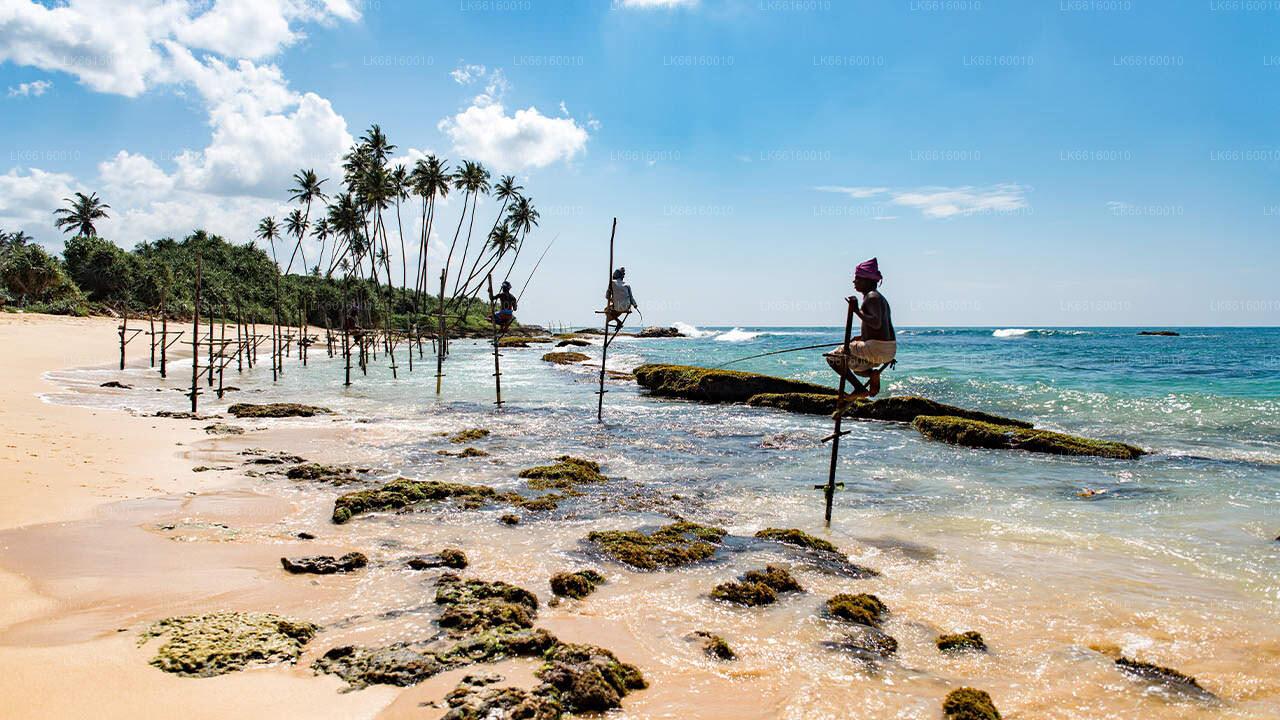
Kathaluwa Poorwarama Viharaya liegt in der Nähe von Koggala, einer kleinen Küstenstadt am Rande einer Lagune an der Südküste Sri Lankas. Koggala ist bekannt für seine langen Strände und die Nähe zu Sehenswürdigkeiten wie dem Martin Wickramasinghe Folk Museum und traditionellen Stelzenfischern.

Kathaluwa Poorwarama Viharaya Kathaluwa Poorwarama Viharaya Kathaluwa Poorwarama Viharaya

About Galle District

Galle is a city situated on the southwestern tip of Sri Lanka, 119 km from Colombo. Galle is the best example of a fortified city built by Europeans in south and Southeast Asia, showing the interaction between European architectural styles and south Asian traditions. The Galle fort is a world heritage site and the largest remaining fortress in Asia built by European occupiers.

Galle is the best example of a fortified city built by Europeans in south and Southeast Asia, showing the interaction between European architectural styles and south Asian traditions. The Galle fort is a world heritage site and the largest remaining fortress in Asia built by European occupiers.

Galle is a sizeable town, by Sri Lankan standards, and has a population of 91,000, the majority of whom are of Sinhalese ethnicity. There is also a large Sri Lankan Moor minority, particularly in the fort area, which descend from Arab merchants that settled in the ancient port of Galle.

About Southern Province

The Southern Province of Sri Lanka is a small geographic area consisting of the districts of Galle, Matara and Hambantota. Subsistence farming and fishing is the main source of income for the vast majority of the people of this region.

Important landmarks of the Southern Province include the wildlife sanctuaries of the Yala and Udawalawe National Parks, the holy city of Kataragama, and the ancient cities of Tissamaharama, Kirinda and Galle. (Although Galle is an ancient city, almost nothing survives from before the Portuguese invasion.) During the Portuguese period there were two famous Sinhalese poets called Andare who was from Dickwella and Gajaman Nona who was from Denipitiya in Matara District, composing poems on common man.