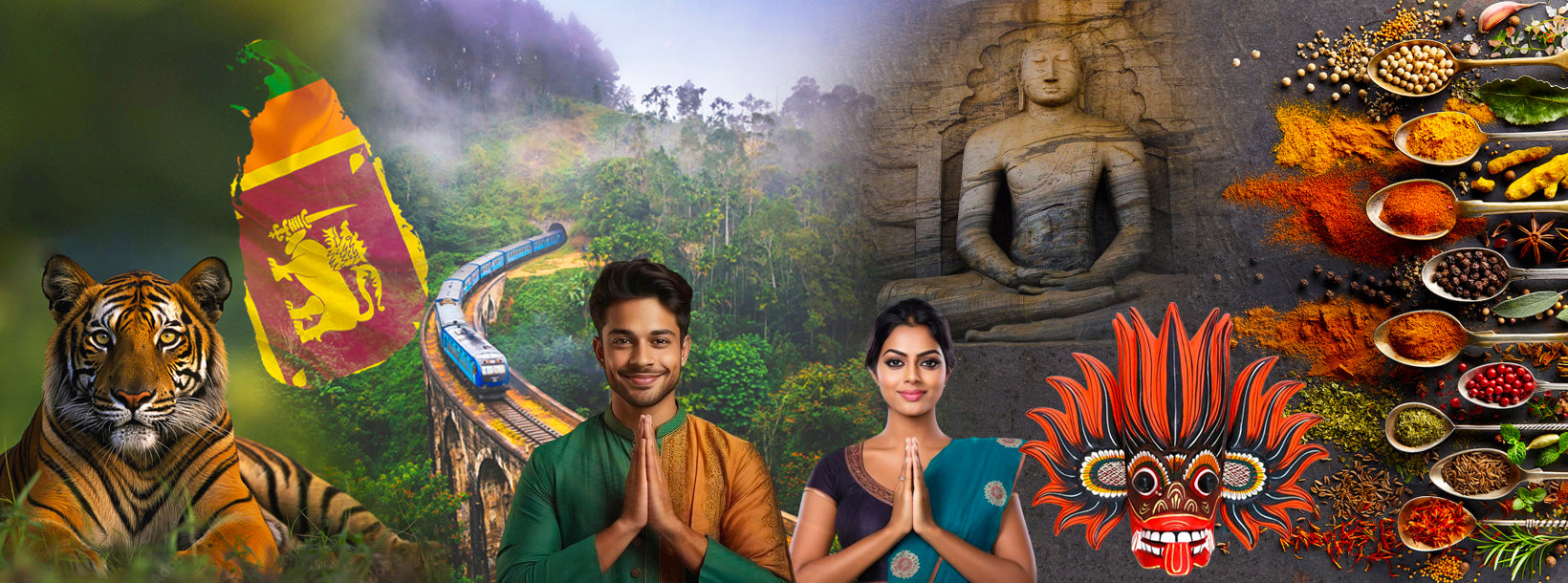
Sri Lanka's South Coast stretches roughly 200 kilometres from the reef-fringed beaches north of Galle down to the vast bay at Hambantota. It is the country's most-visited coastal corridor, yet it remains remarkably varied — colonial port towns sit alongside quiet fishing coves, surf breaks give way to whale-watching grounds, and the hinterland hides wetland rivers and a UNESCO-listed rainforest within easy reach. Whether you have three days or three weeks, the south coast rewards both the first-time visitor and the returning traveller who peels away from the main road.
What are the main destinations along Sri Lanka's South Coast?
The A2 coastal highway links most of the key towns, and the Colombo–Matara railway line runs closely parallel for much of the route, making it easy to hop between stops without a private vehicle.
- Hikkaduwa — One of the earliest beach resorts on the island, about 98 km from Colombo and 14 km north of Galle. It built its reputation on snorkelling and scuba diving around the nearshore coral reef, which is now protected as a national marine sanctuary. The town has a lively strip of guesthouses and seafood restaurants without losing its neighbourhood feel.
- Galle — Around 116 km from Colombo, Galle is the south coast's cultural and commercial anchor. The 17th-century Dutch Fort encloses a living neighbourhood of boutique hotels, galleries, and cafés within its ramparts. A Galle city tour typically covers the fort walls, the Dutch Reformed Church, the lighthouse, and the old market quarter.
- Unawatuna — A sheltered bay just south of Galle, accessible by the A2 road or the coastal railway. Its calm, arc-shaped beach makes it popular with families and swimmers; the surrounding coral gardens also draw snorkellers.
- Koggala — A quieter stretch about 15 km east of Galle. The broad beach is rarely crowded, and Koggala Lake — a large inland lagoon — is excellent for birdwatching and boat rides. The lake is also home to a sea turtle conservation project worth supporting.
- Ahangama & Midigama — Twin surf villages on a rocky point between Koggala and Weligama. Both are well known among intermediate and advanced surfers for consistent reef breaks.
- Weligama — Famous for its bay-wide anchorage, the stilted fishermen who perch on poles above the surf, and increasingly strong surf culture. The town centre is one block inland from the beach and has good local transport connections.
- Mirissa — A small headland beach in Matara District that has become one of the world's premier whale-watching departure points. Blue whales and sperm whales pass through the waters south of Mirissa from roughly November to April.
- Matara — A busy southern city about 160 km from Colombo at the mouth of the Nilwala River. Matara has its own Dutch fortifications, a scenic star fort across the river, and serves as a transport hub for the deep south.
- Dickwella — A small market town in Matara District with good surf at Hiriketiya Bay, one of the south's most picturesque horseshoe coves, and the Wewurukannala Vihara — a temple known for a very large seated Buddha statue.
- Tangalle — About 195 km from Colombo and 35 km east of Matara, Tangalle centres on a protected fishing harbour bay with an enclosing reef. Palm-fringed coves, including Rekawa Beach — a nesting site for five species of marine turtle — spread east of the town. The pace here is noticeably slower than Galle or Mirissa.
- Hambantota — The easternmost major town on the south coast, reachable via the A2 coastal road (around 241 km from Colombo) or the faster A8/A18 inland route (around 221 km). Hambantota's deep-water port has transformed the town economically, but its surroundings — salt pans, flamingo flats, and the Bundala wetlands — keep naturalists interested.
What wildlife and nature experiences are available on the South Coast?
The south coast's hinterland punches well above its weight for wildlife. Udawalawe National Park, roughly an hour and a half inland from the coast, shelters one of Sri Lanka's densest elephant populations and is considered one of the best places in Asia to see wild elephants at close range. Adjacent to the park, the Elephant Transit Home rehabilitates orphaned calves before releasing them back into the wild — visits are timed around the thrice-daily milk feeds.
Closer to the coast, the Sinharaja Forest Reserve — a UNESCO World Heritage Site — lies about 30 km inland from the coast between Galle and Hambantota. This lowland rainforest holds species found nowhere else on earth, including endemic birds such as the Sri Lanka blue magpie and the red-faced malkoha. Access roads from Deniyaya or Kudawa are manageable in a standard vehicle.
Marine wildlife is equally compelling. Whale-watching boats depart Mirissa from around November through April, targeting blue whales and sperm whales in the deep water south of the continental shelf. Spinner dolphins are frequently encountered year-round. Sea turtles nest on several south coast beaches; the Hikkaduwa Turtle Hatchery and the Rekawa beach monitoring programme are the most established places to learn about conservation efforts.
What water activities can I do on the South Coast?
Snorkelling and diving around Hikkaduwa's reef remain the classic entry point — the marine park designation means the coral is in better condition than many unprotected sites. Surf breaks run almost continuously from Hikkaduwa south to Hambantota, with Midigama, Weligama, Hiriketiya, and Mirissa offering the most consistent conditions between October and April. Beginners tend to favour the sandy-bottomed beach break at Weligama Bay.
For something calmer, the Madu River Safari on the Madu Ganga — a Ramsar-listed mangrove estuary near Balapitiya — takes visitors by motorboat through a network of mangrove islands, past a rock temple, and to a cinnamon-peeling demonstration. It is one of the south coast's most rewarding half-day excursions. Deep sea fishing trips also depart from several south coast harbours, targeting yellowfin tuna and dorado in season.
How do I get to and around the South Coast from Colombo?
Three main options connect Colombo with the south coast:
- Southern Expressway (E01) — The fastest route by road, cutting journey time to Galle to around 90 minutes from the city limits. It joins the A2 coastal highway at Pinnaduwa, just north of Galle. There is limited scenery along the expressway itself.
- A2 coastal road — The scenic option, hugging the coastline through Kalutara, Beruwala, Bentota, Ambalangoda, and Hikkaduwa before reaching Galle. Allow at least three hours from Colombo to Galle on this route during daylight.
- Colombo–Matara railway — One of the most enjoyable train journeys in Sri Lanka. The line follows the coast closely, with sea views from the right-hand side heading south (left-hand returning). Trains run regularly and stop at Hikkaduwa, Galle, Unawatuna, Koggala, Weligama, Mirissa, and Matara, among others.
Within the south coast, the same A2 road and railway line serve most destinations. Tuk-tuks are plentiful for short hops between beaches; a private driver gives the most flexibility for day trips into the interior.
When is the best time to visit the South Coast?
The south coast's peak dry season runs from November through April, when the southwest monsoon has retreated and skies are generally clear. This period coincides with the best whale-watching conditions and the most reliable surf season. Sea temperatures hover around 27–29°C year-round.
The southwest monsoon arrives around May and June, bringing heavier swells and occasional rough seas to the south and west-facing beaches. Some surf enthusiasts actively prefer this period for the stronger waves, and many guesthouses offer lower rates. The coastal towns themselves remain open and accessible even during the monsoon; rain tends to arrive in heavy but short bursts rather than all-day drizzle.
Are there cultural and religious sites worth visiting near the South Coast?
Galle Fort alone justifies a full day — its layered Dutch, Portuguese, and British colonial history is accessible through its streets, the National Maritime Museum, and the fort's own National Museum. East of Tangalle, the Kataragama shrine complex is one of Sri Lanka's most significant multi-faith pilgrimage sites. The principal shrine is dedicated to the deity Skanda (Murugan), and its history extends to at least the 2nd century BC. Daily offerings are made at 4.30 am, 10.30 am, and 6.30 pm; the annual Esala festival in July or August draws hundreds of thousands of pilgrims and features fire-walking and Kavadi dancers.
The village of Kirinda, east of Tangalle near the Bundala wetlands, has a Buddhist shrine dramatically positioned on large coastal boulders at the shoreline, with a stupa visible from the sea. It is associated with Queen Viharamahadevi and is a rewarding stop on the drive between Tangalle and Hambantota.
What should I know about the smaller towns between Galle and Matara?
Several smaller settlements between Galle and Matara deserve more than a drive-through glance. Ambalangoda, about 35 km north of Galle, is the traditional centre of Sri Lanka's mask-carving craft; workshops and a mask museum are open to visitors. Balapitiya, just north of Ambalangoda, is the gateway to the Madu Ganga mangrove system. Dodanduwa, 4 km south of Hikkaduwa, has a quieter beach and a floating Buddhist island monastery on its lagoon. Habaraduwa and Thalpe sit between Galle and Koggala and are popular addresses for boutique villa rentals, largely because they offer proximity to Galle without the tourist foot traffic. Talalla, between Dickwella and Tangalle, has an isolated crescent beach with strong community-based guesthouse accommodation.
