Matara sits at the southern tip of Sri Lanka's coastal highway, roughly 160 km from Colombo, where the Nilwala Ganga river meets the Indian Ocean. It is one of the oldest continuously inhabited cities on the island, shaped in turn by Kandyan kings, Portuguese sailors, and Dutch colonial administrators — all of whom left something behind. Today it functions as the principal transport and commercial hub of the Southern Province, while its beaches, reef, and Dutch-era monuments draw a steady stream of independent travellers and those extending a southern coast itinerary.
How do I get to Matara from Colombo?
The most comfortable option is the coastal railway, which runs from Colombo Fort station south through Galle and terminates at Matara. Journey times vary between roughly three and four hours depending on the service; the observation car on the Rajarata Rajini express is worth booking in advance for the ocean views. The Southern Expressway (E01) also connects Colombo to Matara in around two hours by private vehicle, making a self-drive or private car transfer practical for those with luggage or onward plans.
Long-distance buses serve the route as well, departing from Colombo's Bastian Mawatha terminal, though the expressway journey by car remains noticeably faster and more direct.
What is the layout of Matara city?
The Nilwala Ganga divides Matara into two distinct zones. The Old Town — locally called Fort — occupies a narrow estuary peninsula. It holds the Dutch Reformed Church, the old rest house, the main bus station, a covered market, and a mosque, all concentrated within a short walking circuit. The New Town spreads across the mainland and contains the railway station, major banks and shops, a cricket ground, and the Dutch Star Fort.
These two areas are linked by the Mahanama Bridge, a six-lane crossing that handles the bulk of daily traffic. Most visitors base themselves in the beach suburbs to the west, but the old colonial quarter repays an afternoon of unhurried walking.
What are the Dutch colonial landmarks worth visiting?
Matara has two distinct Dutch fortifications, which is unusual even by Sri Lankan standards. The Dutch Star Fort in the new town is a small, geometrically precise bastion built in 1763. Its angular ramparts are intact and largely unmodified, and the interior has been converted into a public library — visitors can enter during opening hours. The Fort area in the old town is an older and larger enclosure whose walls partly survive; the Dutch Reformed Church inside the compound is one of the better-preserved colonial churches in the Southern Province.
The construction of these fortifications reflects Matara's strategic value as a regional administrative and trading post under the Dutch East India Company (VOC) in the eighteenth century. For context on Dutch colonial presence elsewhere on the coast, the Galle City Tour offers a complementary perspective on the more extensively preserved Galle Fort, a UNESCO World Heritage Site.
Which beaches are closest to Matara?
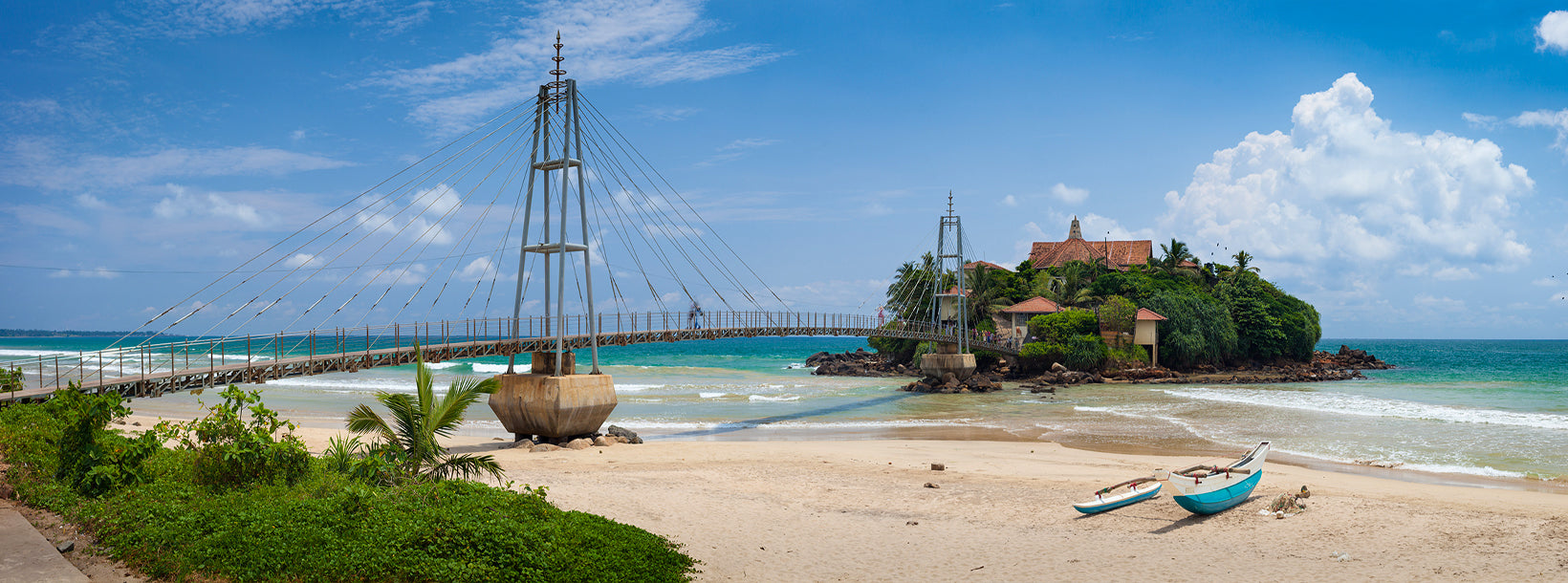
Two beaches immediately west of the city centre are popular with visitors for different reasons.
- Polhena Beach is a sheltered cove protected by a natural reef. The shallow lagoon created by the reef makes snorkelling accessible even for non-swimmers, and sea turtles are sometimes spotted feeding in the area. The calm conditions also make it suitable for families.
- Medawatta Beach is more exposed and picks up stronger swells, making it the local choice for surfing. Board rental and beginner lessons are available from outfitters along the beach road.
Both beaches are within a short tuk-tuk ride of the city centre. Accommodation ranging from guesthouses to small boutique retreats clusters along the coastal strip between Polhena and Medawatta.
What day trips can I take from Matara?
Matara's position at the southern end of the expressway network makes it a practical base for exploring a wide arc of the island.
- Udawalawe National Park is around two hours north by road, accessible via the Beliatta–Embilipitiya route. The park holds one of Sri Lanka's densest resident elephant populations and offers reliable wildlife sightings year-round.
- Sinharaja Forest Reserve, a UNESCO-listed rainforest and one of South Asia's most significant biodiversity hotspots, is reachable in roughly two hours via Deniyaya. Morning guided walks are the standard format.
- Weligama and Mirissa, to the west along the coastal road, offer whale- and dolphin-watching boat trips between November and April, along with a well-established surf scene at Weligama Bay.
- The Dondra Head Lighthouse, about 6 km south of Matara city, marks the southernmost point of Sri Lanka. The lighthouse itself is one of the tallest in South Asia and remains an active navigational aid.
When is the best time to visit Matara?
Matara lies on Sri Lanka's southwestern coast, which means it benefits from the southwest monsoon's dry inter-monsoon periods. The most reliable dry weather falls between December and April, when seas are calm, snorkelling conditions at Polhena are at their best, and whale-watching off Mirissa reaches its peak season. The southwest monsoon arrives around May and brings heavy rainfall and rough seas through September.
Visiting outside peak season is not without appeal — the crowds are thinner, accommodation rates drop noticeably, and the surrounding countryside turns intensely green. However, beach activities become limited and some boat operators suspend services during the monsoon months.
What wildlife can I find around Matara?
Beyond the national parks accessible on day trips, the Nilwala Ganga estuary itself supports a small population of estuarine crocodiles. Local boat operators run crocodile watching trips along the river, typically in the early morning when sightings are most likely. The reef at Polhena Beach also attracts green and hawksbill sea turtles, particularly outside the high-tourist months.
Birders find the wetlands fringing the river productive, with a mix of wading birds, kingfishers, and raptors active at dawn and dusk.
Where should I stay in Matara?
The preferred accommodation belt runs along the coast between Polhena and Medawatta, giving guests direct beach access while keeping the city's amenities within easy reach. Options span compact guesthouses favoured by long-stay surfers through to small boutique properties with garden pools. The Talalla stretch, a short drive south of Polhena, has developed a quieter enclave of retreat-style accommodation for those seeking a less commercial atmosphere.
Visitors who prefer to be within walking distance of the old town's market and restaurants can find guesthouses in the Fort area, though beach access there is limited by the river estuary.