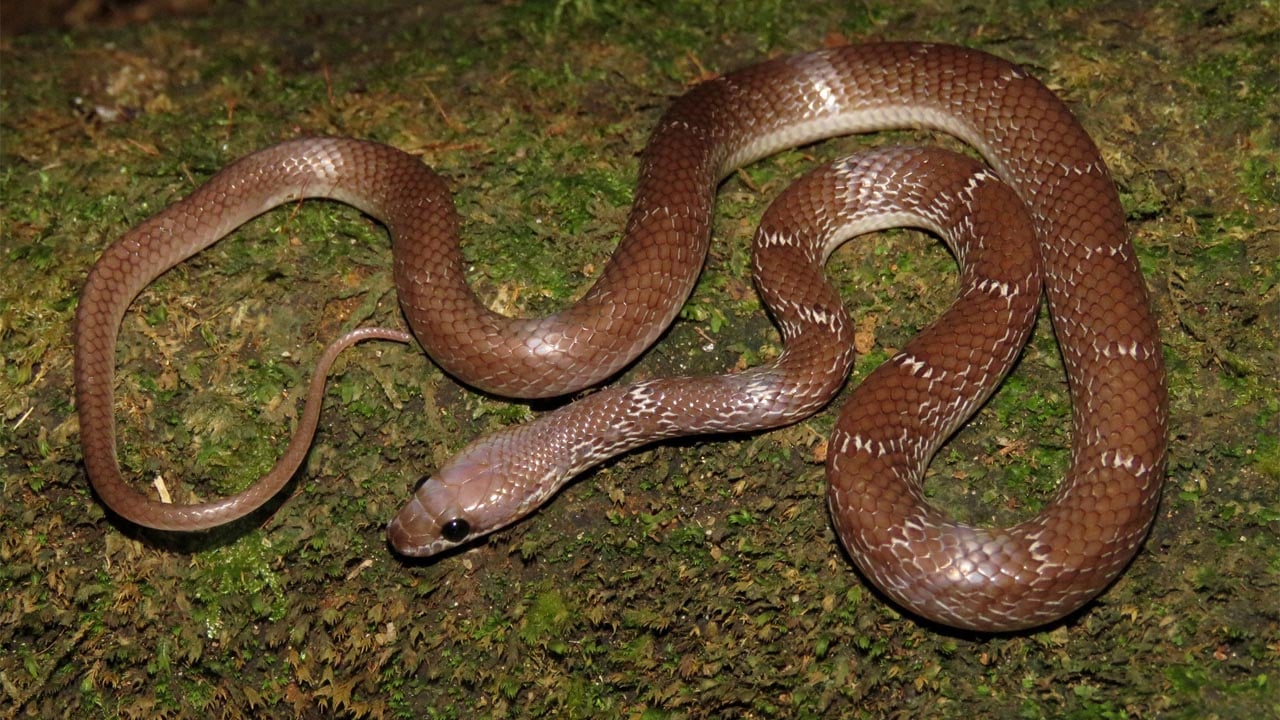
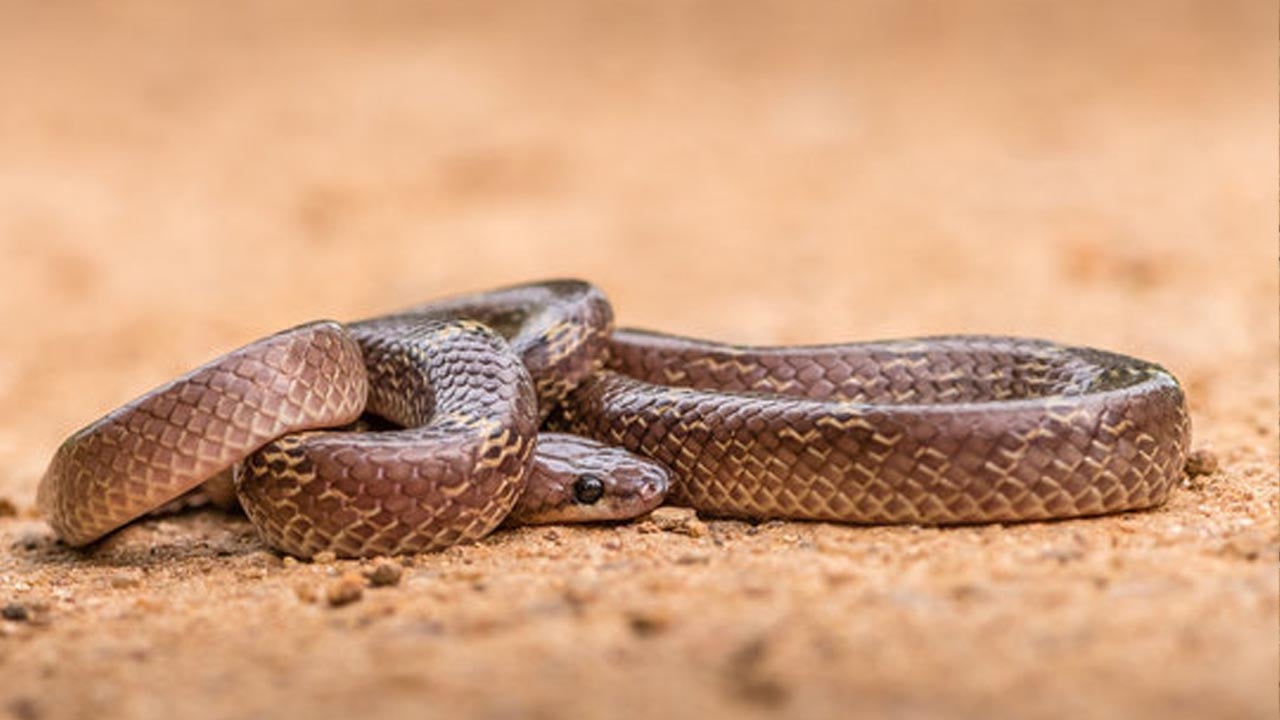
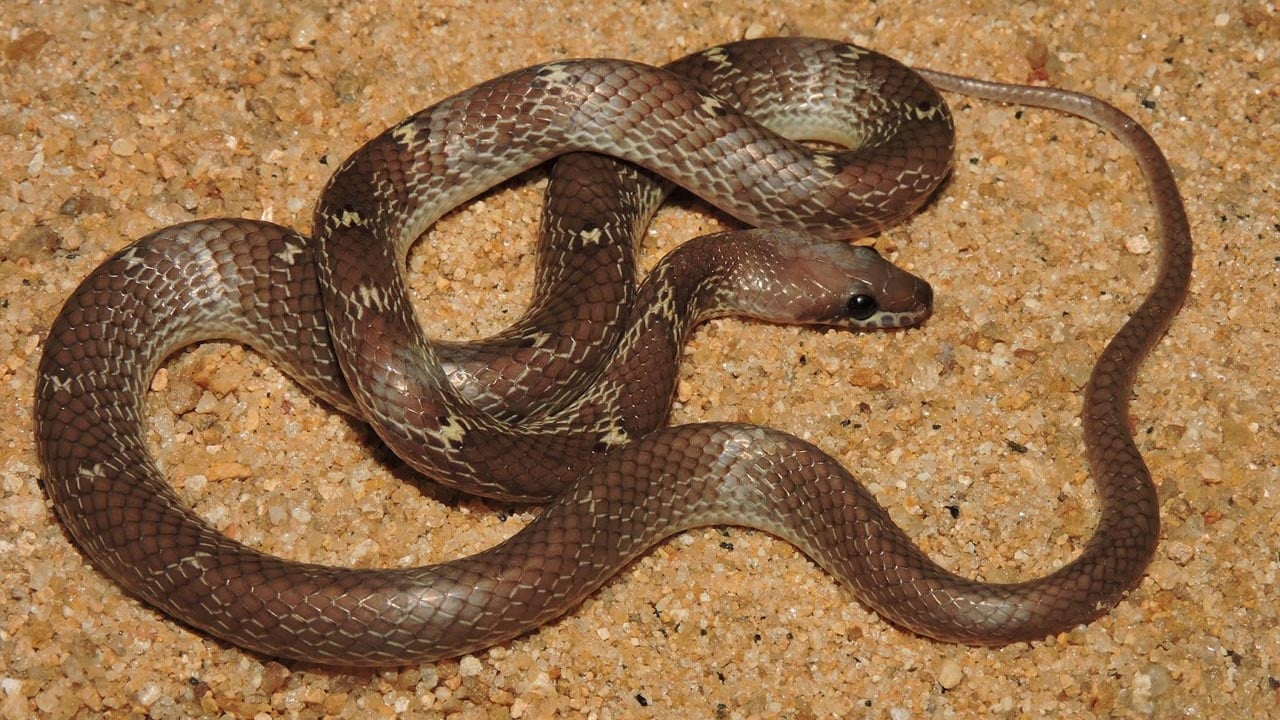
The Flowery Wolf Snake (Lycodon capucinus) is one of Sri Lanka's quietly fascinating reptiles — small, non-venomous, and almost entirely nocturnal. Despite bearing the word "wolf" in its name, this colubrid poses no threat to humans and plays a useful role in controlling populations of small lizards and frogs in the ecosystems it inhabits. Its common name comes from the ornate, floral-patterned markings that run along its back, making it one of the more visually distinctive members of its genus.
What does the Flowery Wolf Snake look like?
Most individuals measure between 50 cm and 70 cm in length, though larger specimens can approach 1 metre. The body is slender and covered in smooth, non-keeled scales that give the skin a subtly glossy sheen. Background colouration is typically light brown or greyish, overlaid with irregular dark brown or black blotches that trail along the dorsal surface — the source of the "flowery" description.
The head is slightly flattened, with large eyes suited to low-light hunting. A dark postocular stripe running through the eye is a characteristic shared across much of the genus Lycodon. The tail is proportionally short and tapers to a slender tip, typical of colubrid snakes in this size range.
Where is the Flowery Wolf Snake found in Sri Lanka?
Within Sri Lanka, the species occurs across lowland and mid-elevation zones, extending from the wet and intermediate zones into agricultural margins and secondary forest edges. It is broadly distributed across South and Southeast Asia, with confirmed populations in India, Sri Lanka, and Bangladesh, as well as wider records across parts of Southeast Asia.
Habitat preferences are notably broad. The snake turns up in tropical forest understorey, the edges of cultivated fields, rocky outcrops, riverbanks, and occasionally in well-vegetated garden settings near human habitation. Protected areas such as Sinharaja Forest Reserve provide ideal undisturbed habitat, though the species is by no means restricted to primary forest.
When is the Flowery Wolf Snake most active?
This is a strictly nocturnal species. During daylight hours it typically shelters beneath leaf litter, under rocks, inside ground crevices, or within rotting logs. Activity peaks in the hours after sunset, when the snake emerges to hunt. Sightings by casual observers are therefore rare and usually accidental — most encounters happen when turning over garden debris or rocks in the evening.
There is no pronounced seasonal dormancy, but activity levels can vary with rainfall and temperature. The species tends to be encountered more frequently during and immediately after monsoon periods, when prey animals are also more active at ground level.
What does the Flowery Wolf Snake eat?
The diet is primarily composed of small lizards (particularly geckos and skinks), frogs, and occasionally small invertebrates. Unlike constrictors, the Flowery Wolf Snake subdues prey through speed and direct jaw grip rather than coiling around it. The enlarged teeth at the rear of the upper jaw — a feature common to many wolf snakes — help it grip smooth-scaled lizards that might otherwise slip free.
- Primary prey: geckos, skinks, small frogs
- Secondary prey: small invertebrates, occasionally earthworms
- Hunting method: active nocturnal foraging, ambush at close range
Is the Flowery Wolf Snake venomous or dangerous?
No. Lycodon capucinus is a non-venomous colubrid. It has no venom glands and poses no medical risk to humans. If handled carelessly it may bite in self-defence, as most small snakes will, but the bite is superficial and produces at most minor local irritation. In Sri Lanka, the species is sometimes confused with more dangerous snakes because of its nocturnal habits and the dark patterning on its scales, but correct identification removes any cause for concern.
Conservation status for the species across its range is not currently of major concern, largely because of its adaptability to disturbed and agricultural landscapes. However, deliberate killing based on misidentification remains a common threat in many parts of South Asia.
How does the Flowery Wolf Snake reproduce?
Like most members of the genus Lycodon, the Flowery Wolf Snake is oviparous — it reproduces by laying eggs rather than giving birth to live young. Clutch sizes are typically small, and eggs are deposited in sheltered, humid microhabitats such as decomposing wood or leaf mould. Hatchlings are miniature versions of the adults and are immediately independent.
How to identify the Flowery Wolf Snake versus similar species in Sri Lanka?
Several small, dark-banded or blotched snakes share similar microhabitats in Sri Lanka. Key identification points for Lycodon capucinus are its smooth scales, the characteristic postocular stripe, and the irregular floral blotching rather than neat transverse bands. Common krait (Bungarus caeruleus) — which is venomous — has clean, evenly spaced white crossbands and a more triangular cross-section to the body. When in doubt, observe from a distance and do not attempt to handle any unidentified snake.
| Feature | Flowery Wolf Snake | Common Krait |
|---|---|---|
| Venom | None | Highly venomous |
| Pattern | Irregular floral blotches | Even white crossbands |
| Scale texture | Smooth, non-keeled | Smooth; enlarged vertebral scales |
| Body section | Rounded | Triangular |
| Activity | Nocturnal | Nocturnal |
Where are the best chances to spot a Flowery Wolf Snake in Sri Lanka?
Because the species is nocturnal and generally elusive, deliberate sightings require patience and a torchlight walk after dark along forest paths or the edges of paddy fields. Guided night walks in areas of mixed forest and cultivation — including habitats near Udawalawe National Park — offer reasonable chances of encountering this and other small reptiles that are otherwise overlooked.
Herpetology-focused nature guides can dramatically improve encounter rates by knowing the microhabitats and seasonal patterns that bring the snake to the surface. Responsible wildlife tourism means observing without disturbing — never relocate or handle wild snakes, and report unusual sightings to local wildlife authorities.