
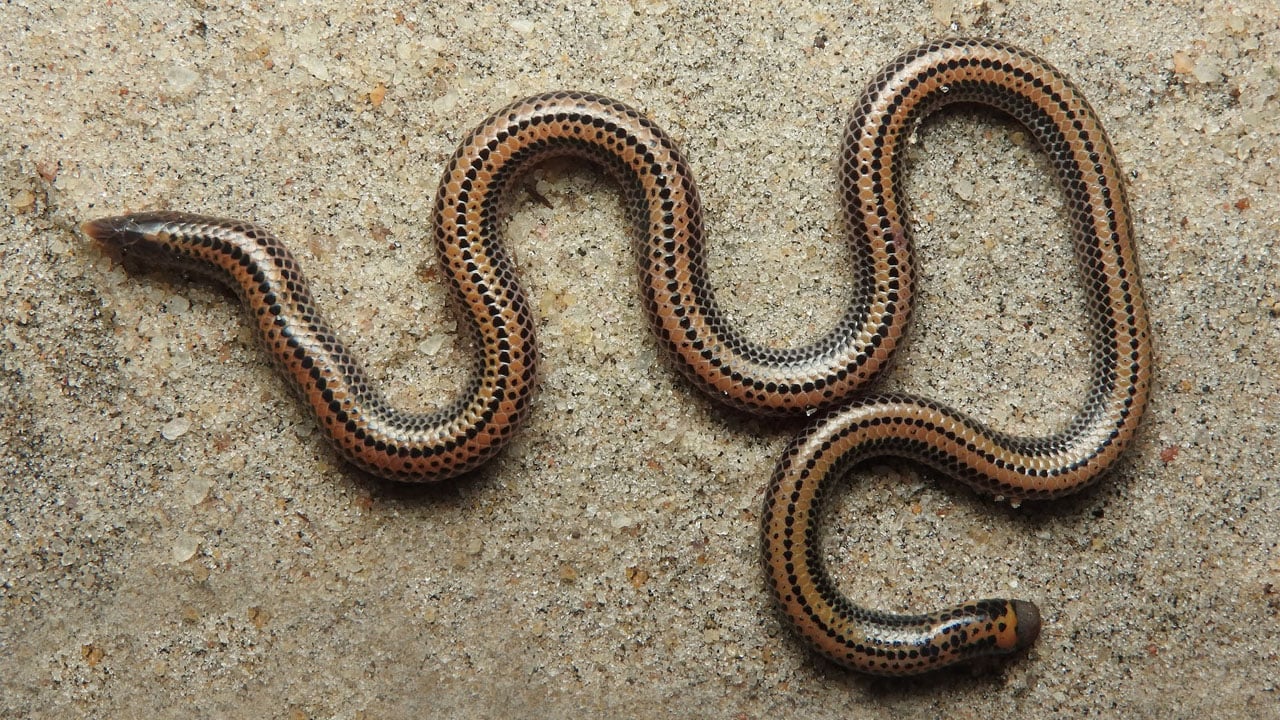


Müller's Shieldtail (Uropeltis mülleri) is one of Sri Lanka's most intriguing endemic reptiles — a small, non-venomous, burrowing snake that spends nearly its entire life underground. Members of the family Uropeltidae are found across peninsular India and Sri Lanka, but this particular species is found nowhere else on earth, making it a notable symbol of the island's exceptional biodiversity.
What is Müller's Shieldtail and how is it different from other snakes?
Unlike the slender, surface-dwelling snakes most people picture, Müller's Shieldtail is built for a subterranean life. It belongs to the Uropeltidae — a family sometimes called shieldtail snakes or earth snakes — all of which share a distinctive adaptation: the tail ends in a flattened, keratinised shield rather than a tapered point. This structure acts as a brace when the snake drives its pointed head through soil and leaf litter, and also presents a blunt, armoured surface to anything approaching from behind.
The head is small, conical, and barely distinguishable from the neck, an elegant solution for pushing through compacted earth. The eyes are tiny, consistent with a lifestyle in which vision is largely irrelevant. In overall body plan the snake is cylindrical, smooth-scaled, and quite uniform in girth from neck to tail.
What does Müller's Shieldtail look like?
Adults are relatively small, typically between 30 cm and 50 cm in total length. The dorsal (upper) surface is generally brown to reddish-brown, sometimes with faint darker flecking or faint patterning along the flanks. The ventral (belly) surface is considerably paler — often cream or pale yellow — a contrast common across the Uropeltidae family. Because the snake is rarely seen above ground, and when it is it tends to be partially obscured by leaf litter, field identification usually relies on the combination of its small size, uniform coloration, and the characteristic shield at the tail tip.
Where in Sri Lanka is Müller's Shieldtail found?
The species is recorded primarily from the wet zone of Sri Lanka — the southwestern quarter of the island that receives heavy monsoon rainfall and supports dense tropical rainforest. Central and southern hill-country localities have been noted in the literature, in areas of high humidity where deep leaf litter and loose, moist soil allow the fossorial lifestyle to work. Forests such as Sinharaja Forest Reserve, Sri Lanka's UNESCO-listed lowland rainforest, represent the kind of structurally intact habitat this snake depends on, even if specific population records vary by site.
Shieldtails are rarely encountered by casual observers. Most records come from individuals turned up during agricultural work, road construction, or deliberate herpetological surveys. The cloud forests and mid-elevation slopes of the central highlands are also considered suitable habitat, provided soil disturbance is not excessive.
What does Müller's Shieldtail eat?
The diet is dominated by soft-bodied invertebrates encountered underground. Earthworms are the primary prey, supplemented by insect larvae and other small soil invertebrates the snake encounters while burrowing. This diet is entirely consistent with the species' fossorial habits: it hunts in the same tunnels it uses for shelter, rarely needing to surface. The smooth body scales, which reduce friction in tunnels, and the reinforced tail shield both reflect millions of years of evolutionary fine-tuning to this underground niche.
How does Müller's Shieldtail reproduce?
Like other members of the Uropeltidae, Müller's Shieldtail is ovoviviparous — the female retains developing embryos internally and gives birth to fully formed live young, rather than laying eggs. This reproductive strategy is likely an adaptation to the underground environment, where maintaining the temperature and humidity needed for egg incubation would be difficult. Litter sizes in shieldtails are generally small, and the neonates are independent from birth. Detailed reproductive data for this species specifically remain limited in the published literature.
Is Müller's Shieldtail venomous or dangerous?
Müller's Shieldtail is entirely non-venomous and poses no threat to humans. Its mouth is small and adapted for grasping invertebrate prey, not for biting in defence. If disturbed at the surface, it typically tries to burrow away or may curl its body to hide the head while presenting the armoured tail as a deterrent — a behaviour observed in other uropeltids and sometimes called tail-display. There is no credible risk of harm to a person who encounters this snake.
What threats does Müller's Shieldtail face?
The species is not currently listed as endangered, but it faces a range of pressures tied directly to land-use change. Deforestation — driven by agricultural expansion, rubber and tea cultivation, and urban development in the wet zone — removes the forest floor structure that shieldtails depend on. Soil compaction from heavy machinery eliminates the loose, humus-rich layers these snakes inhabit. Because the species is endemic, any significant decline in Sri Lanka's wet-zone forest cover translates directly into population loss with no alternative range to fall back on.
Pesticide use in plantations is a secondary concern: if earthworm and invertebrate populations in plantation soils are suppressed, food availability for shieldtails diminishes even in areas where the physical habitat still exists. Broader conservation of Sri Lanka's forest ecosystems — including community-level protection and responsible land management — is therefore the most important factor in the species' long-term survival.
How can travellers and naturalists encounter Müller's Shieldtail responsibly?
Encountering a Müller's Shieldtail in the wild is genuinely serendipitous. The best strategy is to visit intact wet-zone forest habitats and pay close attention to disturbed leaf litter — near fallen logs, the edges of streams, or loose soil banks. Moving slowly and quietly maximises the chance of catching any surface activity. If a shieldtail is found, observe without picking it up if possible; if handling is unavoidable (for example to move it from a road), replace it gently in adjacent leaf litter and allow it to burrow away. Never keep one: wild-caught endemic reptiles face significant stress in captivity and collection is illegal under Sri Lanka's Fauna and Flora Protection Ordinance.
Guided nature walks in the wet zone and central highlands, particularly those focusing on herpetofauna, offer the most informed context for an encounter. Sri Lanka's network of endemic reptiles extends well beyond the shieldtails, and any guide specialising in the island's herpetology will help set a sighting in its broader ecological context.
Why does Sri Lanka have so many endemic snake species?
Sri Lanka's high endemism — in snakes, birds, amphibians, and plants — is a product of its island geography combined with a long period of ecological isolation from peninsular India, its varied rainfall zones, and the structural complexity of its forests. The wet zone in particular acts as a biodiversity hotspot within a hotspot. The island is recognised as one of the world's 36 biodiversity hotspots, and the shieldtail snakes are among the clearest illustrations of why: a whole family of snakes that evolved their subterranean lifestyle here and in southern India, with species found nowhere else on the planet.