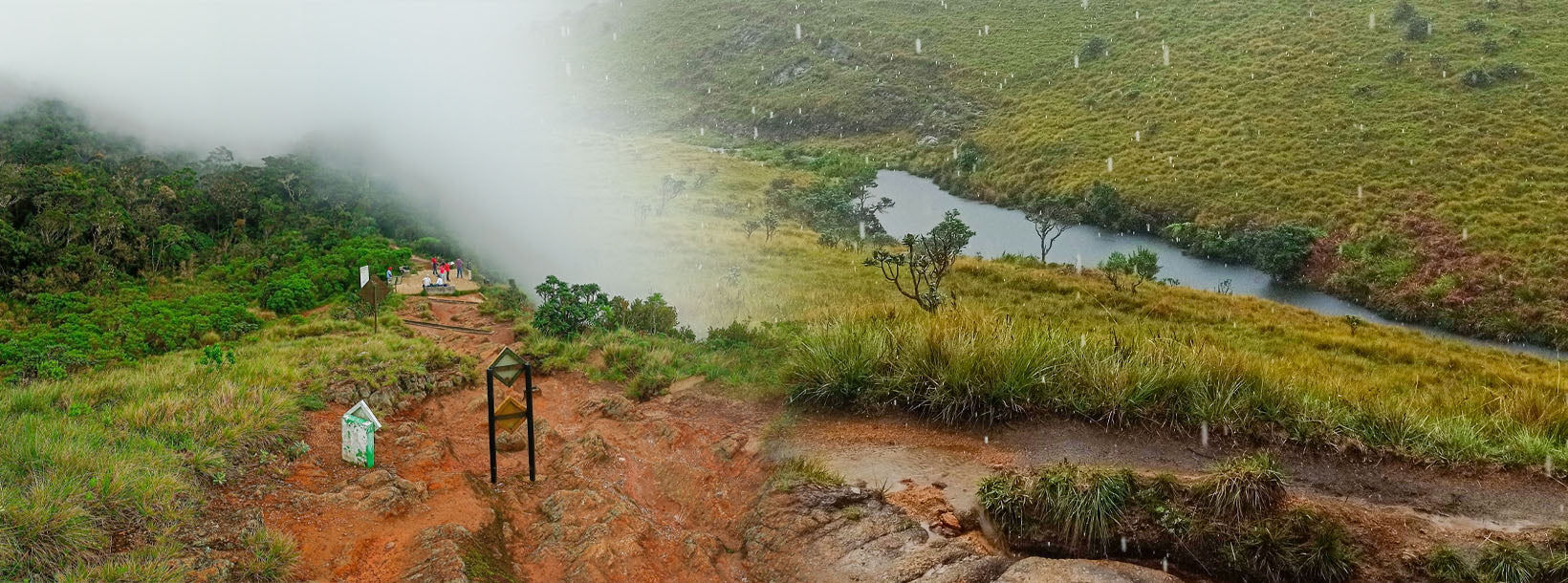
Horton Plains rises to around 2,100–2,300 metres above sea level in Sri Lanka's Central Province, forming one of the island's most ecologically significant landscapes. Rolling grasslands give way to dense cloud forest, freshwater streams cut through open plateau, and on clear mornings the horizon stretches for dozens of kilometres. It is part of a Horton Plains National Park that was designated a UNESCO World Heritage Site in 2010 as part of the Central Highlands of Sri Lanka — a status that reflects both its exceptional biodiversity and the global rarity of its montane ecosystem.
What makes Horton Plains ecologically important?
The plateau sits at the heart of a montane wet zone that sustains a disproportionately high number of Sri Lanka's endemic species. The cloud forest — perpetually draped in mist and lichen — shelters endemic trees such as Rhododendron arboreum ssp. zeylanicum and Calophyllum walkeri, both of which grow nowhere else on Earth. The open grasslands beyond support a suite of highland specialists, from the endemic purple-faced langur to the sambar deer, which graze in herds across the plateau at dawn.
Bird populations here are exceptional. The Sri Lanka whistling thrush, dull-blue flycatcher, yellow-eared bulbul, and Sri Lanka wood pigeon are reliably recorded along the main trails. The cloud forest edges, where light filters through the canopy, are particularly productive for birdwatching in the early morning hours.
Freshwater streams originating in Horton Plains feed rivers that supply water to a significant portion of Sri Lanka's population — a less-discussed but critical ecosystem service provided by this highland plateau.
What can I see and do at Horton Plains?
The main trail system forms a roughly circular route of around 9 kilometres, manageable for most visitors in two to three hours. The path passes through alternating zones of cloud forest and open grassland before reaching the two signature viewpoints.
- World's End: A near-vertical escarpment dropping approximately 870 metres to the southern lowlands below. On clear days — most reliably between January and March — the view extends all the way to the southern coastline.
- Baker's Falls: A tiered waterfall set within forest, roughly 20 metres in height, named after the British explorer Samuel Baker who passed through this region in the 19th century.
- Mini World's End: A smaller escarpment encountered earlier on the circuit, offering a preview of the dramatic drop that characterises the southern rim of the plateau.
Beyond the main loop, guided birdwatching treks venture into less-trafficked sections of the forest, where endemic species are more likely to be encountered without the foot traffic of peak morning hours. Kirigalpoththa — Sri Lanka's second-highest peak at around 2,395 metres — is accessible from the park boundary on a longer hiking route suited to those seeking a more demanding outing.
When is the best time to visit Horton Plains?
The drier months from January through March offer the most reliable conditions for viewing World's End. Mist typically rolls across the plateau by mid-morning, often obscuring the escarpment entirely by 10 a.m., so arriving at the park gate by 6 a.m. or shortly after is strongly recommended regardless of season.
The park receives two monsoon influences: the northeast monsoon brings rain between October and January, while the southwest monsoon affects the area from May to August. Neither closes the park, but visibility at the viewpoints is substantially reduced. The grasslands take on a particularly atmospheric quality during the misty season, and the forest birdlife is active year-round.
Temperatures at the plateau rarely climb above 16°C even in the warmest months, and early mornings can dip close to zero in January and February. A windproof layer and sturdy footwear are worthwhile regardless of when you visit.
How do I get to Horton Plains from Colombo or Nuwara Eliya?
The park entrance at Pattipola lies around 32 kilometres from Nuwara Eliya by road, and the journey takes roughly an hour depending on conditions. Most visitors reach the area via Nuwara Eliya, which itself is accessible from Colombo in approximately four to five hours by road, or by the scenic hill-country train from Kandy or Ella.
Day trips combining Horton Plains with Ella are a popular option for travellers already based in the hill country. The Pattipola train station — one of the highest in Sri Lanka — sits near the park, making a rail-and-hike combination feasible for the adventurous. Some visitors choose to enter the park via the rail-track route from Pattipola itself, a longer but unusually scenic approach.
Private transfers from Colombo Airport or from Nuwara Eliya are the most comfortable option for those not self-driving, as tuk-tuks and public buses are not well suited to the mountain roads before dawn.
What wildlife can I expect to see?
Horton Plains supports a fuller range of highland endemics than almost anywhere else in Sri Lanka. Key species to watch for include:
- Sambar deer (Rusa unicolor) — often seen grazing in open grassland, particularly at dawn and dusk
- Purple-faced langur — found in the forest canopy along the trail
- Leopard — present but rarely seen; the population here is adapted to highland conditions distinct from the leopards of the lowland dry zone
- Sri Lanka whistling thrush, dull-blue flycatcher, Sri Lanka wood pigeon, yellow-eared bulbul — all along the forest margins
- Streams harbour the endemic Horton Plains shrubfrog and several endemic freshwater fish
Leeches are present along the trail, particularly after rain. Long socks and insect repellent applied to boots and lower legs are a practical precaution.
Are there any facilities or accommodation near Horton Plains?
Facilities within the park are minimal — a small visitor centre near the entrance and basic amenities at the trailhead. Food and drink are not available on the trail itself, so carrying water and a light snack is advisable.
Accommodation ranges from guesthouses in Ohiya village — the closest settlement to the park — to established hill-country hotels in Nuwara Eliya. Camping within the park is permitted with prior arrangement through the Department of Wildlife Conservation, and this provides the rare opportunity to experience the plateau at night and in the very early morning before day visitors arrive.
The Grand Hotel in Nuwara Eliya is one of the well-known colonial-era properties in the area for those preferring comfortable hill-country accommodation as a base.
What should I know before visiting?
- The park opens daily from 6 a.m. Foreign visitors pay a national park entrance fee; tickets can be arranged in advance to avoid delays at the gate.
- Pets and food waste are not permitted inside the park.
- The trail can be slippery after rain — proper footwear is not optional.
- Drones are not permitted within the national park boundaries.
- Guided tours with an accredited naturalist significantly increase the probability of spotting endemic wildlife and understanding the ecology of what you are seeing.
Horton Plains rewards those who arrive prepared and early. The combination of an accessible trail, a dramatic geological feature in World's End, and a genuinely species-rich highland ecosystem makes it a rare category of destination: one that delivers on its reputation without requiring specialist fitness or equipment.