The Ornate Flying Snake (Chrysopelea ornata) is one of nature's more improbable performers: a slender, brilliantly patterned colubrid that launches itself from tree canopies and glides, with surprising precision, to a landing point metres away. Found across South and Southeast Asia — including Sri Lanka's wet-zone forests — it is not venomous and poses no threat to humans, yet its aerial agility and vivid colouration make it one of the most talked-about reptile encounters a naturalist can hope for on the island.
What does the Ornate Flying Snake look like?
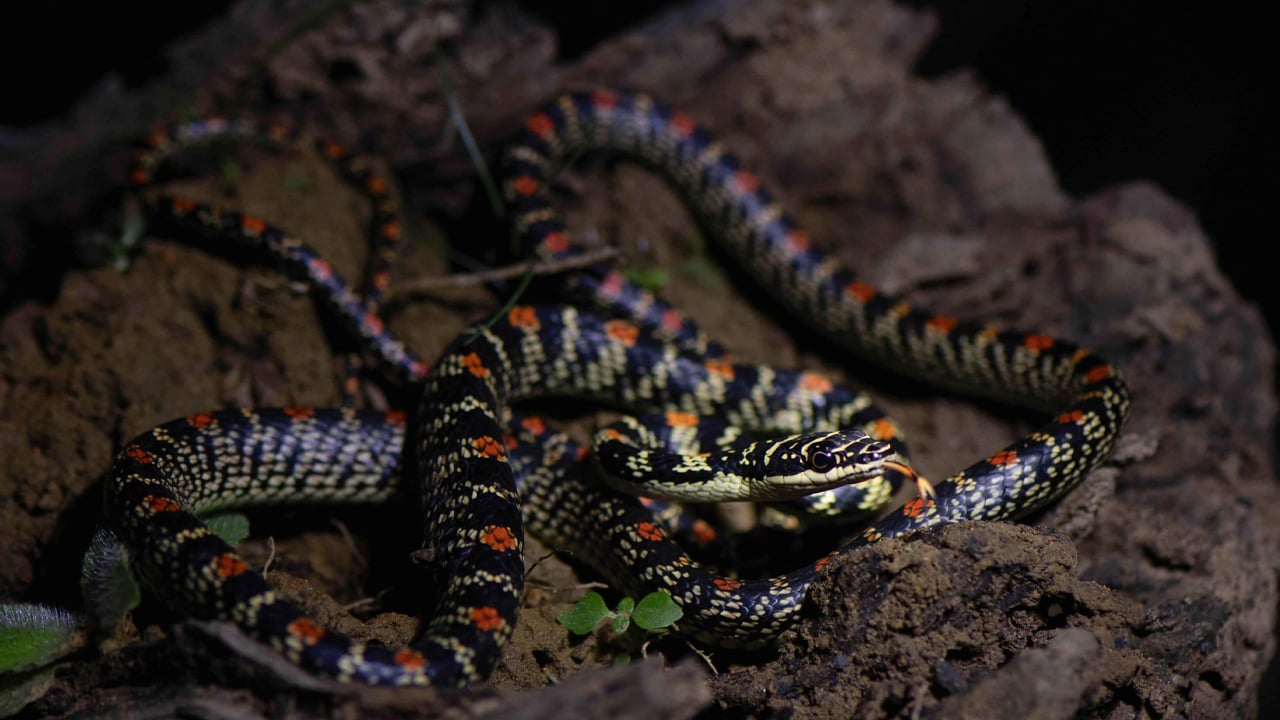
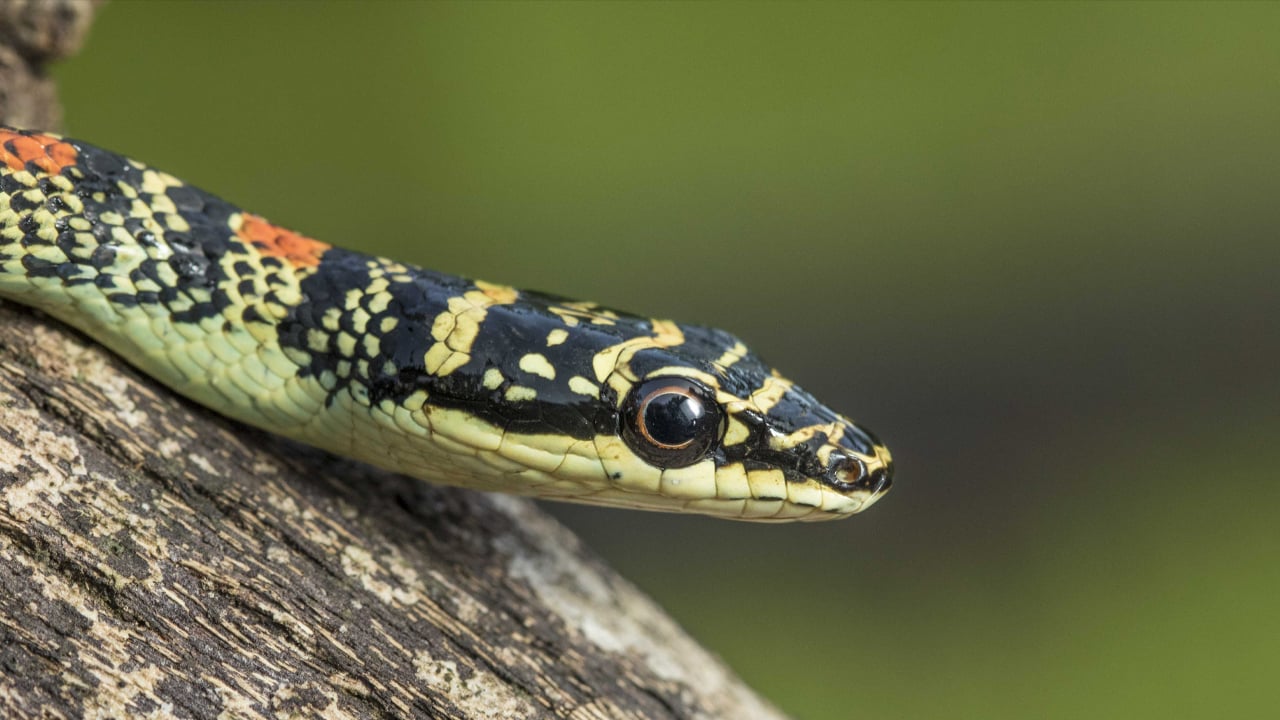
Adults typically reach between 1.2 and 2 metres in length, with a body that is noticeably slender and slightly compressed from side to side — an adaptation that becomes critical during a glide. The dorsal scales are arranged in a mosaic of bright yellow or greenish-yellow scales edged in black, producing an irregular banded pattern that breaks up the snake's outline against dappled canopy light. The underside is paler, often cream or light yellow.
The head is small and only slightly wider than the neck, with large, forward-facing eyes that give the snake good depth perception — useful for judging distance before a leap. The tail is long and tapers to a fine point; while not strictly prehensile in the manner of a chameleon's tail, it provides counterbalance during climbing and gliding. The scales along the ventral surface have keeled edges that help the snake grip bark as it ascends vertical trunks.
How does the Ornate Flying Snake glide?
The glide mechanism is genuinely unusual among vertebrates. When the snake launches itself from a branch, it spreads its ribs laterally and simultaneously sucks in its abdomen, transforming the cross-section of the body from roughly circular to a concave, ribbon-like shape. This creates a wing-like surface along the entire length of the animal. The result is a controlled, S-shaped undulation through the air rather than a straight ballistic fall.
Recorded glide distances in research settings have exceeded 10 metres horizontally, and the snake can change direction mid-air by adjusting the amplitude of its lateral undulations. It loses relatively little altitude per metre of horizontal distance — making it, gram for gram, a more efficient glider than many specialised gliding lizards. The behaviour is used primarily to move between trees when the canopy is too broken to cross by climbing, and to escape aerial or arboreal predators quickly.
Where does the Ornate Flying Snake live in Sri Lanka?
In Sri Lanka, Chrysopelea ornata occurs across the lowland wet zone and into the intermediate zone, favouring areas with dense canopy cover, abundant vines, and a reliable water source nearby. The Sinharaja Forest Reserve — a UNESCO World Heritage Site and the island's largest intact lowland rainforest — is among the most suitable habitats on the island, though sightings remain infrequent due to the snake's strictly arboreal habits and tendency to remain high in the canopy.
The species also turns up in home gardens and plantation edges adjacent to forests in Galle, Ratnapura, and Kalutara districts, particularly where large mature trees are present. It is occasionally seen near slow-moving waterways, where it descends to hunt frogs and small fish.
| Characteristic | Detail |
|---|---|
| Scientific name | Chrysopelea ornata |
| Family | Colubridae |
| Adult length | Typically 1.2–2 m |
| Venom | Non-venomous (mildly opisthoglyphous but harmless to humans) |
| Glide range | Up to 10 m or more per launch |
| IUCN status | Least Concern |
| Sri Lanka habitat | Lowland and mid-elevation wet-zone forests |
What does the Ornate Flying Snake eat?
The diet is carnivorous and skewed heavily towards small, agile prey that shares the arboreal environment. Lizards — particularly geckos and skinks — form the core of the diet in most studies. Frogs, small birds, and occasionally small bats or nestlings are also taken. The snake is a pursuit predator rather than an ambush specialist: it actively searches tree hollows, bark crevices, and vine tangles for resting prey.
Prey is seized in the jaws and constricted briefly against a branch or against the snake's own coils before being swallowed head-first. Although Chrysopelea species possess rear-fangs capable of delivering a mild venom, this is effective mainly against small lizard prey and is not considered medically significant for humans.
Is the Ornate Flying Snake dangerous to humans?
No. The species is rear-fanged (opisthoglyphous), meaning any mild venom is delivered by teeth towards the back of the mouth and only when the snake is actively chewing. A human would need to force their finger to the very back of the snake's mouth and hold it there for an extended period to experience any effect — and even then, reactions in the scientific literature are limited to local minor swelling. Treat any wild snake with calm respect, observe from a distance, and the encounter will be entirely safe for both parties.
When and where is the best time to spot one in Sri Lanka?
The Ornate Flying Snake is active year-round rather than seasonally, but sightings increase during warmer, drier periods when snakes bask in the upper canopy in the early morning. Dawn walks through forested trails, scanning the mid-canopy level, give the best odds. Look for the contrasting yellow-and-black pattern against smooth bark or broad leaves — the snake moves slowly when not alarmed, which makes it briefly visible before it disappears into the foliage.
Guided naturalist walks in protected forests offer the most realistic chance of a sighting. Experienced local guides know the microhabitats — particular tree species, stream-side fig trees, and vine-tangled edges — where the snake tends to concentrate. Bring binoculars; the snake is almost always discovered 4–10 metres above the ground.
How does the Ornate Flying Snake fit into Sri Lanka's broader reptile diversity?
Sri Lanka punches well above its weight in herpetological diversity for an island of its size. The country hosts over 100 snake species, of which a significant proportion are endemic or near-endemic. Chrysopelea ornata is not endemic — it ranges widely through South and Southeast Asia — but its presence in Sri Lanka is an indicator of intact, mature forest, making it a useful umbrella species for forest conservation arguments. Researchers documenting Sri Lanka's reptile fauna have produced authoritative field guides that remain essential reading for anyone serious about identification in the field.
The island's protected areas, from the wet-zone reserves of the south-west to the dry-zone parks, shelter a remarkable breadth of colubrid, viperid, and elapid species alongside C. ornata. A structured wildlife itinerary combining multiple habitat types will expose a visitor to a far wider reptile community than any single forest walk can offer.