Lakpura
Lakpura®

Dambulla Cave Temple

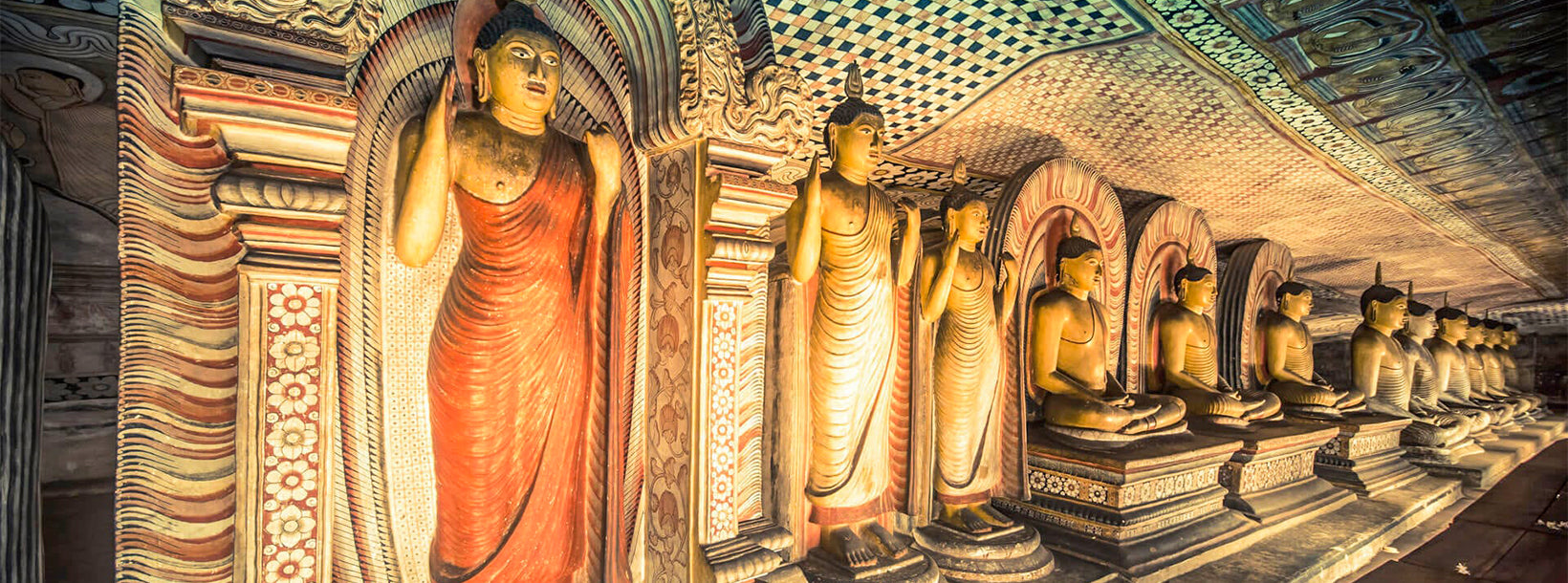
Der Dambulla Cave Temple — offiziell als Golden Temple of Dambulla bekannt und seit 1991 UNESCO-Weltkulturerbe — ist der größte und am besten erhaltene Höhlentempelkomplex Sri Lankas. In einen Granitinselberg gehauen, der sich rund 160 Meter über die umliegende Ebene erhebt, beherbergen seine fünf Heiligtümer mehr als 150 Buddha-Statuen, kunstvolle Deckengemälde auf einer Fläche von rund 2.100 Quadratmetern sowie Inschriften aus dem ersten Jahrhundert v. Chr. Für alle, die den Bogen der singhalesisch-buddhistischen Zivilisation entlang des Kulturellen Dreiecks nachverfolgen, ist dies ein unverzichtbarer Halt.

Geschichte und Bedeutung

Die Höhlen von Dambullugala — dem singhalesischen Namen des Felsens — waren von buddhistischen Mönchen bewohnt, lange bevor irgendeine königliche Schirmherrschaft bestand. Brahmi-Inschriften, die unmittelbar unterhalb des Traufvorsprungs der zentralen Höhle gefunden wurden und paläografisch auf das erste Jahrhundert v. Chr. datiert sind, belegen Schenkungen aus der Regierungszeit von König Vattagamani Abhaya (89–77 v. Chr.). Laut der Mahavamsa, der wichtigsten Pali-Chronik Sri Lankas, suchte Vattagamani Abhaya während seines Exils aus Anuradhapura — nach einer brahmanischen Invasion — in Dambulla Zuflucht. Als er den Thron zurückerobert hatte, ließ er die Höhlen in einen offiziellen Felsentempel umwandeln — die älteste heute noch sichtbare Bauschicht.

Nachfolgende Herrscher bauten das, was Vattagamani Abhaya begonnen hatte, erheblich aus. König Nissanka Malla von Polonnaruwa vergoldete die Innenräume im zwölften Jahrhundert n. Chr. und gab dem Komplex seinen alternativen Namen Ran Giri (Goldener Felsen). Weitere Renovierungen und die Hinzufügung neuer Statuen setzten sich durch die Kandyanische Periode fort; die jüngste bedeutende Malerunde wurde im achtzehnten Jahrhundert abgeschlossen. Das Ergebnis ist ein vielschichtiges Palimpsest: antike felsgeschnittene Nischen, mittelalterliche Ergänzungen und spätere Verzierungen im Kandyanischen Stil koexistieren innerhalb derselben Mauern.

Die Stätte ist in der Mahavamsa als Jumbukola Vihara verzeichnet und ist nach wie vor ein aktiver Ort des Gottesdienstes. Mönche wohnen noch immer im Kloster am Fuß des Felsens, und die morgendliche Puja wird täglich in den Höhlen abgehalten — eine Erinnerung daran, dass dies eine lebendige religiöse Stätte ist und kein bloßes Museum.

Die fünf Höhlen: Was Sie erwartet

Die fünf Heiligtümer sind von West nach Ost nummeriert und unterscheiden sich erheblich in Größe, künstlerischer Dichte und Atmosphäre. Die meisten Besucher verbringen zwischen fünfzehn und dreißig Minuten pro Höhle.

Höhle I — Devaraja Viharaya (Tempel des göttlichen Königs)

Die kleinste der fünf und die älteste in ihrem Ursprung: Höhle I enthält einen einzigen kolossalen liegenden Buddha, der aus dem lebenden Felsen gehauen wurde und etwa 15 Meter lang ist. Die Figur stellt das Parinirvana dar — das Eingehen des Buddha in das endgültige Nirwana —, und Ananda, sein treuer Begleiter, steht zu seinen Füßen. Die Decke ist bemalt, wenn auch weniger aufwendig als in den späteren Höhlen. Das Schuhwerk wird vor dem Betreten der Heiligtümer abgelegt; ein Schuhständer befindet sich am Eingang der Terrasse.

Höhle II — Maharaja Viharaya (Tempel der großen Könige)

Das größte und meistbesuchte Heiligtum mit einer Grundfläche von rund 2.200 Quadratmetern. Ein sitzender Buddha unter einem vergoldeten Baldachin dominiert die Mitte, flankiert von Statuen von Vishnu und Saman — ein eindrucksvolles Beispiel der synkretistischen Tradition, in der hinduistische Gottheiten als Beschützer des Dhamma aufgenommen wurden. Decke und Wände sind vollständig mit Gemälden bedeckt, die Jataka-Erzählungen (frühere Leben des Buddha), Szenen aus dem Leben von Vattagamani Abhaya und sich wiederholende Buddha-Figuren darstellen. Durch die Felsdecke sickert eine natürliche Quelle in einen kleinen goldenen Topf; dieser leert sich selbst während Dürreperioden nie vollständig und gilt als heilig.

Höhle III — Maha Alut Viharaya (Neuer großer Tempel)

Im Auftrag von König Kirti Sri Rajasinha von Kandy im achtzehnten Jahrhundert errichtet, ist diese Höhle in ihrer Farbpalette merklich heller als Höhle II. Etwa fünfzig Buddha-Statuen sind in Meditationshaltungen um eine zentrale liegende Figur angeordnet. Die Deckengemälde folgen hier einem systematischeren Raster sitzender Buddhas als die Erzählbilder in Höhle II.

Höhle IV — Pachima Viharaya (Westlicher Tempel)

Ein kleineres Heiligtum mit einer Dagoba (Stupa), die einem Bericht zufolge einst Juwelen der Königin Somawathie enthielt. Die Stupa wurde vor Jahrhunderten von Schatzsuchern aufgebrochen; sie steht nun restauriert, aber leer. Zehn sitzende Buddha-Statuen säumen die Wände.

Höhle V — Devana Alut Viharaya (Zweiter neuer Tempel)

Die zuletzt umgestaltete Höhle, die ursprünglich als Lagerraum diente. Sie enthält einen großen liegenden Buddha sowie Statuen von Vishnu und mehrere Bodhisattva-Figuren und ist im Allgemeinen ruhiger als die Höhlen I bis III. Die Bemalung ist weniger ausgefeilt, bietet jedoch einen nützlichen Kontrast, der veranschaulicht, wie sich künstlerische Konventionen im Laufe der Zeit verändert haben.

Besuchshinweise

Lage und Anreise

Dambulla liegt an der A9-Fernstraße, etwa 148 km nördlich von Colombo und 72 km nördlich von Kandy. Der Eingang zum Felsentempel befindet sich am östlichen Rand der Stadt Dambulla und ist von der Hauptstraße aus klar ausgeschildert.

  • Mit dem Bus: Häufige Überlandbusse verbinden Colombo (Terminal Bastian Mawatha) in drei bis vier Stunden mit Dambulla; der Fahrpreis beträgt etwa LKR 300–400. Von Kandy fahren Busse entlang der A9 und benötigen neunzig Minuten bis zwei Stunden, bei Kosten von rund LKR 150–200. Aussteigen am Busbahnhof Dambulla, von dort ist der Tempelparkplatz etwa zehn Minuten per Tuk-Tuk entfernt.
  • Mit dem Zug: Es gibt keine direkte Bahnverbindung. Der nächstgelegene geeignete Bahnhof ist Habarana (28 km östlich), der an die Strecke Colombo–Trincomalee angeschlossen ist; von dort verkehren Busse und Tuk-Tuks nach Dambulla.
  • Mit Mietfahrzeug oder Selbstfahrer: Die flexibelste Option, um die Stätte mit Sigiriya (etwa 19 km nordöstlich) zu kombinieren. Die Fahrt von Colombo nach Dambulla über den E01-Expressway bis Kurunegala und dann die A6 dauert im Auto etwa zweieinhalb Stunden.
  • Von Habarana aus: Habarana dient als beliebter Ausgangspunkt für das Kulturelle Dreieck; die Fahrt nach Dambulla dauert auf der A11 etwa dreißig Minuten.

Der Aufstieg

Vom Parkplatz auf Straßenniveau aus passieren Besucher den modernen Golden Temple-Komplex (der eine große sitzende Buddha-Statue und ein sehenswertes Museum beherbergt) und steigen dann eine Steintreppe mit etwa 350 Stufen hinauf, um die Höhlenterrasse zu erreichen. Der Aufstieg dauert je nach Fitness und Hitze fünfzehn bis fünfundzwanzig Minuten, mit Abschnitten auf blankem Fels und abgenutzten Stufen, die nach Regen rutschig sein können. Entlang der meisten Wegabschnitte sind Handläufe vorhanden. Oben bietet die erhöhte Terrasse einen Panoramablick über die Dambulla-Ebene in Richtung Sigiriya und an klaren Tagen bis hin zum Knuckles Range.

Öffnungszeiten und Eintrittskarten

Die Höhlen sind täglich von etwa 07:00 bis 19:00 Uhr geöffnet, wobei das zuverlässigste Besuchszeitfenster 07:00 bis 17:30 Uhr ist. Die Stätte schließt an Feiertagen nicht, ist jedoch an Poya-Tagen (Vollmond) sowie zu Sinhala/Tamil Neujahr erheblich stärker besucht.

BesuchertypUngefähre Kosten (USD)Ungefähre Kosten (LKR)
Ausländische ErwachseneUSD 15LKR 5.000–5.500
SAARC-StaatsangehörigeErmäßigter PreisLKR 2.500
Einheimische (Sri Lanka)Symbolischer BetragLKR 100–200
Kinder unter 12 Jahren (Ausland)USD 7–8LKR 2.500

Eintrittskarten werden am Schalter in der Nähe des Parkplatzes erworben, nicht am Höhleneingang. Das Ticket umfasst den Zugang zu allen fünf Höhlen sowie zum Golden Temple-Museum weiter unten. Wechselkursschwankungen lassen die LKR-Äquivalente variieren; bitte aktuelle Preise vor Ort bestätigen lassen. Für das normale Fotografieren in den Höhlen wird kein zusätzliches Entgelt erhoben, allerdings können der Einsatz eines Stativs oder professioneller Ausrüstung Anfragen nach zusätzlichen Gebühren nach sich ziehen.

Beste Tages- und Jahreszeit

Der frühe Morgen — Ankunft bei der Öffnung, etwa zwischen 07:00 und 08:30 Uhr — ist klar zu bevorzugen. Ab dem späten Vormittag treffen Reisegruppen aus Sigiriya, Kandy und Habarana ein, und die Höhlen, insbesondere Höhle II, werden unangenehm überfüllt. Das weiche, flach einfallende Licht erleichtert außerdem das Fotografieren der Deckengemälde ohne Blitz (der sowohl aus Respekt vor dem Kunstwerk als auch vor den Gläubigen auf ein Minimum reduziert werden sollte).

MonatWetterBesucherandrangHinweise
Jan–MrzTrocken, 27–33 °CHoch (Hochsaison)Beste Gesamtbedingungen; Unterkunft frühzeitig buchen
Apr–MaiHeiß, gelegentliche RegenfälleMittel–hochSinhala-Neujahr (April) zieht einheimische Besucher an
Jun–AugTrocken im Kulturellen DreieckHochEuropäische Sommerferien; Kombination mit Sigiriya empfohlen
Sep–OktÜbergangszeit; kurze SchauerMittelGutes Preis-Leistungs-Verhältnis, weniger Andrang
Nov–DezNordostmonsun möglichMittel–niedrigStufen bei Nässe rutschig; leichte Regenjacke empfehlenswert

Was Sie mitbringen sollten und Verhaltensregeln

  • Schuhwerk: Wird auf der Höhlenterrasse abgelegt, nicht am Fuß des Felsens. Die Steinterrasse und der Weg zu den Höhlen werden ab dem späten Vormittag extrem heiß; dünne Socken sind hilfreich. Eine Schuhbeutel ist praktisch, wenn Sie Ihr Schuhwerk nicht am Ständer lassen möchten.
  • Kleidung: Schultern und Knie müssen bedeckt sein. Sarongs sind an der Basis leihweise erhältlich, doch ein eigenes leichtes Abdecktuch mitzubringen ist praktischer.
  • Wasser: Tragen Sie mindestens einen Liter pro Person, bevor Sie aufsteigen. Am Fuß des Felsens gibt es Händler; oben sind die Möglichkeiten eingeschränkter.
  • Taschenlampe oder Handylicht: In den hinteren Bereichen der Höhlen I und V, die wenig natürliches Licht erhalten, sehr hilfreich.
  • Verhalten: Lautes Reden in der Nähe einer laufenden Puja, das Berühren von Statuen oder das Drehen des Rückens zum Buddha für Selfies ist respektlos. Morgenbesuche fallen oft mit Ritualen der Mönche zusammen; treten Sie ruhig zur Seite.
  • Affen: Hutaffen (Toque macaques) halten sich häufig auf der Treppe und der Terrasse auf. Lebensmittel verdeckt halten und Taschen geschlossen halten; die Tiere sind dreist und gelegentlich aggressiv.

Barrierefreiheit

Der Felsentempel ist für Besucher mit erheblichen Mobilitätseinschränkungen nicht zugänglich. Die Treppe ist steil, uneben und verfügt über keine Rampen; auf blankem Fels ist sicherer Tritt erforderlich. Der Golden Temple-Komplex auf Straßenniveau, einschließlich des Museums, ist weitgehend eben und mit dem Rollstuhl zugänglich. Besucher, die den Aufstieg nicht bewältigen können, können sich durch die Artefakte und Dokumentationen des Museums dennoch sinnvoll mit dem Kontext der Stätte auseinandersetzen.

Sehenswürdigkeiten in der Nähe

Die Lage Dambullas im Kulturellen Dreieck macht es naheliegend, mehrere bedeutende Stätten in einer einzigen Rundtour zu kombinieren.

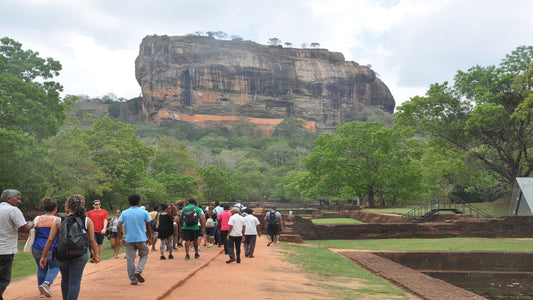
  • Sigiriya — die Felsenfestung aus dem 5. Jahrhundert mit ihren berühmten Fresken und der Spiegelwand — liegt 19 km nordöstlich und ist die häufigste Kombination für einen Tagesausflug. Planen Sie für Sigiriya einen vollen separaten halben Tag ein; beide Stätten an einem Vormittag zu besuchen, ist zu gehetzt.
  • Pidurangala-Felsen, unmittelbar nördlich von Sigiriya, bietet einen weniger frequentierten Aufstieg mit Blick zurück auf das Profil von Sigiriya. Er ist etwa 20 km von Dambulla entfernt.
  • Polonnaruwa, die mittelalterliche Hauptstadt mit ihren hervorragenden Bildhauerarbeiten, liegt 66 km östlich und eignet sich als ganztägiger Ausflug von einer Basis in Dambulla oder Habarana.
  • Anuradhapura, die antike Hauptstadt mit ihren von Kilometern weit sichtbaren Dagobas, befindet sich etwa 65 km nordwestlich an der A9.
  • Habarana, 28 km östlich, ist eine praktische Übernachtungsbasis mit Safarizugang zu den Nationalparks Minneriya und Kaudulla für Elefantenbeobachtungen.

Ehrliche Hinweise: Menschenmassen, Abzocke und was Sie auslassen können

Aufdringliche Anbieter am Parkplatz: Mehrere Personen in der Nähe des unteren Eingangs werden anbieten, als inoffizielle Führer zu fungieren, oder behaupten, der Tempel sei geschlossen, und Besucher zu einer kostenpflichtigen Alternative in der Nähe lotsen. Die Höhlen sind während der veröffentlichten Öffnungszeiten zugänglich; informieren Sie sich vorab unabhängig über die Öffnungszeiten und gehen Sie solchen Versuchen höflich, aber bestimmt aus dem Weg.

Der Golden Temple (unterer Komplex): Die große moderne sitzende Buddha-Statue und das Museum auf Straßenniveau sind im Ticketpreis inbegriffen. Die Sammlung des Museums mit Artefakten, Tempelmodellen und historischen Fotografien ist wirklich informativ und vor dem Aufstieg dreißig Minuten wert. Die äußere goldene Buddha-Statue ist in erster Linie von fotografischem Interesse.

Timing der Reisegruppen: Pauschalreisen aus Kandy und Colombo treffen typischerweise zwischen 09:30 und 12:00 Uhr ein. Wer vor Ort übernachtet und um 07:00 Uhr am Kassenhäuschen sein kann, wird einen deutlichen Unterschied im Erleben feststellen. Die Höhlen um 07:15 Uhr — kühl, ruhig, mit gerade einfallendem Tageslicht — sind kaum mit denselben Räumen um 11:00 Uhr zu vergleichen.

Fotografie: Blitzfotografie schädigt die Wandmalereien im Laufe der Zeit und ist in den Höhlen offiziell nicht erwünscht. Viele Besucher ignorieren dies; widerstehen Sie dem Impuls. Mit modernen Kameras und hohen ISO-Einstellungen lassen sich die Innenräume auch ohne Blitz gut aufnehmen.

Der Aufstieg in der Mittagshitze: Zwischen 11:00 und 14:00 Uhr von März bis September wird der freie Granit unter den Füßen und über dem Kopf zu einer echten Belastung. Wer am späten Vormittag ankommt, sollte auf der Terrasse im Schatten rasten, bevor er wieder absteigt.

The caves, one by one

A room-by-room account of the five shrines, their statuary and their paintings.

The Caves and Paintings of Dambulla (General)

There are five caves (shrine rooms) in Dambulla temple. All of these caves are full of statues of Buddha and various personages of the Buddhist Order or History. There are 150 Buddha images in these caves. Cave No. 5 (the last in order) has no historical value as it was done in the second decade of this century. All of the other caves contain statues and paintings representing various epochs of Sinhalese sculpture and painting. The early paintings of Dambulla are believed by some to belong to the 8th century A. C. But this cannot be proved at all because of overpainting. Nevertheless, this place is a mine of decorative designs, the patterns of which resemble those of Sigiriya. To a student of the history of Buddhism, a careful study of the paintings of Dambulla provides a good deal of source material.

It is generally accepted that the classical school of Sinhalese painting ceased to exist after the fall of the Polonnaruve kingdom at the end of the twelfth century. There are no extant examples of this style after the 13th century. It is from the 17th and 18th centuries that we have, once again, examples of the work of a school of indigenous painters.

This new school does not seem to have had its roots in the artistic traditions which created the masterpieces of Sigiriya and Polonnaruva.

Its style is purely two dimensional; in compositions it does not exhibit the skill of the masters of earlier epochs. In its conventions, particularly in the decorative designs and in the representation of trees and creepers, it does not seem to have any connection with the earlier art of the Island.

This School seems to have been influenced by the Schools of painting which flourished in the Deccan (Southern India) under the patronage of Muslim rulers.The frescoes which adorn the cave of Dambulla represent this new school of Sinhalese painting, Inside the cases of this temple the whole surface of the rock is completely covered with paintings, The earliest phase is believed to be on Cave No. 2, and these consist of decorative designs as surmised above, it is not possible to identify any one of these as actually belonging to a very much earlier period. Nevertheless, the designs themselves show close affinity to Sigiriya ceiling ornamentation. There may have been old painting at this place but perhaps these are lost or have been painted over later. It can be surmised that the designs of the decorative patterns, embody ancient ideas and may even be considered as continuing tradition of the designs at Sigiriya. But as the Dambullu Tudapata referred to above clearly reveals cave No. 1, 2 and 4 of Dambulla were painted by the Kandyan artists of the seventeenth century by the order of king Senarat (1604-1635 A.C). In the reign of Kirti Sri Rajasinha, the paintings of Dambulla were renovated and over painted again. Paintings in Cave No. 4 clearly represent the new school of Sinhalese painting which flourished in the Kandyan provinces after the 17th century.

Cave No. 1 (Deva Raja Viharaya)

The visitor to the Temple of Dambulla through the gateway first comes across Cave No. l, called Dev-Raja-viharaya (temple of the King of Gods). It is believed that this cave is so-called, because the god Sakka (King of Gods) gave the finishing touches to the principal image of this cave. This image, depicting the parinibbana (the last moment) of the Buddha in the typical style is about forty-seven feet in length. It is carved almost in the round from the natural rock to which it still remains joined all along from behind, and is well preserved. The face is wooden in appearance, shapeless and dull. The usual long robe covers the body up to the ankle leaving the right shoulder and breast bare. The shape of the face is round and not artistically sculptured. The eyes are merely cut, the forehead is narrow and the ear is unshapely. The hair is schematically shown by a series of dots. The fine-textured robe is depicted in a series of closely grooved ribs which are arranged close together in twos. The rest of the body is well executed in shapely proportions except for the stiffness of the feet and right leg.

The cave contains another five images of which the standing one at the southern end of the. The room is supposed to be that of Arhat Ananda, the immediate disciple of Buddha, weeping at the death of his master.

At the northern corner of the cave, opposite the face of the principal image, there is a statue, of Visnu, (some scholars believe that this is of Upulvan, one of the four guardian deities of Sri Lanka), which is a well-executed.

The room containing this is always closed to the public for reasons unknown.

Although there are wall and ceiling paintings in this cave, these can hardly be seen as a result of damage done by the incense burnt by devotees.

Cave No. 2 (Maha Raja Viharaya)

The next cave into which the visitor centers is by far the largest and the most impressive one amongst the cares in this place. The portal by which one enters is in front; is a Lofty archway, guarded on each side by figures of stone; intended to represent Janitors. This cave is called Maha Raja Viltaraya (the temple of the Great King), because. According to the common belief, its founder was king Vattagamani Abhaya, who personally assisted in its formation.

The cave is painted all over in brilliant colors, and every part is in good repair. It is one hundred and seventy-two feet in length, seventy-five in breadth, and twenty-one feet in height near the. Front wall. The height from this place gradually decreases in an arc towards the floor on the interior side. This cave contains fifty-three images. The majority of the statues are of Buddha in different attitudes. Many of them are larger, but none much smaller than life.

The visitor who enters by the door at the northern corner of this cave first comes across a figure of the standing Buddha under a neatly executed Makata Torana, both sculptured out of the natural rock. These are the principal images of the shrine room. This image is in Abhaya Mudra. The figure is beautiful sculptured will sturdy features and massive limbs. No attempt has been made by the artist to portray physical details in true proportion. The flowing folds of the Robe are shown by grooves. The right shoulder and arm are bare. The folds are gathered at the left shoulder. The head is covered with a series of lump planted regularly with a crest surmounting all of them. The eyes of the images are carver out with lids shown open. The lips are thick. So is the nose. There is a stiffness of the limbs and a wooden rigidity of the body. The image is standing on a stone lotus pedestal circular in shape. This lotus is neither well carved nor elaborate.

To the right and left of this there are two standing figures respectively of two deities Natha and Maitreya, who, according to Buddhist belief, would become Buddhas in the future.

At the right of the entrance is a handsome stupa, about eighteen feet high, the broad circular pedestal of which is ornamented with four figures of Buddha, each facing a different quarter, each seated on the coil of a Cobra de Capello, and shaded by its expanded hood.

The rest of the Buddha images in this cave are arranged in a row at a little distance from the sides and inner walk of the tile room, but not grouped. None is placed near the outer wall, except the one in a recumbent posture, which is quite new. At the northern end of the cave, figures are arranged in a double row. Towards the eastern end of the shrine room, there is a perpetual dripping of water that filters through the roof from hollows on the top of the rock, which are supplied by rain. The drops of water are caught in a vessel placed in a small square enclosure sunk in the floor and used exclusively for sacred purposes.

The whole of the interior of this cave, whether rock or wall, is painted with brilliant colors of which yellow predominates. The ceiling nearest the entrance is used mostly to depict the life of the Buddha, before and after his Enlightenment. In this part, the artist has also attempted to paint the earlier births of the Buddha. A visitor to the shrine room may want to have a description of at least some of the paintings. The principal paintings of this part are:

1.Prince Siddhartha, the Buddha-to-be, going out of his palace to exhibit his skills in arms. 2.Prince Siddhartha, exhibiting his skill in archery. 3.Prince Siddhartha, leaving home, in quest of Truth. 4.Monsters in the army of Mara, the evil one, attacking the Buddha. 5.Mara, the evil one, being thrown from his elephant after being vanquished by the Buddha.

At the eastern extremity of this cave there is a little recess behind the row of Buddha statues, formed by a huge projecting rock, the walls of which are covered with paint. At the entrance to this recess, there is a standing statue of a king, identified as Nissankamalla who undertook extensive repairs to the temple. This part of the cave seems to have been used by the artist to illustrate the history of the Island. The frescoes, of this part, begin with the earliest and most fabulous period of the history of the country. Among these frescoes, the exploits or Vijaya, the first historical ruler of the country, who is said to have come from India, are conspicuous and cover a great space. The artist seems to have been interested in illustrating the voyage of this hero, which is represented by a boat surrounded by sea-monsters.

The next work of interest is the dedication of the island to the Buddha after the arrival of the Bo-tree and the sacred relics. This is figured by king Devanampiyatissa (250 210 B. C), who ruled the country on the eve of the introduction of Buddhism to Sri Lanka, guiding a plow drawn by a pair of Elephants, attended by monks headed by Arhat Mahinda who introduced Buddhism to Sri Lanka.

Another painting here represents the building of the great city's and other important religious buildings at Anuradhapura.

The most successful of the historical paintings in this part is the one which represents the single combat between Dutta Gamani, The greatest hero of the Sinhalese, and Elara, the Indian usurper who ruled the northern part of the country for 44 years. The drawing of this picture is by no means deficient in spirit and is considerably more correct in the proportions than any other of the historical compartments. The Indian king is represented as falling from his elephant, transfixed by the javelin of his enemy.

At the northern corner of the recess there are two standing statues carved out of wood. The common belief is that these figures represent deities. One is now identified in Sri Lanka with Visnu, the famous Hindu god, and images of this from, of Visnu, are seen side by side with those of the Buddha in a large number of temples on the Island. The other, namely Sumana (or Saman) is supposed to be one of the four guardian deities of the country. According to The Great Chronicle, The Sanrantakuta, i. e, Adam’s Peak, where the Buddha was supposed to have left his footprint, is thus called because the Peak was regarded as the abode of devaraja (king of god’s) called Sumana. Both of these figures are well executed and painted, but are now in a decaying condition.

At the northern corner of the cave there are four Buddha images in sitting posture, facing the main hall. These figures are supposed to be those of Kakusanda, Konagama, and Kassapa, the predecessors of Go Tama, The Buddha, who is represented by the last statue.

To the right of the northern entrance to this cave, there is a figure in standing attitude facing the principal image of the tile shrine room, which is supposed to represent king Vattagamani Abhaya, the earliest benefactor of Dambulla. This is the crudest figure in every respect. And its dress is the simplest and least ornamented.

Cave No. 3 (Maha Alut Viharaya)

This Cave, called Maha Alut Viharaya (The Great New Temple), is separated from Cave No.2 by a wall of masonry. This is said to have been used as a storeroom before the eighteenth century.

The principal entrance to this cave, which is second in size only to cave No.2, is by a door. This was mode a shrine room by Kirti Sri Rajasinha, who reformed the Buddhist Church in the eighteenth century. Most of the new paintings and renovations of the Temple are attributed to this last great benefactor of Dambulla. At the left of the entrance to this cave, there is a well-executed figure of this king, in his robes of state, which resemble those worn by the kings of the Nayakkar dynasty, who ruled the country until the British occupation in 1815.

The cave is about ninety feet long, eighty-one wide, and is a shelving rock whose height is about thirty-six feet. The immense surface of the rock of this cave is also painted of the richest colors. These frescoes depict various and numerous events of Buddhists, some representing the life of the Enlightened One, and score the history of Buddhism. The artistic tradition of this cave is that of the Kandyan period. This cave contains fifty figures of the Buddha.

The principal image, facing the entrance, is a standing one under a Torana. The images and the Torana are carved out of the natural rock.

One statue of Buddha in this cave in the recumbent posture, its head on a pillow, resting on its right hand, is quite similar to that in Cave No. 1. This is about thirty feet long and well proportioned, the face is handsome, and its expression of countenance remarkably peaceful and benignant. Seven other statues of Buddha, in the standing attitude, are about ten feet high, and all the rest are life-size or a little smaller. Most of them are colored bright yellow; three have red robes. To a student of Kandyan art and sculpture, this cave is, no doubt, a mine of raw material.

Cave No. 4 (Paschima Viharaya)

This cave is called the Paschima Viharaya or the Western Temple. It is about fifty-four feet long and twenty-seven wide; and its shelving roof, which dips rapidly inwards, is about twenty-seven feet high.

This cave contains ten figures of the Buddha. The principal image which is under a torana is of the same size as the other statues. This is a very beautiful figure of the Buddha seated in the dhyana mudra (posture of meditation) hewn of the natural rock that forms the cave itself. The image is in a fine state of preservation and painted in brilliant colors in the Kandyan period. The features of the image are clearly discernible. The ears are long with pierced lobes. The nose, eyes, and lips are well executed, the forehead is somewhat receding. A loosely flowing robe covers the body from shoulder to feet leaving the right shoulder bare. The method of treating the robe is the groove technique. Three grooves mark the neck.

The robes are shown well draped and with loose folds. The hair on the head is treated with dots in rows, rising to a bun-shaped lump on the summit. The other images are in a row starting from the right and the left of the principal image.

These figures are well executed and brilliantly painted, and most of them are large as or larger than life-size. There is a neat stupa (cetiya) called Soma Cetiya at the middle of the cave. The roof and sides of the rock and the front wall are painted of the brightest colors, and decorated with a number of figures, chiefly of Buddha.

Dieses Erlebnis mit Lakpura buchen

Zusammengestellt von unserem lokalen Team. Direktbuchung, sofortige Bestätigung.

Ask Lakpura® Agent