Every cup of Ceylon tea carries the fingerprint of the land it came from. Sri Lanka's tea-growing districts are spread across the central highlands and southern foothills, and the elevation at which a bush grows determines almost everything about the tea it yields — the colour of the liquor, the weight of the flavour, even the time of year when the harvest is at its finest. Understanding these regions is the first step to drinking Ceylon tea with genuine appreciation.
How Does Elevation Shape Ceylon Tea Flavour?
Sri Lanka's Tea Board divides growing zones into three broad bands based on altitude: low-country (up to around 2,000 ft above sea level), mid-country (roughly 2,000–4,000 ft), and high-country (above 4,000 ft). As altitude rises, temperatures drop, the pace of leaf growth slows, and the concentration of flavour compounds increases. Lower regions tend to produce bold, full-bodied teas; high-altitude regions yield more delicate, aromatic cups. Micro-climates — local patterns of rainfall, wind, and mist — add further nuance within each band.
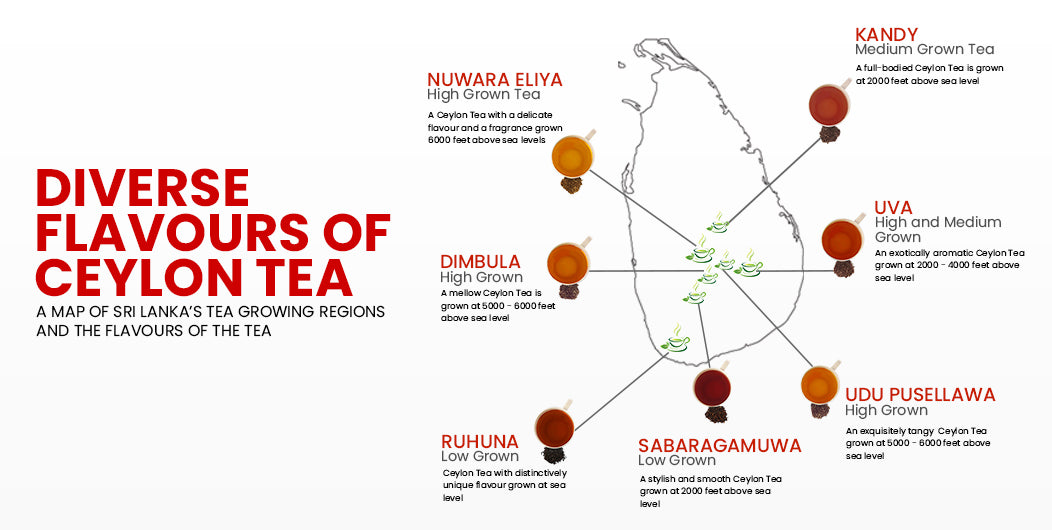
Sri Lanka's Ceylon tea industry spans seven recognised growing regions, each with a distinct character that experienced buyers and blenders identify by taste alone.
What Are the Low-Country Tea Regions?
The two low-country regions, Ruhuna and Sabaragamuwa, sit in the warmer, wetter southern and western foothills. The heat accelerates leaf growth, producing leaves that are generally larger and more robust in the cup.
- Ruhuna — Located in the deep south, Ruhuna estates yield teas with a rich burgundy liquor and a distinctly malty, caramel character. The strong colour makes Ruhuna teas popular for milk tea and chai-style blends. Principal export markets include the Middle East, CIS countries, and the UK.
- Sabaragamuwa — Sitting to the west of the central highlands and close to the Sinharaja Forest Reserve, Sabaragamuwa produces long-leaf teas with a similar bold profile to Ruhuna, though slightly lighter in body. The region is also known for specialty and organic estates.
What Makes Mid-Country Tea Different?
The mid-country zone is anchored by the Kandy district, Sri Lanka's cultural heartland. At elevations between 2,000 and 4,000 ft, the temperature is moderate, and the resulting tea strikes a balance between the muscular body of low-country teas and the refinement found higher up.
- Kandy — Kandy teas brew to a warm copper tone with a full, rounded flavour. They pair well with milk and are popular in Australian and North American markets. If you are visiting the Kandy region, a factory tour through one of the estate roads gives a clear sense of how geography shapes production at this elevation.
Which High-Country Regions Produce the Finest Ceylon Tea?
Above 4,000 ft, the air is cool, the mist frequent, and the leaf growth slow enough to concentrate essential oils and polyphenols that define a tea's character. Sri Lanka has four high-country regions, each with a personality of its own.
- Uva — The eastern highlands around Ella and Badulla are home to one of the world's most celebrated regional teas. Uva is prized for its intense pungency, bright golden liquor, and a clean, brisk finish. A seasonal north-easterly wind called the Cachan dries out the leaf between July and September, concentrating flavour compounds in a way that cannot be replicated elsewhere. Estate owners in Uva have also used the region's unique micro-climate to experiment with white and silver-tip teas.
- Nuwara Eliya — Often called the Champagne of Ceylon teas, Nuwara Eliya sits at the highest elevations of any Sri Lankan tea district. The liquor is pale golden, the aroma floral and delicate, and the taste clean with a gentle astringency. These teas are best enjoyed without milk. The colonial-era Grand Hotel in the town of Nuwara Eliya offers a sense of the era in which this region's reputation was built.
- Dimbula — On the western slopes of the central highlands, Dimbula experiences its best season between January and February, when cold westerly winds sharpen the leaf. Dimbula teas have a bright, medium-bodied character with a reddish-orange liquor and a mildly floral note.
- Uda Pussellawa — Sitting between Nuwara Eliya and Uva, this district produces teas that share characteristics of both neighbours: a rosy liquor, a gentle aroma, and moderate strength. Uda Pussellawa's best teas come during the north-east monsoon season, roughly from January through March.
How Do the Seven Regions Compare at a Glance?
| Region | Altitude Band | Liquor Colour | Flavour Profile | Peak Season |
|---|---|---|---|---|
| Ruhuna | Low-country | Deep burgundy | Malty, caramel, bold | Year-round |
| Sabaragamuwa | Low-country | Dark amber | Full-bodied, robust | Year-round |
| Kandy | Mid-country | Copper | Full, rounded, medium-strong | Year-round |
| Dimbula | High-country | Reddish-orange | Bright, mildly floral | Jan – Feb |
| Uda Pussellawa | High-country | Rosy amber | Aromatic, gentle | Jan – Mar |
| Nuwara Eliya | High-country | Pale gold | Delicate, floral, light | Jan – Mar |
| Uva | High-country | Bright golden | Pungent, brisk, aromatic | Jul – Sep |
What Types of Ceylon Tea Come from These Regions?
While black tea remains the dominant product, the same bushes — primarily Camellia sinensis var. assamica and the smaller-leafed sinensis — are also processed into Ceylon green tea, white tea, and oolong across several high-country estates. The grade of tea (BOPF, BOP, Pekoe, Flowery, etc.) refers to the particle size of the processed leaf rather than the quality, though single-estate teas at higher grades tend to command premium prices. The 2008 Pettiagalla estate auction — documented in this record-price article — illustrates how provenance and grade together can drive extraordinary value at auction.
Can You Visit Ceylon Tea Estates and Factories?
Yes, and doing so adds considerable depth to any Sri Lanka itinerary. Most tea-producing districts have working factories that welcome visitors during manufacturing hours. Bluefield Tea Gardens near Nuwara Eliya is one of the more accessible estates for guided factory tours. The central highlands around Horton Plains make it straightforward to combine high-country trekking with a tea estate stop. For travellers looking for a fully immersive experience, a dedicated tea journey through multiple regions — staying at plantation bungalows and following the harvest cycle — remains one of Sri Lanka's most distinctive travel formats.
When Is the Best Time to Buy Tea Directly from Sri Lanka?
Because each region has a distinct peak season, there is technically always a tea in its prime somewhere in Sri Lanka. Travellers visiting between January and March catch the best of the western high-country regions — Dimbula, Uda Pussellawa, and Nuwara Eliya. Those visiting between July and September will find Uva teas at their most intense. Low-country and mid-country estates produce year-round, so Ruhuna, Sabaragamuwa, and Kandy teas are reliably available whenever you travel. Buying directly from a registered estate or a reputable Sri Lankan exporter ensures you receive tea that is traceable to a single district and grade.