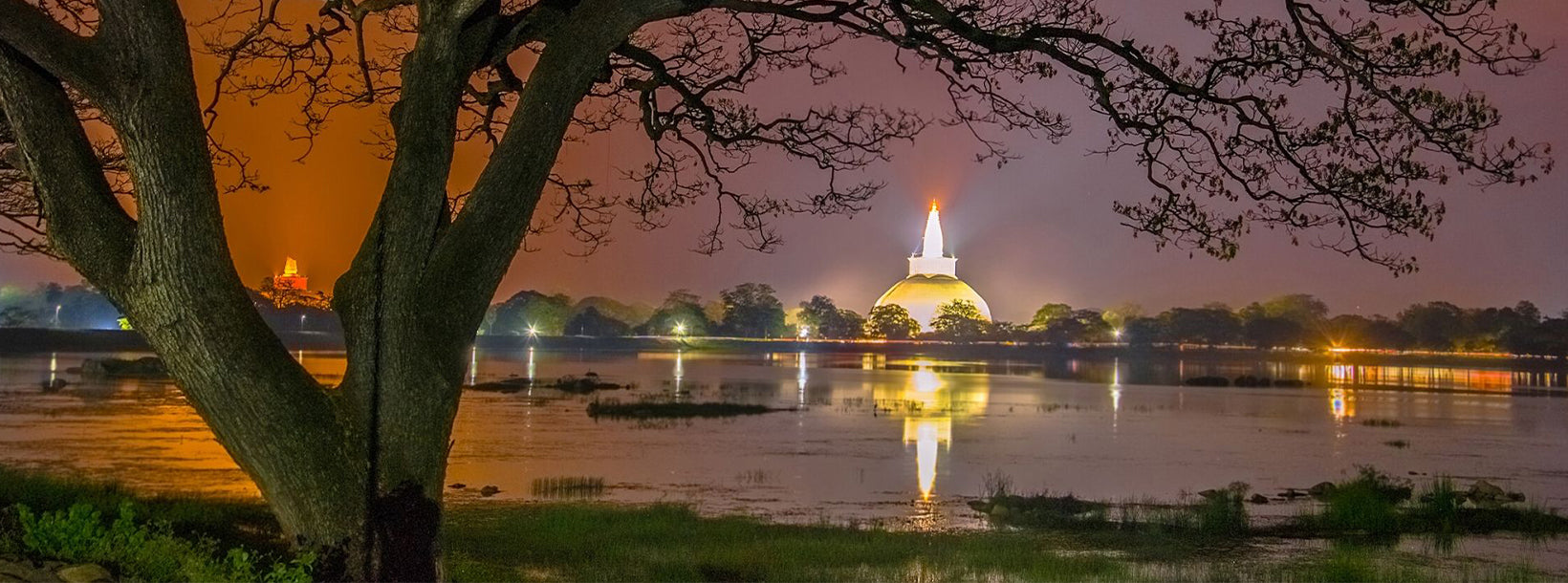
Sri Lanka holds one of the oldest continuously practised Buddhist traditions on earth. While Buddhism eventually faded from its Indian homeland, the island preserved and codified the Theravada lineage with extraordinary care — producing the Pali Canon, ordaining thousands of monks across centuries of political upheaval, and sustaining a monastic culture that still shapes daily life for roughly 70 percent of the population today. Understanding this tradition is essential to understanding Sri Lanka itself.
How did Buddhism first arrive in Sri Lanka?
According to the Mahavamsa and Dipavamsa chronicles, Buddhism reached Sri Lanka in the 3rd century BCE when Mahinda Thera, son of the Indian Emperor Ashoka, led a mission to the island during the reign of King Devanampiya Tissa. The king was residing in Anuradhapura at the time, and his conversion set in motion a transformation that would define the island's character for millennia.
Shortly after Mahinda's arrival, a sapling of the sacred Bodhi Tree — the fig tree under which the Buddha attained enlightenment in Bodh Gaya — was brought to Anuradhapura by Bhikkhuni Sanghamitta, Mahinda's sister. Planted in the Mahamegha Gardens, the Sri Maha Bodhi is today considered the oldest historically authenticated tree in the world. The same era saw the construction of the island's first stupas and monasteries, establishing Anuradhapura as one of the great Buddhist capitals of antiquity.
What is the Pali Canon, and why does Sri Lanka matter to it?
The Pali Canon — the scriptural foundation of Theravada Buddhism — was first committed to writing in Sri Lanka, around the 1st century BCE, during a period of famine and political instability when oral transmission seemed increasingly precarious. Later, the great Indian scholar Buddhaghosa arrived on the island in the 5th century CE and composed the Visuddhimagga (Path of Purification) in Anuradhapura, drawing on Sinhala commentaries that no longer survive elsewhere. Dhammapala and other compilers followed, cementing Sri Lanka's role as the custodian of Theravada's intellectual heritage.
Today, Sri Lanka's approximately 6,000 Buddhist monasteries and more than 15,000 resident monks carry this tradition forward. The monastic education system remains deeply interwoven with rural community life, and Dhamma schools (Daham Pasala) continue to provide children with a grounding in Buddhist ethics and practice alongside their secular schooling.
How did warfare and invasion affect Buddhism in Sri Lanka?
Between roughly the 5th and 11th centuries, Sri Lanka endured recurring invasions by the Pandyan and Chola dynasties from southern India. Many of the great stupas were damaged or destroyed, viharas were abandoned, and the monastic lineage itself was nearly severed — at certain points there were too few qualified monks remaining on the island to conduct valid ordination ceremonies.
The turning point came in 1070 CE, when King Vijayabahu I defeated the Chola occupiers and began restoring the monasteries from his capital at Polonnaruwa. Because the higher ordination (upasampada) required a quorum of monks, Vijayabahu invited senior bhikkhus from Burma to reconstitute the Sangha. He oversaw the ordination of a new generation of Sri Lankan monks, and the reform effort continued under King Parakramabahu I, whose reign (1153–1186 CE) is regarded as a high-water mark of medieval Sinhalese Buddhist civilisation.
What happened to Buddhism during the colonial period?
From the 16th century, Portuguese, Dutch, and later British colonial administrations each brought Christian missionary activity to the island. Coastal temples were destroyed, and institutional support for Buddhism was gradually withdrawn. Yet patronage of the Sangha continued — sometimes quietly, sometimes defiantly — among the Kandyan aristocracy and village-level communities in the interior, who maintained temples and festivals that colonial authorities rarely reached.
The 19th century saw a decisive Buddhist resurgence. A series of public debates between Christian clergy and Buddhist monks culminated in the celebrated Panadura Vaadaya of 1873, in which the monk Migettuwatte Gunananda was widely judged to have prevailed. News of the debate reached the United States, where it prompted the American reformer Colonel Henry Steel Olcott to travel to Sri Lanka. In 1880 Olcott and Helena Blavatsky founded the Buddhist Theosophical Society alongside Sinhala Buddhist leaders including Anagarika Dharmapala, who would go on to become one of the most influential Buddhist reformers of the modern era. The Society established Buddhist schools across the island; by the 1940s there were more than 400 such institutions in operation.
What are the main monastic orders (Nikayas) in Sri Lanka?
Sri Lankan Theravada monks belong to one of three principal nikayas — fraternal orders that differ mainly in their ordination lineages and disciplinary traditions rather than in doctrine:
- Siam Nikaya — the oldest of the three, established in 1753 with the assistance of monks from Siam (Thailand), initially restricted ordination to men of Govigama caste.
- Amarapura Nikaya — founded in the early 19th century following ordination in Burma; open to monks of all castes.
- Ramanna Nikaya — established in 1864 after a reforming mission to Burma, emphasising strict Vinaya discipline.
All three nikayas coexist today and collectively account for the island's monastic population.
What is the status of Buddhist nuns (Bhikkhunis) in Sri Lanka?
Bhikkhuni Sanghamitta established the first order of nuns on the island not long after her brother Mahinda's mission. That lineage survived for more than a millennium but died out around the 11th century during the same period of warfare that disrupted the monks' ordination lineage. For many centuries, women who wished to lead a renunciant life in Sri Lanka did so as dasasil matas — ten-precept nuns who were not formally ordained as bhikkhunis.
Full bhikkhuni ordination was revived in Sri Lanka in 1996 and has since gained increasing acceptance, though it remains contested within certain sections of the traditional Sangha. The revival places Sri Lanka at the centre of an ongoing debate about the restoration of the female monastic lineage across Theravada Buddhism globally.
Where can travellers experience Buddhist culture in Sri Lanka today?
Buddhist practice is visible throughout the island — from the pre-dawn puja chanting at neighbourhood temples to the ancient city complexes of Anuradhapura and Polonnaruwa. Several sites and observances are particularly meaningful for visitors:
- Anuradhapura — the Sri Maha Bodhi tree and surrounding monastic ruins; a living pilgrimage site as well as a UNESCO World Heritage area.
- The Temple of the Tooth Relic (Dalada Maligawa), Kandy — houses the sacred relic of the Buddha's tooth, the most venerated object in Sri Lankan Buddhism. The annual Esala Perahera Festival centred on this relic is among the grandest processions in Asia.
- Stupas — hemispherical monuments housing relics, found across the island; Ruwanwelisaya in Anuradhapura and the Kiri Vehera Stupa in Polonnaruwa are among the most significant.
- Observing Sil — on Poya (full-moon) days, laypeople take eight or ten precepts and spend the day at a temple in meditation and listening to Dhamma teachings. Visitors are generally welcome to observe.
- Dhamma Schools — weekend Dhamma schools run by most temples; a glimpse into how Buddhist values are transmitted to the next generation.
How does Buddhism shape everyday life in Sri Lanka?
The lunar calendar governs religious observance: every full-moon Poya day is a public holiday, and shops selling alcohol are legally closed. White-clad laypeople visiting temples, offerings of lotus flowers and jasmine, the smell of incense drifting through market streets — these are ordinary features of Sri Lankan daily life rather than set-piece tourist experiences.
The ethical framework of the five precepts — refraining from killing, stealing, sexual misconduct, false speech, and intoxicants — shapes social norms in ways that even secular Sri Lankans recognise and broadly observe. Funerals, coming-of-age ceremonies, business openings, and political inaugurations typically include a Buddhist ritual component, reflecting the degree to which the tradition is woven into the fabric of Sri Lankan identity.