The Rock Temple of Dambulla, called Jumbukola Vihara (Dambulla Cave Temple) in the Mahavamsa, the principal Pali Chronicle of Sri Lanka, is situated about forty-seven miles northwest of Kandy, the last capital of the Sinhalese kings, on the main road to Anuradhapura.
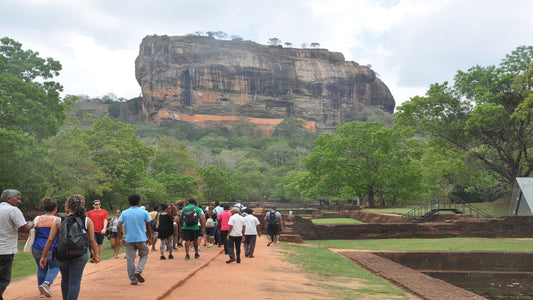
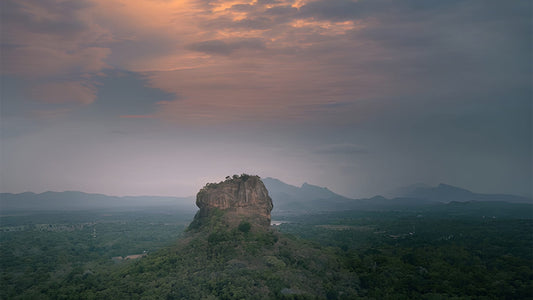
The shortest route from Colombo to Dambulla lies via Kurunegala, one of the capitals of the medieval Sinhalese kings. Another rock temple of equal fame, Aluvihare, where, according to tradition, the Buddhist scriptures were first committed to writing around the first century B.C., is located about twenty-six miles south on the Kandy-Dambulla road. The famous fortress of Sigiriya, with its beautiful frescoes, rises aloft like a gigantic cylinder at a distance of about twelve miles to the northeast of Dambulla. Dambulla is of unique interest. Its rock temples are the most extensive on the island, and one of the most ancient, in the highest state of preservation and order. Dambulu-gala (the rock of Dambulla), where these temples are situated, is almost insulated and of vast size. Its perpendicular height above the plain is about six hundred feet. Very few parts of it are covered with wood, and its surface is generally bare and black.
History
The caves of Dambulla, like the Mihintale caves, were occupied by Buddhist hermits in very early times. The antiquity of this place has been authenticated by the presence of pre-Christian inscriptions in Brahmi characters immediately below the drip-ledge of the central cave. One of these inscriptions records: "Damarakita teraha lene agata anagata catu disa sagas dine. Gamani abaya rajiyahi karite" (The cave of the Elder Damarakita, given to the Community of the four quarters, present or future. In the reign of Gamani Adhaya.) The shape of the letters in all the short inscriptions in Brahmi form at Dambulla is distinctly from the first century B.C. At that time, there was only one king known as Abhaya, also known as Vattagamani Abhaya (89-77 B.C.). This leaves no doubt that the king Abhaya referred to in the inscription is Vattagamani Abhaya. Dambulla became a popular place of residence for Buddhist monks at least from the reign of this king. Vattagamani Abhaya is one of the few kings of ancient Sri Lanka whose name and fame are not dependent on written records. He is credited by the common people with the numerous caves with drip-ledges that were abodes of Buddhist monks in ancient times. As we have seen, one or two of these caves, like Dambulla, bear inscriptions with the royal name attributed to him.
According to tradition, Vattagamani Abhaya, who fled from his kingdom, Anuradhapura, when it was invaded by South Indians, was helped by the monks residing in caves like Dambulla. The Mahavamsa records that the Buddhist scriptures were first committed to writing by Buddhist monks at Aluvihara during the reign of this king. This provides substantial evidence that great caves like Dambulla and Aluvihare in the central part of the island were residences of Buddhist monks during this early period and were also patronized by the kings of Anuradhapura.
Tradition also holds that the five seated Buddha images, including the principal one in Cave No. 4 of the Dambulla temple, were carved from natural rock during the reign of Vattagamani Abhaya. It is also believed that some of the images in Cave No. 4 were made during his reign.
The caves, one by one
A room-by-room account of the five shrines, their statuary and their paintings.
The Caves and Paintings of Dambulla (General)
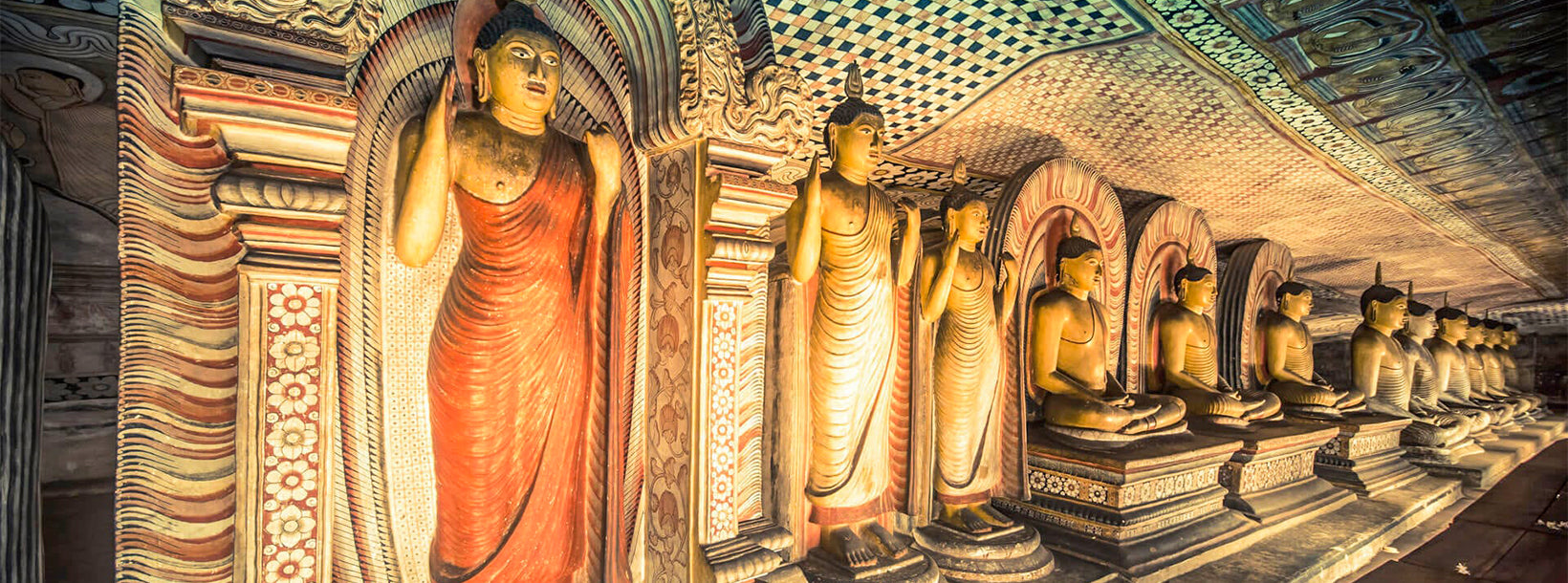
There are five caves (shrine rooms) in Dambulla temple. All of these caves are full of statues of Buddha and various personages of the Buddhist Order or History. There are 150 Buddha images in these caves. Cave No. 5 (the last in order) has no historical value as it was done in the second decade of this century. All of the other caves contain statues and paintings representing various epochs of Sinhalese sculpture and painting. The early paintings of Dambulla are believed by some to belong to the 8th century A. C. But this cannot be proved at all because of overpainting. Nevertheless, this place is a mine of decorative designs, the patterns of which resemble those of Sigiriya. To a student of the history of Buddhism, a careful study of the paintings of Dambulla provides a good deal of source material.
It is generally accepted that the classical school of Sinhalese painting ceased to exist after the fall of the Polonnaruve kingdom at the end of the twelfth century. There are no extant examples of this style after the 13th century. It is from the 17th and 18th centuries that we have, once again, examples of the work of a school of indigenous painters.
This new school does not seem to have had its roots in the artistic traditions which created the masterpieces of Sigiriya and Polonnaruva.
Its style is purely two dimensional; in compositions it does not exhibit the skill of the masters of earlier epochs. In its conventions, particularly in the decorative designs and in the representation of trees and creepers, it does not seem to have any connection with the earlier art of the Island.
This School seems to have been influenced by the Schools of painting which flourished in the Deccan (Southern India) under the patronage of Muslim rulers.The frescoes which adorn the cave of Dambulla represent this new school of Sinhalese painting, Inside the cases of this temple the whole surface of the rock is completely covered with paintings, The earliest phase is believed to be on Cave No. 2, and these consist of decorative designs as surmised above, it is not possible to identify any one of these as actually belonging to a very much earlier period. Nevertheless, the designs themselves show close affinity to Sigiriya ceiling ornamentation. There may have been old painting at this place but perhaps these are lost or have been painted over later. It can be surmised that the designs of the decorative patterns, embody ancient ideas and may even be considered as continuing tradition of the designs at Sigiriya. But as the Dambullu Tudapata referred to above clearly reveals cave No. 1, 2 and 4 of Dambulla were painted by the Kandyan artists of the seventeenth century by the order of king Senarat (1604-1635 A.C). In the reign of Kirti Sri Rajasinha, the paintings of Dambulla were renovated and over painted again. Paintings in Cave No. 4 clearly represent the new school of Sinhalese painting which flourished in the Kandyan provinces after the 17th century.
Cave No. 1 (Deva Raja Viharaya)
The visitor to the Temple of Dambulla through the gateway first comes across Cave No. l, called Dev-Raja-viharaya (temple of the King of Gods). It is believed that this cave is so-called, because the god Sakka (King of Gods) gave the finishing touches to the principal image of this cave. This image, depicting the parinibbana (the last moment) of the Buddha in the typical style is about forty-seven feet in length. It is carved almost in the round from the natural rock to which it still remains joined all along from behind, and is well preserved. The face is wooden in appearance, shapeless and dull. The usual long robe covers the body up to the ankle leaving the right shoulder and breast bare. The shape of the face is round and not artistically sculptured. The eyes are merely cut, the forehead is narrow and the ear is unshapely. The hair is schematically shown by a series of dots. The fine-textured robe is depicted in a series of closely grooved ribs which are arranged close together in twos. The rest of the body is well executed in shapely proportions except for the stiffness of the feet and right leg.
The cave contains another five images of which the standing one at the southern end of the. The room is supposed to be that of Arhat Ananda, the immediate disciple of Buddha, weeping at the death of his master.
At the northern corner of the cave, opposite the face of the principal image, there is a statue, of Visnu, (some scholars believe that this is of Upulvan, one of the four guardian deities of Sri Lanka), which is a well-executed.
The room containing this is always closed to the public for reasons unknown.
Although there are wall and ceiling paintings in this cave, these can hardly be seen as a result of damage done by the incense burnt by devotees.
Cave No. 2 (Maha Raja Viharaya)
The next cave into which the visitor centers is by far the largest and the most impressive one amongst the cares in this place. The portal by which one enters is in front; is a Lofty archway, guarded on each side by figures of stone; intended to represent Janitors. This cave is called Maha Raja Viltaraya (the temple of the Great King), because. According to the common belief, its founder was king Vattagamani Abhaya, who personally assisted in its formation.
The cave is painted all over in brilliant colors, and every part is in good repair. It is one hundred and seventy-two feet in length, seventy-five in breadth, and twenty-one feet in height near the. Front wall. The height from this place gradually decreases in an arc towards the floor on the interior side. This cave contains fifty-three images. The majority of the statues are of Buddha in different attitudes. Many of them are larger, but none much smaller than life.
The visitor who enters by the door at the northern corner of this cave first comes across a figure of the standing Buddha under a neatly executed Makata Torana, both sculptured out of the natural rock. These are the principal images of the shrine room. This image is in Abhaya Mudra. The figure is beautiful sculptured will sturdy features and massive limbs. No attempt has been made by the artist to portray physical details in true proportion. The flowing folds of the Robe are shown by grooves. The right shoulder and arm are bare. The folds are gathered at the left shoulder. The head is covered with a series of lump planted regularly with a crest surmounting all of them. The eyes of the images are carver out with lids shown open. The lips are thick. So is the nose. There is a stiffness of the limbs and a wooden rigidity of the body. The image is standing on a stone lotus pedestal circular in shape. This lotus is neither well carved nor elaborate.
To the right and left of this there are two standing figures respectively of two deities Natha and Maitreya, who, according to Buddhist belief, would become Buddhas in the future.
At the right of the entrance is a handsome stupa, about eighteen feet high, the broad circular pedestal of which is ornamented with four figures of Buddha, each facing a different quarter, each seated on the coil of a Cobra de Capello, and shaded by its expanded hood.
The rest of the Buddha images in this cave are arranged in a row at a little distance from the sides and inner walk of the tile room, but not grouped. None is placed near the outer wall, except the one in a recumbent posture, which is quite new. At the northern end of the cave, figures are arranged in a double row. Towards the eastern end of the shrine room, there is a perpetual dripping of water that filters through the roof from hollows on the top of the rock, which are supplied by rain. The drops of water are caught in a vessel placed in a small square enclosure sunk in the floor and used exclusively for sacred purposes.
The whole of the interior of this cave, whether rock or wall, is painted with brilliant colors of which yellow predominates. The ceiling nearest the entrance is used mostly to depict the life of the Buddha, before and after his Enlightenment. In this part, the artist has also attempted to paint the earlier births of the Buddha. A visitor to the shrine room may want to have a description of at least some of the paintings. The principal paintings of this part are:
1.Prince Siddhartha, the Buddha-to-be, going out of his palace to exhibit his skills in arms. 2.Prince Siddhartha, exhibiting his skill in archery. 3.Prince Siddhartha, leaving home, in quest of Truth. 4.Monsters in the army of Mara, the evil one, attacking the Buddha. 5.Mara, the evil one, being thrown from his elephant after being vanquished by the Buddha.
At the eastern extremity of this cave there is a little recess behind the row of Buddha statues, formed by a huge projecting rock, the walls of which are covered with paint. At the entrance to this recess, there is a standing statue of a king, identified as Nissankamalla who undertook extensive repairs to the temple. This part of the cave seems to have been used by the artist to illustrate the history of the Island. The frescoes, of this part, begin with the earliest and most fabulous period of the history of the country. Among these frescoes, the exploits or Vijaya, the first historical ruler of the country, who is said to have come from India, are conspicuous and cover a great space. The artist seems to have been interested in illustrating the voyage of this hero, which is represented by a boat surrounded by sea-monsters.
The next work of interest is the dedication of the island to the Buddha after the arrival of the Bo-tree and the sacred relics. This is figured by king Devanampiyatissa (250 210 B. C), who ruled the country on the eve of the introduction of Buddhism to Sri Lanka, guiding a plow drawn by a pair of Elephants, attended by monks headed by Arhat Mahinda who introduced Buddhism to Sri Lanka.
Another painting here represents the building of the great city's and other important religious buildings at Anuradhapura.
The most successful of the historical paintings in this part is the one which represents the single combat between Dutta Gamani, The greatest hero of the Sinhalese, and Elara, the Indian usurper who ruled the northern part of the country for 44 years. The drawing of this picture is by no means deficient in spirit and is considerably more correct in the proportions than any other of the historical compartments. The Indian king is represented as falling from his elephant, transfixed by the javelin of his enemy.
At the northern corner of the recess there are two standing statues carved out of wood. The common belief is that these figures represent deities. One is now identified in Sri Lanka with Visnu, the famous Hindu god, and images of this from, of Visnu, are seen side by side with those of the Buddha in a large number of temples on the Island. The other, namely Sumana (or Saman) is supposed to be one of the four guardian deities of the country. According to The Great Chronicle, The Sanrantakuta, i. e, Adam’s Peak, where the Buddha was supposed to have left his footprint, is thus called because the Peak was regarded as the abode of devaraja (king of god’s) called Sumana. Both of these figures are well executed and painted, but are now in a decaying condition.
At the northern corner of the cave there are four Buddha images in sitting posture, facing the main hall. These figures are supposed to be those of Kakusanda, Konagama, and Kassapa, the predecessors of Go Tama, The Buddha, who is represented by the last statue.
To the right of the northern entrance to this cave, there is a figure in standing attitude facing the principal image of the tile shrine room, which is supposed to represent king Vattagamani Abhaya, the earliest benefactor of Dambulla. This is the crudest figure in every respect. And its dress is the simplest and least ornamented.
Cave No. 3 (Maha Alut Viharaya)
This Cave, called Maha Alut Viharaya (The Great New Temple), is separated from Cave No.2 by a wall of masonry. This is said to have been used as a storeroom before the eighteenth century.
The principal entrance to this cave, which is second in size only to cave No.2, is by a door. This was mode a shrine room by Kirti Sri Rajasinha, who reformed the Buddhist Church in the eighteenth century. Most of the new paintings and renovations of the Temple are attributed to this last great benefactor of Dambulla. At the left of the entrance to this cave, there is a well-executed figure of this king, in his robes of state, which resemble those worn by the kings of the Nayakkar dynasty, who ruled the country until the British occupation in 1815.
The cave is about ninety feet long, eighty-one wide, and is a shelving rock whose height is about thirty-six feet. The immense surface of the rock of this cave is also painted of the richest colors. These frescoes depict various and numerous events of Buddhists, some representing the life of the Enlightened One, and score the history of Buddhism. The artistic tradition of this cave is that of the Kandyan period. This cave contains fifty figures of the Buddha.
The principal image, facing the entrance, is a standing one under a Torana. The images and the Torana are carved out of the natural rock.
One statue of Buddha in this cave in the recumbent posture, its head on a pillow, resting on its right hand, is quite similar to that in Cave No. 1. This is about thirty feet long and well proportioned, the face is handsome, and its expression of countenance remarkably peaceful and benignant. Seven other statues of Buddha, in the standing attitude, are about ten feet high, and all the rest are life-size or a little smaller. Most of them are colored bright yellow; three have red robes. To a student of Kandyan art and sculpture, this cave is, no doubt, a mine of raw material.
Cave No. 4 (Paschima Viharaya)
This cave is called the Paschima Viharaya or the Western Temple. It is about fifty-four feet long and twenty-seven wide; and its shelving roof, which dips rapidly inwards, is about twenty-seven feet high.
This cave contains ten figures of the Buddha. The principal image which is under a torana is of the same size as the other statues. This is a very beautiful figure of the Buddha seated in the dhyana mudra (posture of meditation) hewn of the natural rock that forms the cave itself. The image is in a fine state of preservation and painted in brilliant colors in the Kandyan period. The features of the image are clearly discernible. The ears are long with pierced lobes. The nose, eyes, and lips are well executed, the forehead is somewhat receding. A loosely flowing robe covers the body from shoulder to feet leaving the right shoulder bare. The method of treating the robe is the groove technique. Three grooves mark the neck.
The robes are shown well draped and with loose folds. The hair on the head is treated with dots in rows, rising to a bun-shaped lump on the summit. The other images are in a row starting from the right and the left of the principal image.
These figures are well executed and brilliantly painted, and most of them are large as or larger than life-size. There is a neat stupa (cetiya) called Soma Cetiya at the middle of the cave. The roof and sides of the rock and the front wall are painted of the brightest colors, and decorated with a number of figures, chiefly of Buddha.