At the edge of Pettah, where Colombo Harbour traffic dissolves into one of South Asia's most energetic street markets, a four-storey clock tower marks the boundary between the port and the city. The Khan Clock Tower has stood on its landscaped roundabout since 1923 — quiet, precise, and easy to overlook amid the surrounding commerce. It rewards a closer look.
What is the Khan Clock Tower?
The Khan Clock Tower is a century-old memorial tower erected in Pettah, the historic trading district of Colombo. It was commissioned by two brothers — Bhikhajee and Munchershaw Framjee Khan — in honour of their father, Framjee Bhikhajee Khan, who died in 1878. The inscription on the tower's base records the dedication precisely: the tower and its accompanying fountain were gifted through the Municipal Council to the citizens of Colombo on 4 January 1923, the 45th anniversary of Framjee Khan's death.
The structure itself is a four-storey tower topped with a working clock. A decorative water fountain was built at its base; the fountain no longer operates, but the clock mechanism has continued to function through more than a century of Colombo's rapid transformation around it.
Who were the Khan family?
The Khans were a Parsi family with deep commercial roots in colonial Ceylon. The Parsis are a community of Zoroastrian faith whose ancestors migrated from Persia — present-day Iran — to the Indian subcontinent, primarily Gujarat, around the 7th century CE, fleeing religious persecution following the Arab conquest. Over subsequent centuries they became known as skilled traders and entrepreneurs across South and Southeast Asia.
The Khan family carried that tradition to Ceylon. Among their ventures, the Colombo Oil Mills was particularly prominent, producing a range of high-quality oils that were widely traded in the region. When patriarch Framjee Bhikhajee Khan passed away in 1878, his sons inherited not only his business but also, it appears, his discipline and ambition. Over the following decades they expanded the family's commercial interests considerably.
The clock tower was their public expression of gratitude — a filial tribute made permanent in stone and steel at the heart of the district where their father had worked.
Where exactly is the Khan Clock Tower located?
The tower stands on a roundabout in Pettah, the oldest commercial neighbourhood of Colombo, close to the main entrance to Pettah Market. Arriving by road from Colombo Fort or the Harbour, the tower is one of the first landmarks a visitor encounters. It is also within easy walking distance of the Old Dutch Hospital and the historic Fort area.
Pettah Market itself stretches immediately behind and around the tower. The market is the largest and busiest wholesale and retail market on the island, a place where goods arriving through the port filter into the wider Sri Lankan economy. The mix of wholesale textile stalls, spice vendors, hardware dealers, and street-food carts makes the surrounding lanes a strong case for a deliberate wander rather than a rushed pass-through.

When is the best time to visit the Khan Clock Tower?
The tower is a public monument on an open roundabout, so it is accessible at any hour. That said, Pettah is a working commercial district and is liveliest — and most crowded — on weekday mornings between roughly 9 am and noon, when wholesale trade is in full swing. Visiting on a weekday morning gives you the most atmospheric setting: the streets humming with porters, vendors, and buyers, the tower standing composed amid the organised chaos.
If you prefer to study the inscription and tower facade at leisure, an early morning visit (before 8 am) or a Sunday morning, when much of the market is quiet, allows more time around the roundabout without heavy traffic. Pettah is hot and humid for much of the year; the period from November to March is generally more comfortable for walking the surrounding streets.
What else can you see nearby?
The Khan Clock Tower fits naturally into a half-day walking itinerary of Colombo's historic core. Notable stops within a short radius include:
- Jami Ul-Alfar Mosque (Red Mosque): A striking red-and-white striped mosque a few minutes' walk into Pettah, built in 1909 and one of Colombo's most photographed landmarks.
- Colombo Fort: The adjacent neighbourhood retains several colonial-era buildings, including the Old Dutch Hospital complex, now repurposed as a dining and retail precinct.
- Pettah Market streets: The parallel lanes of Pettah are each informally specialised — one street for electronics, another for fabrics, another for hardware — making them interesting to explore even without the intent to buy.
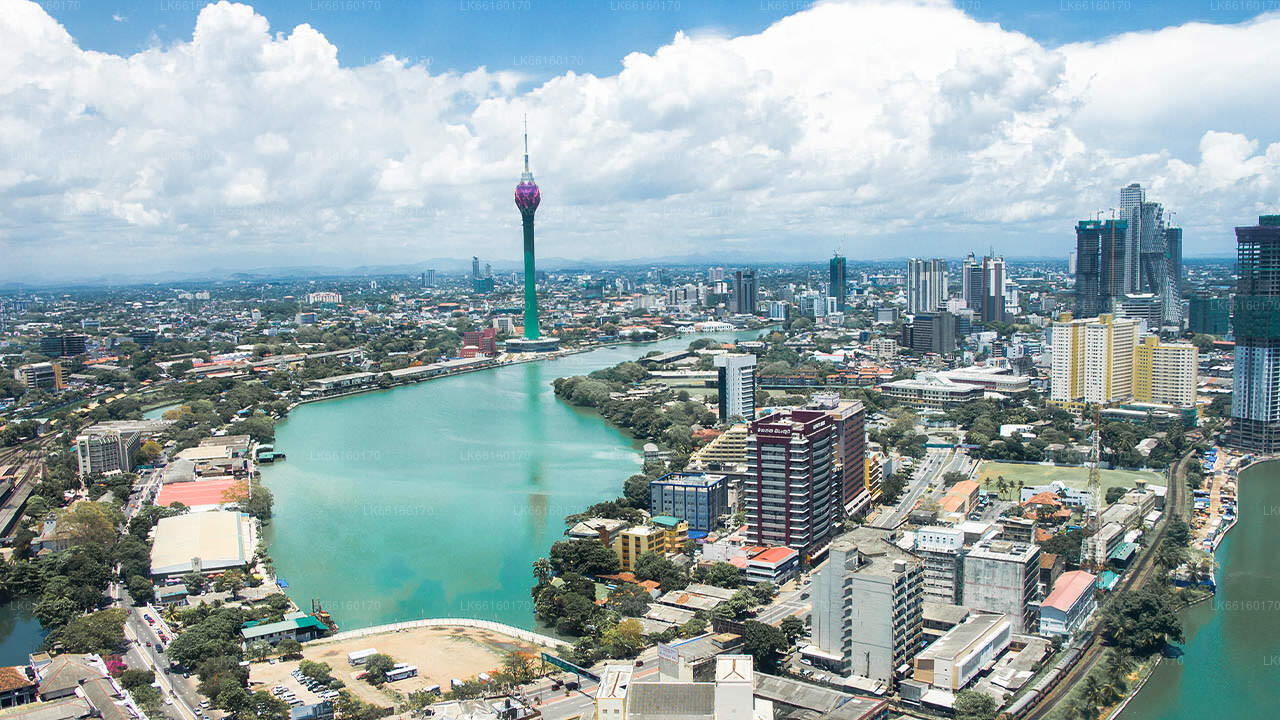
- Colombo Harbour promenade: A short walk north offers views of the working port and the broader Colombo skyline.
How do I get to the Khan Clock Tower from Colombo Fort?
The tower is roughly a 10-minute walk from Colombo Fort railway station, heading east along Main Street into Pettah. By tuk-tuk from Fort or the Colombo city centre the ride takes around 5 to 10 minutes depending on traffic. If you are arriving from Colombo Harbour via the main port road, the tower is among the first landmarks you will pass on entering Pettah.
Parking near the roundabout is limited, as with most of Pettah. Arriving on foot or by three-wheeler is considerably more practical than driving, particularly during market hours.
Why does the Khan Clock Tower matter historically?
The tower is a small but concrete reminder that Colombo's commercial history was shaped by communities from far beyond the island — Arab, Malay, Indian, Parsi, Dutch, British, and many others passed through and settled, leaving traces in the city's architecture, language, and family names. The Parsi contribution to trade in colonial-era Ceylon is not widely documented, and the Khan Clock Tower stands as one of the few visible markers of that chapter.
It also illustrates a particular Victorian and Edwardian tradition of civic philanthropy: wealthy merchant families across the British Empire frequently donated public infrastructure — fountains, clocks, libraries — to the cities in which they had prospered. The Khan brothers followed this practice, framing their gift as one dedicated to the citizens of Colombo rather than to the family alone. That the clock still keeps time, more than a hundred years on, gives the inscription a certain understated weight.