Between 1658 and 1796, the Dutch Vereenigde Oost-Indische Compagnie — the United East India Company, better known as the VOC — governed the coastal territories of Ceylon, leaving behind canals, fortifications, legal codes, and architectural styles that still shape the island today. Their arrival was not an invasion in the conventional sense: the Kandyan king Rajasinghe II invited them. What followed was a colonial chapter that outlasted Portuguese rule, reshaped trade across the Indian Ocean, and embedded itself permanently in Sri Lankan culture and law.
How did the Dutch come to control Ceylon?
By the early 17th century, the Portuguese had held Sri Lanka's maritime provinces for well over a century, and their repeated campaigns against the Kandyan kingdom had made them deeply unpopular with its rulers. Rajasinghe II saw an opportunity when Dutch VOC fleets began contesting Portuguese sea lanes across Asia. In 1638 he signed the Kandyan Treaty with the Dutch, agreeing that the VOC would receive a monopoly on cinnamon and other spices in exchange for military assistance against the Portuguese.
The alliance worked — up to a point. By 1658, the Dutch had expelled the Portuguese from virtually every coastal stronghold in Ceylon. But rather than returning those territories to Kandyan sovereignty as the treaty implied, the VOC retained control for itself. The Kandyan kingdom had replaced one European power with another, though the new occupants proved markedly less interested in religious conversion and territorial expansion inland.
Why did the Dutch and Portuguese come into conflict in Asia?
For roughly a century after Vasco da Gama's 1498 voyage, Portugal faced no serious European rival in Asian waters. The VOC, chartered in 1602, changed that equation decisively. The company was structured to pursue profit rather than empire: shareholders demanded returns, not missionaries. This commercial focus put Dutch and Portuguese interests into direct conflict across the spice routes from the Malabar Coast to the Banda Islands — and in Ceylon, where cinnamon was among the most valuable commodities in the world.
Portugal's vulnerability was compounded by its political situation in Europe. From 1580 to 1640 the Portuguese crown was united with Spain, exposing Portuguese colonial assets to the enemies Spain had accumulated. Once Portugal regained independence in 1640, it negotiated peace with the Netherlands. A subsequent treaty — signed in Goa — divided their respective colonial holdings, and Ceylon's coastal areas were confirmed under Dutch administration. Ceylon black pepper and cinnamon remained at the heart of what the VOC was determined to control.
What did 140 years of Dutch rule look like in practice?
The VOC never conquered the Kandyan highlands. Like the Portuguese before them, the Dutch mounted several campaigns against Kandy and were repelled each time. Their authority was effectively limited to a coastal belt — the cinnamon-producing lowlands, the ports, and the trade routes connecting them. Within that zone, however, they governed systematically.
Key features of Dutch colonial administration included:
- Trade monopolies — cinnamon, elephants, and arecanuts were tightly controlled by the VOC, with severe penalties for private trading.
- Canal construction — an extensive network of canals was dug along the west coast to move goods efficiently and avoid the dangerous open-sea coastal route. Many of these canals remain navigable today, including those visible on a Madu River Safari.
- Fortification — Dutch engineers rebuilt or extended fortifications at Galle, Colombo, Jaffna, Trincomalee, Batticaloa, and Negombo. The Dutch Fort in Negombo is among the best-preserved remnants of this building programme.
- Legal codification — rather than imposing a single Dutch code across the island, VOC administrators documented and formalised existing customary laws where they did not directly contradict Roman-Dutch legal principles.
What legal legacy did the Dutch leave in Sri Lanka?
The Dutch contribution to Sri Lankan law is arguably their most durable legacy. Roman-Dutch law — the hybrid jurisprudence that had evolved in the Netherlands from medieval Roman law — was introduced as the general law of the colony. Elements of it survive in Sri Lankan civil law today, more than two centuries after Dutch rule ended.
The most celebrated example of Dutch legal work in Ceylon is the codification of the Thesavalamai, the customary legal code governing property, inheritance, and matrimony among the Tamil community of Jaffna. Dutch officials documented these customs in writing in 1707, giving them formal legal standing that protected them through subsequent British rule and into the post-independence period. The Thesavalamai remains legally operative in the Northern Province to this day.
The Dutch also documented Sinhalese customary law (known as Kandyan law in the highlands and Tesawalamai's lowland equivalents along the coast), and they introduced land-registration practices that, however imperfect, created a paper record of property rights where none had previously existed in formal written form.
Where can you see Dutch heritage in Sri Lanka today?
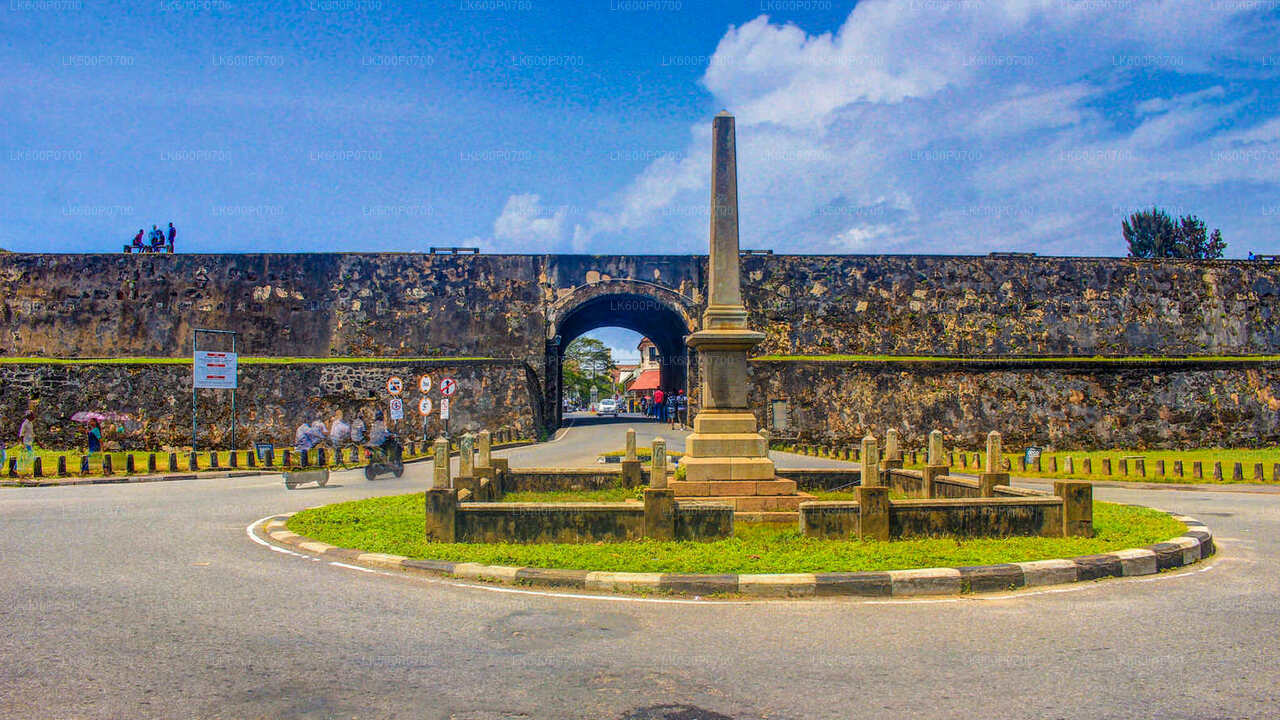
Dutch-era structures and place names are scattered across the island's western and southern coasts, and into the north and east. The most substantial surviving ensemble is the Galle Fort, a UNESCO World Heritage Site whose ramparts, grid-plan streets, and merchant houses reflect VOC town-planning on a remarkably intact scale. Walking its perimeter walls at dusk, with the Indian Ocean on three sides, gives a concrete sense of how the Dutch thought about defence and commerce simultaneously.
In Colombo, the old VOC headquarters area around the Pettah district retains some Dutch-era buildings, and the layout of certain streets still follows the 17th-century grid. Negombo, with its canal system and fort ruins, is perhaps the most visible reminder in the northwest of how thoroughly the Dutch reorganised the coastal landscape for trade. A Negombo city tour typically includes both the fort and a stretch of the Dutch canal.
In the north, Jaffna Fort stands as one of the largest Dutch fortifications in Asia, though it sustained damage during the civil conflict of the late 20th century. Batticaloa and Trincomalee also retain Dutch-era ramparts in varying states of preservation.
How did Dutch rule in Ceylon end?
By the 1790s the VOC was in severe financial difficulty, weakened by corruption, over-extension, and the disruption caused by the French Revolutionary Wars in Europe. When French forces occupied the Netherlands in 1795, the British — allied with the Dutch government-in-exile — moved quickly to take over VOC territories in Asia to prevent them falling under French influence. British forces took Colombo in 1796 and systematically assumed control of all the Dutch coastal territories over the following years. The VOC itself was formally dissolved in 1799.
The British inherited not only the fortifications and canals the Dutch had built but also the Roman-Dutch legal framework they had established. Rather than replacing it entirely, British administrators grafted English common law onto the existing structure, producing the mixed legal system — partly Roman-Dutch, partly English — that Sri Lanka still operates under.
What cultural imprints of Dutch rule survive in everyday Sri Lankan life?
Beyond law and architecture, the Dutch colonial period left traces in language, food, and family names. A number of Sinhalese and Sri Lankan Tamil family names of Dutch origin persist, particularly among the Burgher community — descendants of unions between VOC employees and local women. Dutch loanwords entered Sinhala, and certain pastry traditions, including kokis, the crisp fried snack made with a cast-iron mould, are widely attributed to Dutch culinary influence and remain a fixture of Sinhala New Year celebrations.
The canal network the Dutch built for moving cinnamon and other goods continues to serve fishing communities, small-boat transport, and, increasingly, tourism. Stretches of it along the west coast pass through wetlands of significant ecological value, offering boat rides through landscapes that have changed surprisingly little since the VOC era.