Lakpura
Lakpura®

Culture

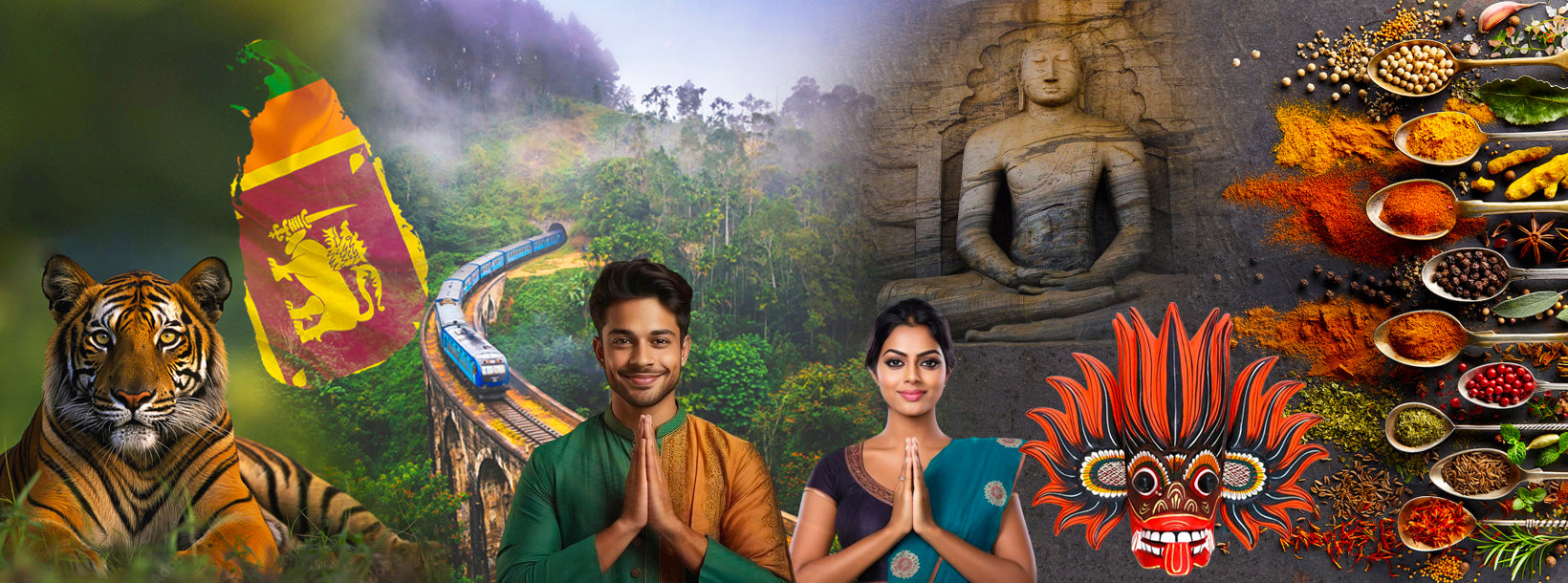
Sri Lanka's culture is not a single thread but a fabric woven from thousands of years of Buddhist civilisation, South Indian influence, colonial contact, and the living traditions of Sinhalese, Tamil, Moor, and Burgher communities. What makes it distinctive is not diversity for its own sake, but the way these layers coexist — sometimes in the same street, sometimes in the same meal.

How has religion shaped Sri Lankan culture?

Theravada Buddhism, introduced to the island around the 3rd century BCE, remains the dominant force in Sinhalese cultural life. Its influence shows in architecture, calendar, cuisine, and daily routine. Full-moon Poya days are observed every month as public holidays; monks receive alms at dawn in towns across the central and southern provinces; and stupas dot the landscape from the coast to the hills.

Hinduism is the primary faith of Sri Lanka's Tamil community, concentrated in the north and east. Kovils dedicated to Murugan, Ganesha, and Amman anchor neighbourhood life, and major festivals draw large communal gatherings. Muslim communities — particularly along the west and east coasts — follow Islamic traditions that arrived with Arab traders centuries before any colonial power. Catholic and Protestant Christianity, rooted in Portuguese and Dutch colonial rule, is practised most visibly in coastal towns such as Negombo and Galle.

The result is a ritual calendar unlike almost anywhere else in Asia. Vesak, Thai Pongal, Deepavali, Eid al-Fitr, and Christmas are all national events, and each carries its own food, music, and visual language.

What festivals and ceremonies define the Sri Lankan year?

The Esala Perahera in Kandy is arguably the most spectacular religious procession in South Asia — ten nights of costumed dancers, fire-performers, and elaborately adorned elephants parading through the city streets in July or August. It draws pilgrims and visitors from around the world.

Sinhala and Tamil New Year in April marks the solar new year with rituals timed to the auspicious nakath: lighting the hearth, preparing milk rice, anointing with oil, and exchanging sweets with neighbours. The nakath calendar governs each activity down to the minute, and even urban families observe the traditions closely.

Other notable events include the Vel Festival in Colombo, the Kataragama pilgrimage in the deep south, and the Diya Kepeema water-cutting ceremony in Kandy — a lesser-known but ancient rite that signals the end of the Perahera season.

What are the main art forms and crafts of Sri Lanka?

The country's artistic heritage is anchored in Buddhist iconography. Cave-temple painting reached its peak at Dambulla, where ceiling frescoes depicting Jataka stories span centuries of artistic tradition. Rock-face frescoes at Sigiriya, dating to the 5th century CE, are among the oldest surviving secular paintings in South Asia.

Traditional crafts include:

  • Mask carving — low-country Kolam and Raksha masks used in ritual drama, produced mainly around Ambalangoda on the south-west coast.
  • Kandyan metalwork — silver and brass repousse work used for temple lamps, betel sets, and jewellery.
  • Clay pottery — hand-thrown earthenware produced in villages near Kelaniya and in the north.
  • Batik — wax-resist fabric dyeing, a technique that arrived from Indonesia and is now produced commercially around Kandy and Matale.
  • Lace-making — particularly in the Galle area, a craft introduced during the Portuguese period.
  • Wooden handicrafts — carved from ebony, satinwood, and teak, specialised in Ambalangoda and the Matara district.

Heritage sites where architectural craftsmanship is most evident include the ancient cities of Polonnaruwa — with its moonstone-flanked entrances, image houses, and irrigated tank systems — and the Temple of the Tooth Relic in Kandy, where Kandyan decorative arts reached their height under the last kings.

What are the performing arts traditions of Sri Lanka?

Kandyan dance — known in Sinhala as Udarata Natum — is the classical dance form of the highlands, performed by male dancers in elaborate headdresses and layered ivory-coloured costumes to the rhythm of the geta bera drum. It is both a ritual art, performed at the Perahera, and a theatrical form taught in dedicated schools in Kandy.

Low-country dance styles, including Pahatharata and Sabaragamu, have a more vigorous, earthier character and are closely connected to devil-dancing (Tovil) ceremonies conducted to ward off illness. Kolam dance drama, performed wearing the carved masks of Ambalangoda, blends comedy, social satire, and supernatural narrative.

Sri Lankan cinema has documented and reimagined local culture since Rekava (1956), the country's first Sinhala feature film. Contemporary stage theatre in Colombo regularly reinterprets classical stories alongside original work. Traditional puppetry (Raban) and folk drumming circles remain alive in village festivals across the country.

What is Sri Lankan cuisine and what makes it distinctive?

Sri Lankan cooking is built on rice, coconut, and a spice palette that the island has traded for millennia. A typical meal centres on steamed rice with three or four accompaniments — a protein curry, a vegetable mallum (shredded and wilted with coconut), a dhal, and a fresh sambol. Coconut milk moderates heat; roasted dried chillies and goraka (gamboge) add depth to fish and meat preparations.

Spices grown on the island are central to the flavour profile. Ceylon cinnamon — a finer, sweeter variety than the cassia sold elsewhere — is used both in savoury cooking and in tea. Ceylon black pepper is one of the island's historically significant exports, and cloves (Syzygium aromaticum) grown in the south appear in rice dishes and spiced infusions.

Hoppers (appa) — bowl-shaped fermented rice-flour pancakes — are a breakfast staple. String hoppers, pittu, and roti serve as alternatives to plain rice. Street food deserves particular attention: kokis, a crispy fried snack introduced by the Dutch, is made during New Year; pani kadju (honey cashews) and lunu dehi (salted lime pickle) appear on tables across the country.

Most restaurants in Colombo and the main tourist corridors now offer a range of international cuisines alongside local food, but the clearest expression of Sri Lankan cooking remains in home kitchens and small local restaurants (referred to simply as "hotels" in colloquial Sinhala).

Why is Ceylon tea central to Sri Lankan culture?

Tea was introduced to Sri Lanka by the British in the 1860s, rapidly replacing coffee after a blight destroyed most of the island's coffee plantations. It transformed the hill country — the Nuwara Eliya, Dimbula, and Uva districts — both economically and culturally, bringing a Tamil estate-worker community whose descendants continue the trade today.

Ceylon tea is exported worldwide and recognised for its quality across several grades and growing elevations. High-grown teas from Nuwara Eliya tend toward delicate, floral profiles; mid-grown Kandy teas are fuller-bodied; low-grown Ruhuna teas are robust and dark. Visitors to the hill country can tour working estates such as Bluefield Tea Gardens to see plucking, withering, rolling, and firing in sequence.

Beyond export, tea is a social institution. A guest in any Sri Lankan home — however modest — is offered tea almost immediately on arrival, typically served sweet and milky. It is among the more genuine expressions of local hospitality.

What role does Ayurveda play in Sri Lankan culture?

Ayurveda — the traditional Indian medical system adopted and adapted in Sri Lanka over more than two millennia — remains in active daily use, not merely as a wellness tourism product. Many Sri Lankans consult an Ayurvedic physician alongside or instead of a Western-trained doctor for chronic conditions, particularly musculoskeletal and digestive complaints.

The system relies heavily on plant-based preparations. Formulae such as Yogaraja Guggulu and Kaishore Guggulu are dispensed in dedicated Ayurvedic pharmacies found throughout the country. Herbal gardens in Matale and the Kandy region cultivate the raw materials used in these preparations. Dhamma schools and rural temples have historically served as repositories of traditional medical knowledge, transmitting plant-lore alongside religious instruction.

For visitors, Ayurvedic treatments — particularly oil therapies like Shirodhara and Abhyanga — are widely available at dedicated wellness retreats and within larger hotel spas. The quality and clinical rigour varies considerably; those seeking therapeutic rather than purely relaxation-oriented treatment should look for practitioners with formal training from a recognised Sri Lankan Ayurvedic college.

How has colonialism shaped Sri Lankan culture?

Three successive colonial powers — Portuguese (1505–1658), Dutch (1658–1796), and British (1796–1948) — each left a distinct mark. The Portuguese introduced Catholicism along the west coast, European musical instruments that were absorbed into local folk traditions, and culinary influences including lace-making and certain fried snacks. The Dutch Fort in Negombo is one of the more accessible surviving examples of Dutch colonial infrastructure.

British rule was the most economically transformative: it introduced the plantation system, built the railway network that still connects Colombo to Kandy and the hill country, established English-medium education, and standardised a legal and administrative framework that persists today. Cricket — introduced by British colonisers — is now the dominant sport and a genuine cultural passion across all communities.

Colonial-era architecture is visible in Colombo's Fort district, in the bungalows of Nuwara Eliya, and in the fortified city of Galle, a UNESCO World Heritage Site where Dutch-built ramparts enclose streets of colonial-era merchants' houses now occupied by boutique hotels and galleries.

Book this experience with Lakpura

Curated by our local team. Direct booking, instant confirmation.

Ask Lakpura® Agent
