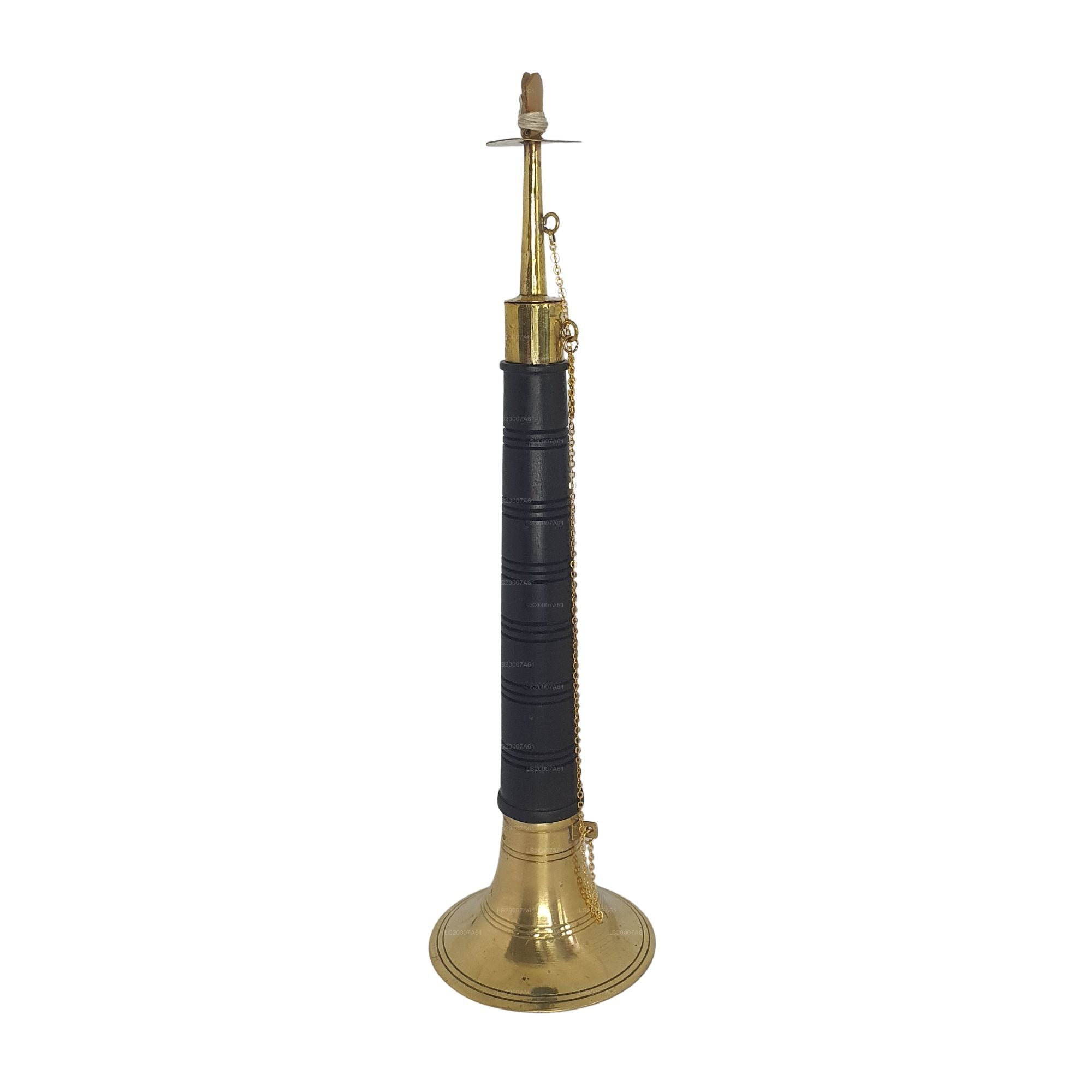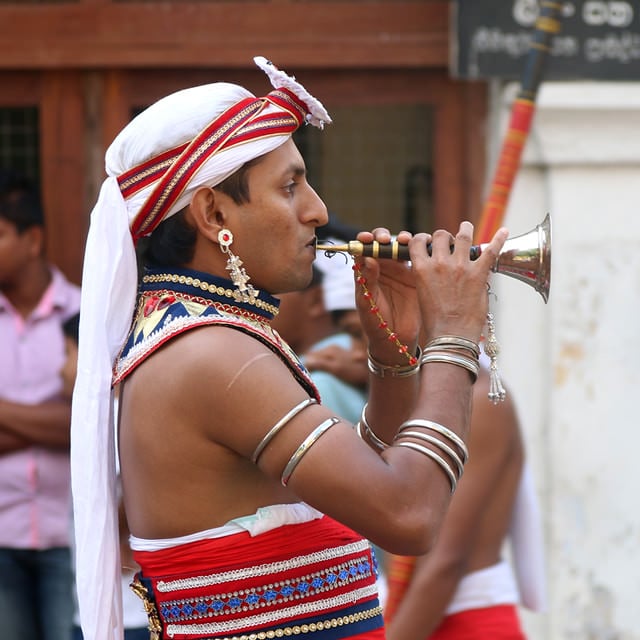


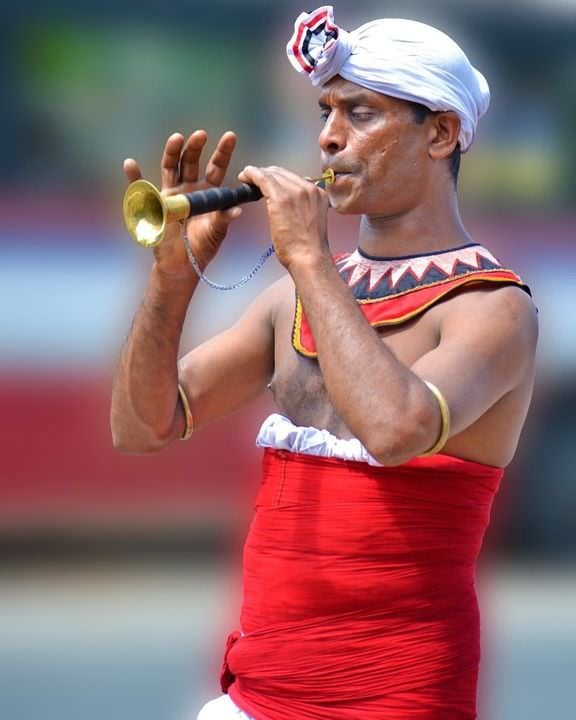

The horanawa is Sri Lanka's foremost double-reed wind instrument — a woodwind whose haunting, reedy timbre has carried across temple courtyards, royal processions, and village theatrical stages for centuries. Close relatives of the horanawa appear across South Asia, the Middle East, and beyond under names such as the shehnai, shenai, and zurna, but the Sri Lankan instrument has developed its own distinct character, repertoire, and spiritual weight within Sinhala Buddhist culture.
Where does the horanawa come from?
Musicologist Kulathillaka, citing earlier scholars, traces the horanawa's origins to Western Asia, from where it is believed to have gradually migrated to the Indian subcontinent and eventually to Sri Lanka. This foreign lineage is considered to be encoded in the very word horanawa itself, which linguistically points outward rather than inward — unlike the Sinhala terms for many indigenous drums, whose etymologies reveal their local roots.
Historical sources record two alternative names for the instrument: oththu thanthiri and pata thanthiri. These older designations appear in classical texts and inscriptions, suggesting the horanawa was a recognised and respected presence in Sri Lankan musical life well before its foreign name became standard usage.
What is the horanawa's place in Sri Lankan musical classification?
Traditional Sri Lankan music is organised under a system called panchaturya, which groups instruments by their method of sound production. The horanawa falls within the sushira (blown) category of this classification — one of five broad families that together constitute a complete ritual and ceremonial ensemble.
Panchaturya ensembles were not casual folk orchestras. They were specifically assembled for occasions of the highest cultural and religious significance: royal court ceremonies, Buddhist temple festivals, and the three great forms of classical Sinhala popular theatre — sokari, kolam, and nadagam. Within these ensembles, the horanawa held equal standing with the drums, carrying melodic lines that the percussion alone could not provide.
How was the horanawa used in Buddhist ceremonies?
The instrument's association with Sinhala Buddhism runs deep. Buddhist murals painted on the walls of temples along Sri Lanka's southern coast depict musicians playing the horanawa and other panchaturya instruments, offering a rare visual record of how ceremonial music was performed and perceived across different parts of the island. These images confirm that the horanawa was not confined to a single region or community — it was understood island-wide as an appropriate sound for sacred occasions.
The Esala Perahera Festival in Kandy, one of Asia's grandest Buddhist processions, remains a living context in which traditional wind instruments maintain a ceremonial role, offering modern visitors a direct encounter with the kind of ritual soundscape the horanawa once dominated.
How did colonial contact change the horanawa's cultural position?
The nineteenth century brought significant disruption to the horanawa's place in Sri Lankan music. Temple murals from this period begin to show a striking change: alongside the traditional panchaturya instruments, painters started including the musical tools of colonial Europe — brass wind instruments, snare drums, harps, and the violin. This visual evidence documents, with unusual clarity, how colonial cultural contact reshaped the sonic landscape of Sri Lankan religious and social life.
The arrival of European ensemble music did not eliminate the horanawa, but it did shift the instrument's status. Where it had once been essential to any significant public or religious occasion, it gradually became associated more specifically with temple ritual and heritage performance, as Western instruments claimed space in civic and popular contexts.
What does the horanawa sound like and how is it played?
The horanawa is a conical-bore double-reed instrument, typically carved from wood with a flared bell at the lower end. The player blows through a small double reed inserted at the top of the instrument, controlling pitch through a series of finger holes along the body. Skilled players use circular breathing — a technique that allows continuous sound without interrupting to inhale — producing the sustained, unbroken melodic lines that give the instrument its characteristic ceremonial presence.
The sound is penetrating and high-pitched, designed to carry outdoors across processions and open courtyards. In ensemble, the horanawa typically plays the principal melodic role while drums provide rhythmic support and other instruments fill out the harmonic texture of the panchaturya group.
Is the horanawa still played in Sri Lanka today?
The horanawa remains an active instrument in Sri Lanka, though the number of skilled practitioners has declined over recent decades. It is most reliably heard at Buddhist temple festivals, perahera processions, and traditional theatrical performances, particularly in the southern and central provinces. Researchers and ethnomusicologists, including Chinthaka Prageeth Meddegoda, have worked to document the instrument's living tradition through interviews with practicing musicians and scholars, preserving knowledge that has remained largely outside international academic awareness.
For travellers interested in Sri Lanka's classical performing arts, the horanawa offers a direct connection to a musical lineage that predates written records and continues to carry spiritual and communal meaning for Sinhala Buddhist communities today.
Can visitors buy or learn about the horanawa in Sri Lanka?
Authentic horanawa instruments are crafted by specialist artisans, and acquiring a genuine example is both a cultural experience and a tangible way to support traditional craftspeople. The instrument makes a considered, meaningful keepsake for anyone drawn to Sri Lanka's living heritage rather than mass-produced souvenirs. For travellers keen to explore the broader culture in which the horanawa flourishes, the Kandy City Tour provides access to the city most closely associated with Sinhala classical arts, including music, dance, and temple ceremony.