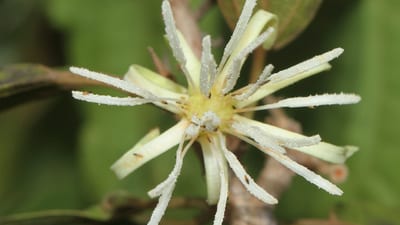
Allophylus cobbe, commonly known as Kobbeka in Sinhala, is a native woody shrub that belongs to the Sapindaceae family. It grows throughout Sri Lanka and parts of India, typically in scrub forests, forest margins, and village homesteads. Because of its scrambling, vine-like growth habit, the plant is sometimes called the Kobbe vine. It holds a respected place in traditional Sri Lankan medicine, particularly among rural communities who rely on it for wound care, fracture treatment, and management of snake venom.
What does Allophylus cobbe look like?
The plant is a much-branched shrub that can take on a trailing or climbing form depending on its surroundings. Its leaves are trifoliate — composed of three leaflets — with a delicate, soft texture when young. The inflorescence emerges at the tips of branches, appearing as small racemes of white and greenish flowers. Flowering typically occurs in two seasons: March to May and again in September to October. After flowering, the plant produces small, round fruits that start green and ripen to a bright red, making them conspicuous among the foliage. The plant is endemic to Sri Lanka and India and is not found elsewhere in the wild.
Where does Kobbeka grow in Sri Lanka?
Allophylus cobbe thrives in the dry and intermediate zones of Sri Lanka, often appearing in scrublands, secondary forests, and along field margins. Village farmers have traditionally cultivated or preserved it near homesteads because of its practical uses. It can also be found in protected habitats and forest reserves across the country, from the lowlands up to mid-elevation areas. Its adaptability to disturbed environments means it is not considered threatened, and it remains widely available in rural areas.
How is Kobbeka used in traditional Sri Lankan medicine?
Kobbeka is among the better-known plants in Sri Lanka's traditional healing system, particularly within the discipline of desiya chikitsa — the indigenous medical tradition focused on bone-setting and physical trauma. The leaves, stem bark, and root bark are all used medicinally, often in combination with other local plants.
- Wound care: Fresh Kobbeka leaves are crushed and applied directly to cuts and wounds to stop bleeding. This is one of the oldest documented uses of the plant in village medicine.
- Old wounds and ulcers: Leaves ground with coconut — a preparation involving Cocos nucifera — are applied as a poultice to promote the healing of chronic or infected wounds.
- Fractures and swellings: Bark of Kobbeka leaves is combined with other medicinal plants, including Attamura, Amukaha, and Diluen, in formulations applied externally to bruises, swellings, and bone injuries.
- Snake venom: A traditional remedy for snakebite combines the bark of Kobbeka with the bark of tree branches and Divikaduru leaves. While this is a historical practice, anyone bitten by a snake in Sri Lanka should seek hospital treatment immediately.
- Agricultural use: Beyond medicine, rural communities have used the flexible branches and stems of Kobbeka as binding material in farming and construction — similar to the way Acacia chundra and other native species are utilised in traditional crafts.
What is the botanical classification of Allophylus cobbe?
Allophylus cobbe belongs to the family Sapindaceae, the soapberry family, which also includes lychee, longan, and the Sri Lankan mora tree. The genus Allophylus contains several hundred species distributed across tropical and subtropical regions worldwide. Allophylus cobbe is one of the species native to South Asia, with its natural range centred on Sri Lanka and peninsular India. Within Sri Lanka, it is documented in botanical records and traditional pharmacopoeia as a plant of significant ethnobotanical value.
What is the significance of Kobbeka in Sri Lankan ethnobotany?
Sri Lanka has a long and sophisticated tradition of plant-based medicine, documented in ancient Sinhala texts and still practised by local healers known as veda mahattayas. Kobbeka occupies a specific niche in this tradition: it is primarily a trauma herb, used not for fevers or digestive complaints but for the physical injuries of daily rural life — cuts, broken bones, and animal bites. This focused role has helped preserve knowledge about it in communities where bone-setting practice remains active. Researchers studying Sri Lankan medicinal plants have noted Allophylus cobbe in ethnobotanical surveys, and it is referenced in some Ayurvedic texts under regional names. Its continued use alongside formally validated plants such as Pongamia pinnata illustrates the breadth of Sri Lanka's living herbal tradition.
Is Allophylus cobbe available in herbal markets?
Dried bark and leaf preparations of Kobbeka can occasionally be found in traditional herb shops (veda boutiques) in Sri Lanka, particularly in rural towns and markets serving communities where indigenous medicine remains part of everyday healthcare. The plant itself grows readily in the wild and in home gardens, so fresh material is typically sourced locally rather than traded commercially. Formal pharmaceutical products derived from Allophylus cobbe are limited, though research interest in the genus has been growing as scientists examine bioactive compounds in Sapindaceae species.
How does Kobbeka fit into Sri Lanka's broader natural heritage?
Sri Lanka's remarkable biodiversity — the country has one of the highest plant endemism rates in Asia — means that plants like Allophylus cobbe are part of a larger tapestry of native flora. Protected areas such as the Sinharaja Forest Reserve shelter many such species, preserving both ecological function and ethnobotanical knowledge that might otherwise be lost. Visitors interested in Sri Lanka's plant diversity can explore these landscapes through responsible nature tourism, gaining a deeper appreciation for the living pharmacy that has sustained communities here for centuries.