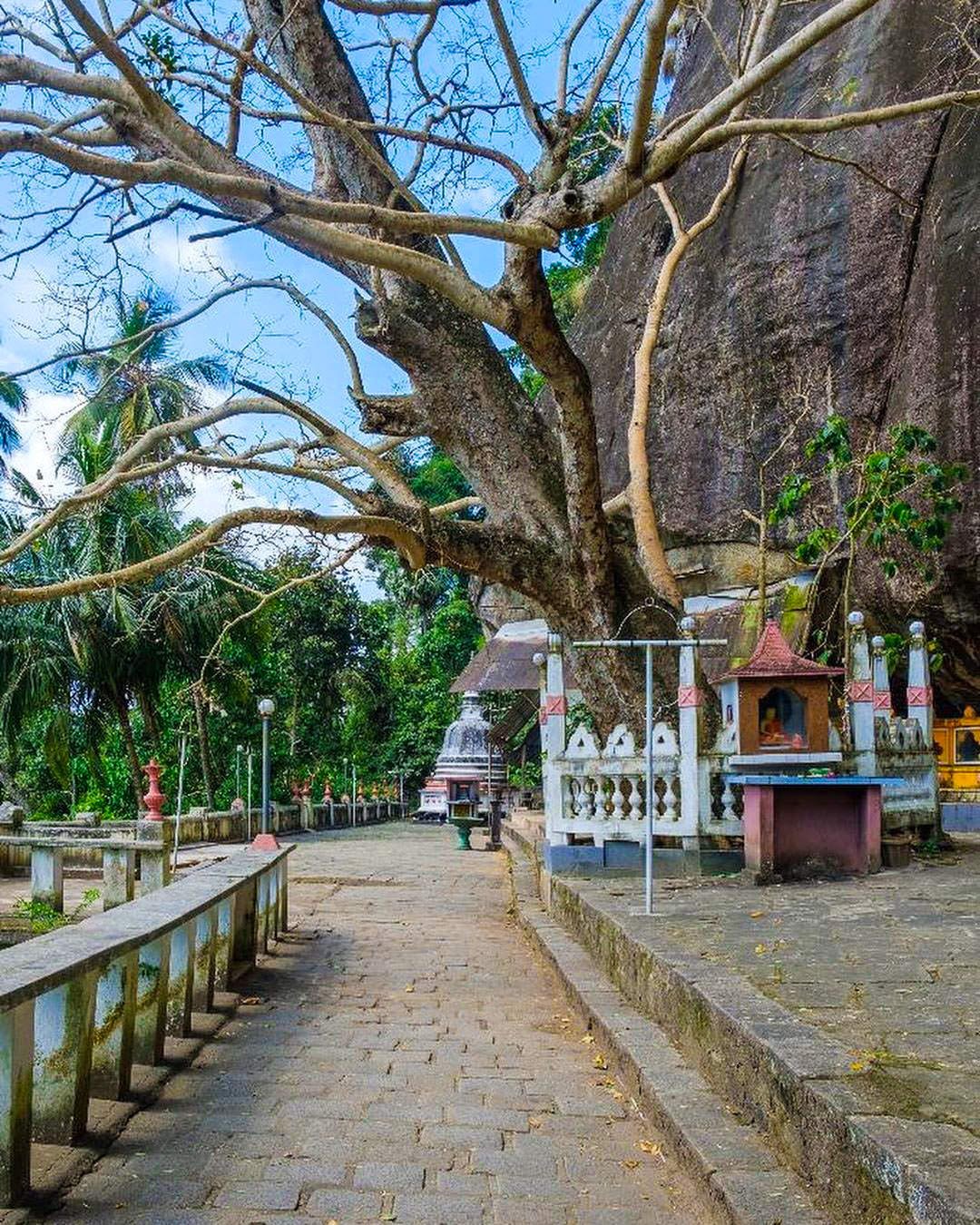
Carved into and around a 205-metre granite outcrop in Sri Lanka's Deep South, Mulkirigala Raja Maha Vihara is one of the island's most rewarding — and least crowded — ancient rock temples. Locals know it as Punchi Seegiriya, or Little Sigiriya, a name that hints at both its dramatic setting and its historical weight. Where Sigiriya draws enormous crowds, Mulkirigala offers a quieter encounter with cave shrines, Kandyan-era murals, and centuries of royal patronage.
What is the history of Mulkirigala Raja Maha Vihara?
Mulkirigala's origins stretch back to the 3rd century BC. The ancient chronicle Bodhi Vamsa identifies it as Giriba Vihara, a site where one of the 32 saplings grown from the original Jaya Sri Maha Bodhi — the sacred bo tree brought to Sri Lanka by the Arahat Sangamitta — was reportedly planted. That connection alone places Mulkirigala at the heart of early Sri Lankan Buddhism.
The Mahavamsa credits King Saddhatissa with constructing the main temple complex, most likely in the 3rd century BC. Subsequent rulers continued to develop the site: King Dhatusena added a stupa during his reign (around 459–477 AD), and King Kirti Sri Rajasinha undertook significant renovations during the mid-18th century, commissioning the vivid Kandyan-period paintings still visible in several caves today.
The temple is also known historically by the names Mulgirigala, Muvathitigala, Muhudungiri, and Dakkhina Vihara. During the Dutch colonial period the rock was referred to as Adam's Berg, a reflection of a local legend that Dutch officials associated with the site.
Where is Mulkirigala, and how do I get there?
The temple sits roughly 2 km from Mulkirigala junction, which lies between the coastal towns of Dikwella and Tangalle in the Southern Province. Both towns are accessible from the Southern Expressway, making a day trip from Mirissa, Weligama, or Matara straightforward. From the junction, three-wheelers and tuk-tuks can cover the final stretch to the temple entrance.
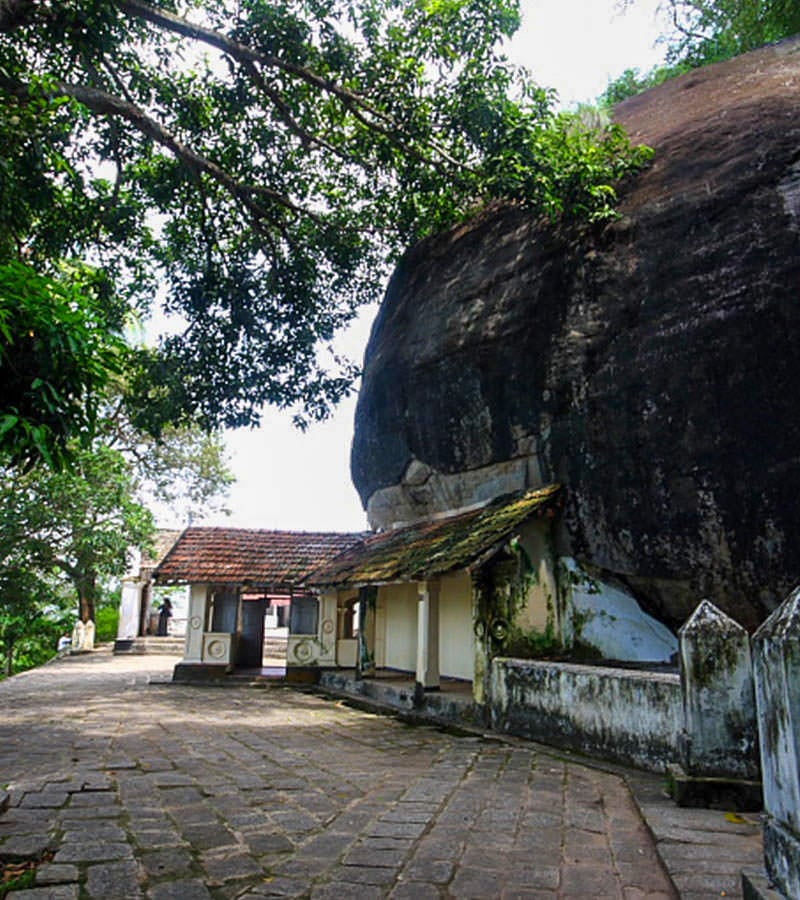
The main rock is surrounded by four smaller outcrops — Benagala, Kondagala, Bisogala, and Seelawathiegala — which together form a natural fortification that ancient monks and kings found easy to defend and consecrate.
What can I see at Mulkirigala?
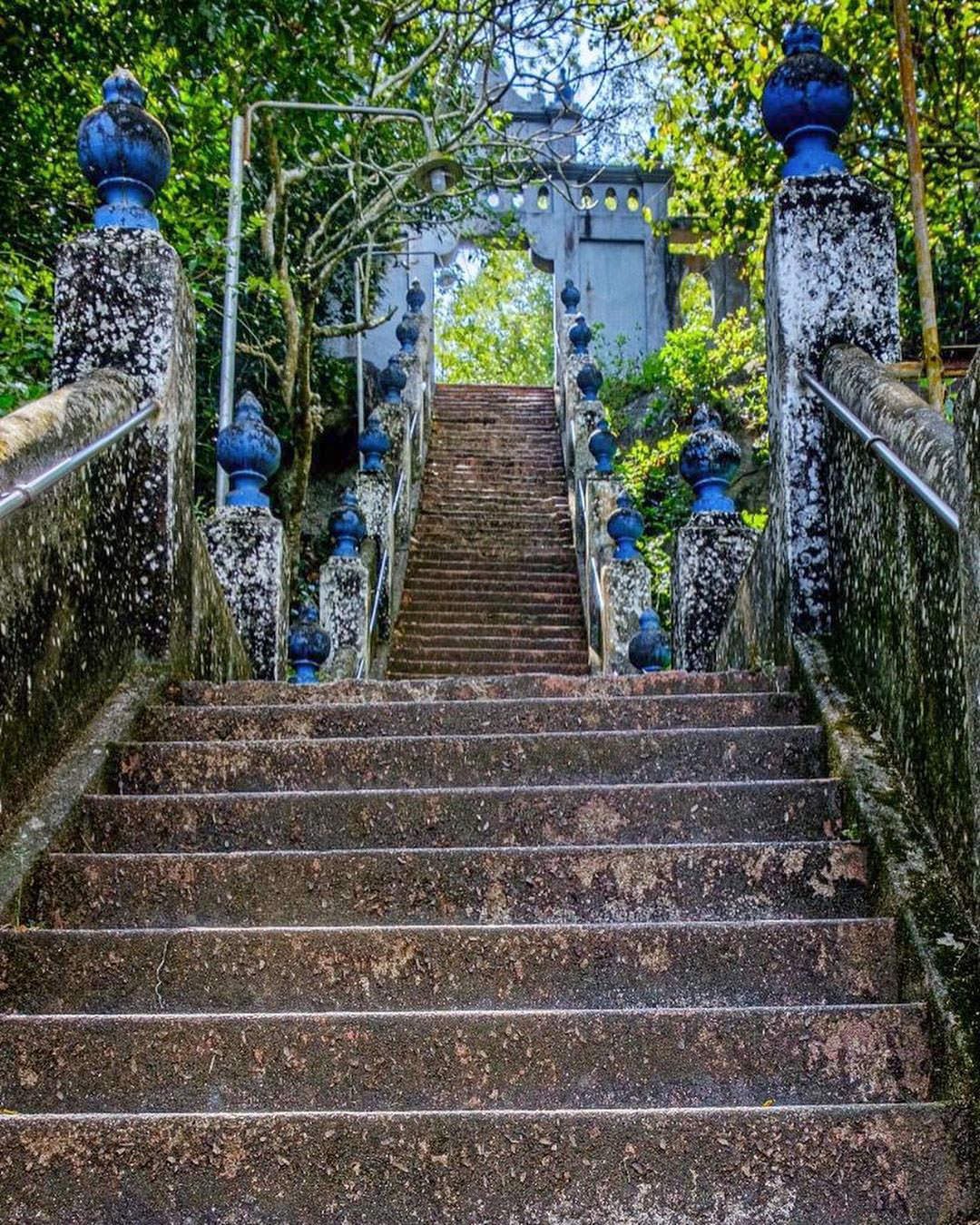
The complex is divided into five distinct areas, each with its own character and collection of shrines. Ascending from the base to the summit takes around 30 to 45 minutes on foot; the climb is moderately steep in places but manageable for most visitors.
Siyambalamaluwa
The entrance area contains the site museum, the lower temple, and a rest house. The museum offers useful context on the rock's archaeology and the royal inscriptions found across the site.
Lower Vihara Compound
This level holds the Royal Temple, tombs, the Seemamalakaya (boundary hall used for monastic ceremonies), a monastery, and the Paduma Rahath Vihara. The Paduma Rahath Vihara houses the largest reclining Buddha image in the entire complex. A small painted pagoda is tucked inside a cave nearby, and a modern information centre has been built on a terrace overlooking the surrounding lowlands.
Bomaluwa
The Bomaluwa level includes the Vesak hall compound and the Majjhima Nikaya cave, known as the Bhanaka cave, which was used by monks who specialised in the oral recitation of the Majjhima Nikaya texts.
Royal Temple Compound
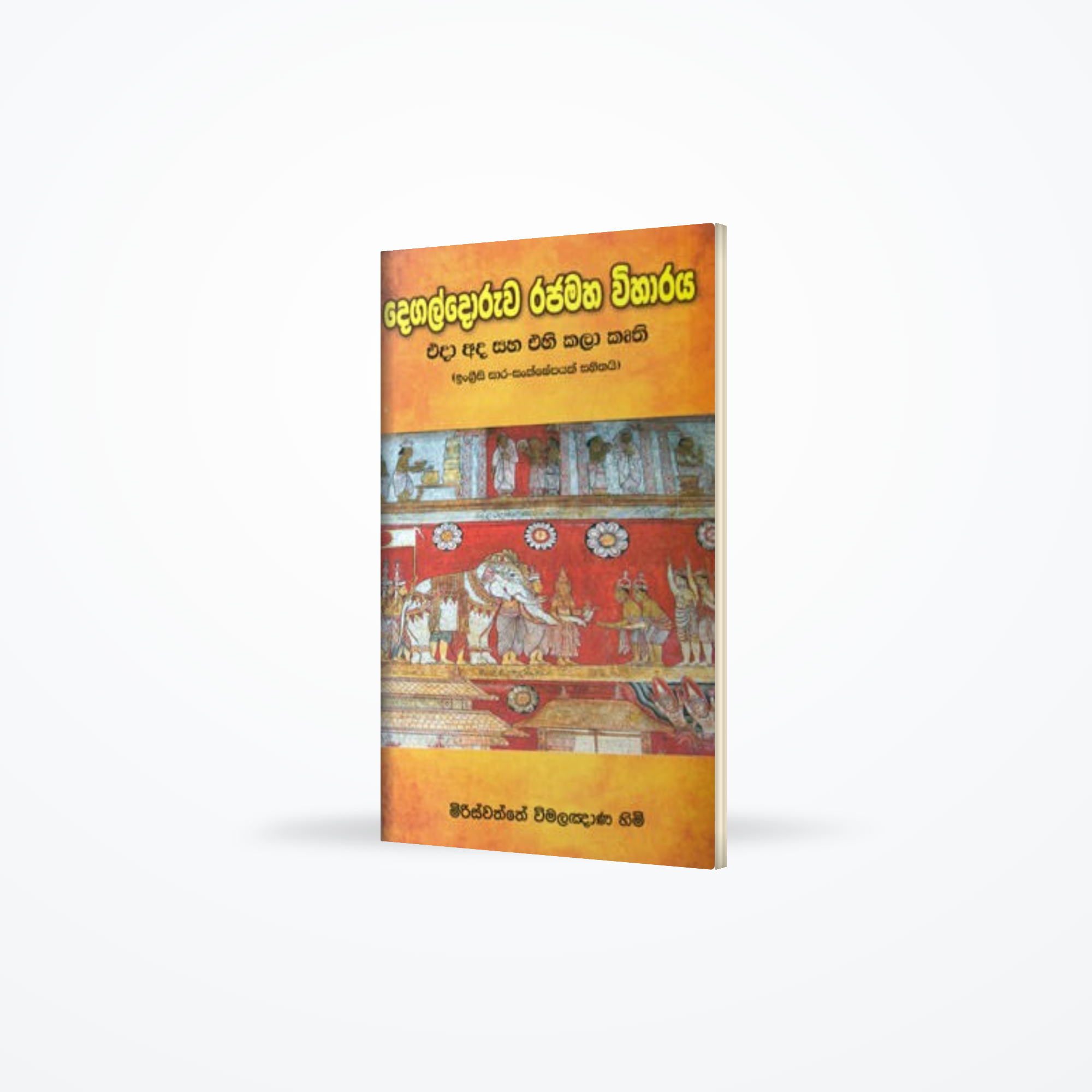
The caves here contain some of the finest Kandyan-period murals on the site, depicting scenes from the Jataka tales and the life of the Buddha. The quality and condition of the paintings at this level are particularly well-preserved, attributable in part to the protection offered by the overhanging rock.
Upper Temple Compound
The uppermost level rewards the effort of the climb. A white dagoba (stupa) crowns the rock, and on clear days the views extend across the southern coastal plain toward the Indian Ocean. The atmosphere here is notably serene, especially in the early morning.
What makes Mulkirigala architecturally significant?
The complex demonstrates a layered approach to rock-temple construction that spans more than two millennia of continuous use. Unlike temples built as freestanding structures, Mulkirigala's shrines exploit the natural contours of the rock: caves were deepened and shaped, overhangs were converted into verandahs, and flat ledges became meditation platforms. The result is a building tradition that reads as much as geology as it does architecture.
The murals deserve particular attention. Painted during the Kandyan renaissance of the 18th century under King Kirti Sri Rajasinha, they follow a stylistic vocabulary — flat perspective, bold outlines, rich ochres and blues — found in other royal patronage temples of that era. Mulkirigala's relative isolation has helped shield them from the humidity and visitor-traffic damage that affects some better-known sites.
When is the best time to visit Mulkirigala?
The Southern Province has two distinct weather patterns. The southwest monsoon (roughly May to September) brings heavier rain to this coast, while the period from November to April is generally drier and more comfortable for outdoor exploration. Mornings are cooler and the light is better for photographing the cave murals. During Vesak (May full moon) and Poson (June full moon) the temple hosts ceremonies worth attending if you happen to be in the area.
Is Mulkirigala suitable for all visitors?
The climb involves several hundred steps cut into the rock face, some of them uneven and steep. Visitors with limited mobility may find the upper levels difficult to reach, though the lower compounds alone contain enough of interest for a satisfying visit. Modest dress — covered shoulders and legs — is required throughout the complex, and shoes must be removed before entering shrine rooms. Carry water, as facilities on the upper levels are limited.
| Detail | Information |
|---|---|
| Location | ~2 km from Mulkirigala junction, between Dikwella and Tangalle |
| Rock height | 205 m (673 ft) |
| Nearest town | Tangalle (~16 km) / Dikwella (~12 km) |
| Best months to visit | November to April |
| Time needed | 2–3 hours for the full ascent and descent |
| Dress code | Covered shoulders and legs; shoes removed at shrine entrances |
Nearby places
8 places within about 25 km, nearest first.
- Naigala Raja Maha Viharaya8 km
- Rekawa City8 km
- Ranna Beach9 km
- Kalametiya Bird Sanctuary9 km
- Seenimodara beach10 km
- Ranna10 km
- Rekawa Town10 km
- Tangalle City10 km