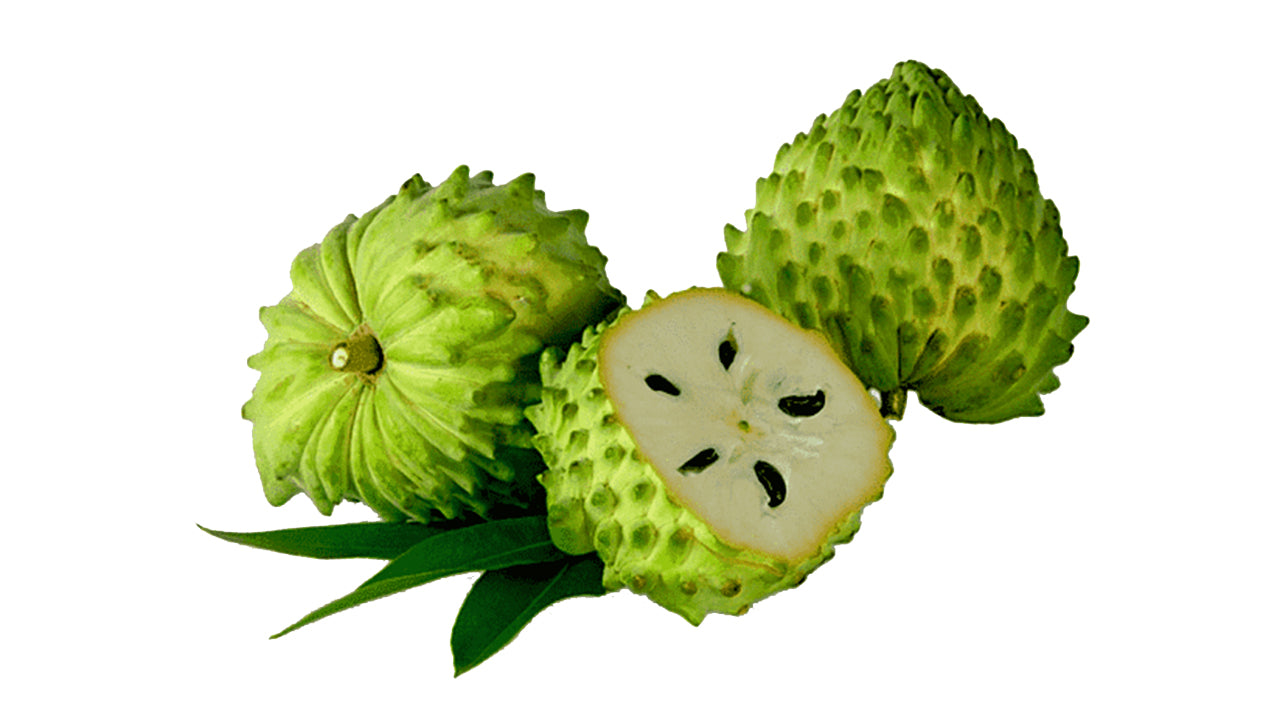
The sugar apple (Annona squamosa) is one of the most widely grown members of the Annona family and a familiar sight at fruit stalls across Sri Lanka. Known locally as seeni anodha (සීනි අනෝදා), the fruit is prized for its intensely sweet, custard-like flesh and its distinctive segmented skin that resembles a cluster of pale green scales. Whether you encounter it in a Colombo market or at a roadside stall in the hill country, the sugar apple is a flavour you are unlikely to forget.
What does a sugar apple tree look like?
The sugar apple tree is a small, open-canopied tree typically growing between 3 and 6 metres in height. Its branches follow an irregular, zigzagging pattern, and the dull green leaves — paler on the underside — release a faintly aromatic scent when crushed. Flowers appear singly or in small clusters of two to four, hanging on long drooping stalks. They are yellow-green on the outside with a pale yellow interior, and carry a light fragrance that attracts pollinators.
The fruit itself measures roughly 6 to 10 cm in length. Its outer surface is made up of rounded, knobby segments that separate easily when the fruit is ripe. Most sugar apples have green skin, though a dark red variety has been gaining popularity in some cultivation regions. Inside, each fleshy segment surrounds a single black or dark brown seed; a single fruit can contain up to 40 seeds.
Where does the sugar apple come from?
The precise origin of Annona squamosa is uncertain, but the species is thought to be native to tropical America and the West Indies. Spanish explorers are credited with bringing seeds to the Philippines, while the Portuguese are believed to have introduced the plant to southern India before 1590. From the Indian subcontinent, cultivation spread widely across South and Southeast Asia. Today the sugar apple is grown commercially in India, Brazil, Thailand, and Sri Lanka, among many other tropical countries.
In Sri Lanka, the tree thrives in the dry and intermediate zones, where warm temperatures and well-drained soils suit its growth. It fruits roughly three to four months after flowering in spring, and the harvest season typically falls between July and October, though this can vary by elevation and location.
How do you eat a sugar apple?
The traditional — and arguably best — way to eat a sugar apple is straight out of hand. Press gently on the skin until the segments pull apart, then scoop the translucent white pulp away from the rind with a spoon or simply with your fingers, setting aside the seeds as you go. The texture is soft and creamy, the flavour intensely sweet with subtle notes of vanilla and pear.
In many countries the pulp is pressed through a sieve to remove seeds, then stirred into ice cream, blended with milk into a chilled drink, or folded into desserts. One point is consistent across all preparations: sugar apples are never cooked, as heat degrades both the texture and delicate flavour of the fruit.
- Fresh, out of hand — the most common and enjoyable method
- Blended with milk — a popular drink in India and Sri Lanka
- Stirred into ice cream — the pulp adds natural sweetness and creaminess
- Pressed and strained — seed-free pulp used in desserts and smoothies
Are any parts of the sugar apple poisonous?
Yes. While the pulp is entirely safe to eat, the seeds, bark, and leaves of Annona squamosa contain toxic compounds. The seeds in particular are considered poisonous if chewed or swallowed whole, and powdered seeds have historically been used as a fish poison and insecticide in parts of India. A paste made from crushed seeds was once applied to the scalp as a traditional remedy for head lice, and oil extracted from the seeds has been used as a pesticide.
This is not a cause for alarm when eating the fruit — provided you spit the seeds out rather than chewing them, the pulp poses no risk. Exercise ordinary caution and keep the seeds away from children and pets.
What are the traditional uses of sugar apple leaves and bark?
Across South Asia, various parts of the sugar apple plant have a long history of use in traditional medicine and household applications. Crushed leaves have been inhaled as a folk remedy for fainting and hysteria, and leaf poultices have been applied topically to minor wounds. A decoction prepared from the leaves has been used in traditional Ayurvedic and folk medicine contexts in India and Sri Lanka, though modern clinical evidence for most of these applications remains limited.
Essential oil derived from the leaves has historically been valued in perfumery for its warm, aromatic character. The bark, like the seeds, contains compounds that have been used as natural insect repellents. None of these applications substitute for medical advice, and any therapeutic use should be discussed with a qualified practitioner.
How does the sugar apple compare to similar fruits?
| Fruit | Species | Skin | Flavour | Seeds |
|---|---|---|---|---|
| Sugar apple (sweetsop) | Annona squamosa | Segmented, scaly | Very sweet, vanilla | Many (up to 40) |
| Soursop | Annona muricata | Spiny, green | Sweet-tart, citrusy | Many |
| Cherimoya | Annona cherimola | Smooth, scaly | Mild, creamy | Fewer |
| Atemoya | Hybrid | Bumpy, pale green | Sweet, less fibrous | Fewer |
Where can you find sugar apples in Sri Lanka?
Sugar apples are sold at local markets (pola) throughout Sri Lanka's dry zone, including areas around Anuradhapura, Kurunegala, and the North Central Province. They also appear at fruit stalls in Colombo, particularly during the main fruiting season. Visitors exploring the rural interior — whether on a tuk-tuk safari through agricultural villages or a countryside drive — often encounter the trees growing in home gardens and smallholdings.
For a more immersive experience, a visit to a working fruit farm such as Midigama Fruit Farm on the southern coast gives travellers the chance to see tropical fruits — including varieties of Annona — growing in context, and often to taste them fresh from the tree.
What nutritional value does the sugar apple have?
Sugar apple pulp is a good source of vitamin C, several B vitamins (particularly B6 and folate), potassium, and magnesium. It also contains dietary fibre and natural sugars — hence the name. The caloric density is moderate for a tropical fruit. Because the pulp is eaten raw, its vitamin content is retained fully. It is generally considered a nutritious addition to a balanced diet, though people monitoring blood sugar levels should be mindful of its high natural sugar content.