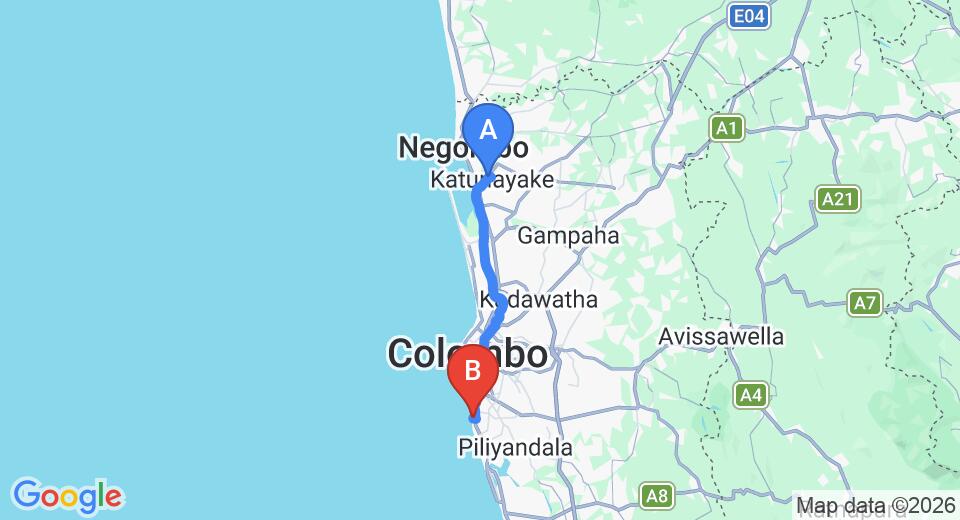
Mount Lavinia sits just 10 kilometres south of central Colombo along the island's western coast, making it one of the most accessible seaside escapes from the capital. Part residential suburb, part low-key resort strip, it occupies a pleasant middle ground between the urban energy of Colombo and the slower pace of the beaches further south. Shaded villas line the lanes that thread between the main road and the sea, and the pace of life here is noticeably quieter than the city centre — even though you are never more than 20 minutes away from it.
How do I get to Mount Lavinia from Colombo?
The most straightforward route is along the A2 highway, the Colombo–Galle road, which runs directly through the suburb. By car or tuk-tuk the journey from central Colombo typically takes 20 to 40 minutes depending on traffic. The southern railway line also serves Mount Lavinia, with frequent commuter trains stopping at Mount Lavinia station — a practical and inexpensive option if you are travelling light. From Bandaranaike International Airport, the drive is around an hour under normal traffic conditions.
If you are arriving from the airport and want a hassle-free start to your stay, a pre-booked private transfer is worth considering, particularly if you are landing late or travelling with luggage.
What is Mount Lavinia Beach like?
Mount Lavinia Beach is the closest stretch of sand to central Colombo, which makes it a favourite for city residents on weekends and public holidays. It is not a wide, palm-fringed bay in the style of Mirissa or Unawatuna — the beach is relatively narrow and the water can be rough during the south-west monsoon (roughly May to September). That said, the northern end of the beach, in front of the historic Mount Lavinia Hotel, offers a sheltered bay that is genuinely pleasant for an early morning walk or a relaxed afternoon. Access to that bay section is generally reserved for hotel guests.
The public beach stretching south of the hotel is lively on Sunday mornings, lined with small seafood restaurants and beach-snack vendors. Sunsets here tend to be vivid, with the sea horizon uninterrupted by headlands.
What is the history behind Mount Lavinia?
The area takes its name — at least in local legend — from a romance involving Sir Edward Barnes, British Governor of Ceylon from 1824 to 1831. According to the story, Barnes built a clifftop residence here for a Spanish dancer named Lovina, and the name Lavinia is said to be a corruption of her name. The colonial-era building became the Mount Lavinia Hotel, which still operates on the promontory and remains one of the most evocative colonial properties on the island. Whether or not the romantic legend is fully accurate, the hotel's setting — a low cliff above the sea, with wide verandas and period architecture — gives the suburb much of its distinctive character.
What can I see and do near Mount Lavinia?
Several worthwhile day excursions are within easy reach:
- Dehiwala Zoo and Aquarium — one of the oldest zoological gardens in Asia, a short drive north along the coast road. It houses a substantial collection of mammals, birds, and reptiles, as well as an aquarium section.
- Ratmalana Sri Lanka Air Force Museum — a compact open-air collection of historic aircraft immediately north of Mount Lavinia. Entry is straightforward and it makes a quick, interesting stop for those interested in aviation history.
- Bellanwila Raja Maha Vihara — a working Buddhist temple set among tall trees in the suburb of Bellanwila, known for its serene atmosphere and large Buddha statues. The annual perahera (procession) here draws large crowds.
- Kelaniya Raja Maha Vihara — one of the most revered Buddhist temples in Sri Lanka, located north of Colombo on the banks of the Kelani River. The existing temple, celebrated for its murals and sculptural detail, was largely restored through the patronage of the Wijewardene family in the early twentieth century after earlier structures were destroyed by Portuguese forces.
- Colombo city sightseeing — the capital's landmarks, including the Colombo Lotus Tower, Gangaramaya Temple, and the Pettah bazaar district, are all reachable in under 30 minutes.
When is the best time to visit Mount Lavinia?
Mount Lavinia is accessible year-round. The driest and calmest period for the western coast runs from approximately November to April, when the north-east monsoon keeps skies relatively clear and sea conditions are settled. This is when the beach is at its most usable. The south-west monsoon, active from May through September, brings heavier rain and rougher surf — the beach is less appealing for swimming but the area remains very much open for sightseeing and dining. October marks the inter-monsoon transition and can be unsettled.
Where should I eat in Mount Lavinia?
The beachfront strip south of the hotel has a cluster of open-air seafood restaurants that are popular with locals and visitors alike. Grilled kingfish, devilled prawns, and crab curry are common offerings. Prices are generally modest compared to hotel dining. The Mount Lavinia Hotel itself operates several restaurants and its Sunday buffet brunch has long been a fixture for Colombo families — booking ahead is advisable on weekends. For something different, the broader Colombo dining scene is close enough to reach easily by car for an evening out: a Colombo city tour can be paired with dinner in the Fort or Colombo 3 areas.
Is Mount Lavinia a good base for exploring Sri Lanka?
For travellers who have business in Colombo or who are arriving and departing through Bandaranaike International Airport, Mount Lavinia makes a practical and pleasant base. It offers a quieter setting than the city centre while keeping Colombo's shops, restaurants, and transport links within easy reach. Day trips to the Cultural Triangle, the hill country, or the southern beaches are all feasible from here, though distances and travel times in Sri Lanka should be planned carefully — roads can be slower than expected.
If your itinerary extends further south, the Galle road (A2) runs directly through Mount Lavinia, giving straightforward onward access to Hikkaduwa, Galle, and beyond. A stop at Galle for its Dutch colonial fort and ramparts is a natural extension of a western-coast journey.