Lakpura
Lakpura®

Tinospora sinensis

Tinospora sinensis is a woody climbing shrub native to tropical Asia and widely documented in Sri Lanka's traditional medicine systems. Known locally as Bu Kinda (බු කින්දා) or Wal Kinda (වල් කින්දා), it belongs to the family Menispermaceae and has been recorded as part of Sri Lanka's official catalog of Ayurvedic medicinal plants. The plant grows inconspicuously in secondary forests, forest margins, and along roadsides, yet its pharmacological reputation in traditional healing is considerable.

What does Tinospora sinensis look like?

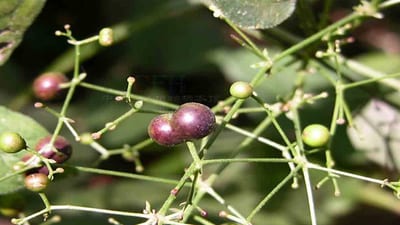
Tinospora sinensis is a succulent woody climber that typically establishes itself by sending long aerial roots down from host trees. These aerial roots are one of the plant's most distinctive identifying features, giving established specimens a striking, cascading appearance in the forest canopy.

  • Bark: Corky or papery in texture, exfoliating as it dries.
  • Leaves: Simple and alternate, broadly ovate to sub-cordate in shape, with a margin that is either entire or lightly dentate. The leaf base is not peltate, and basal veins number between three and seven; lateral veins run in one to three pairs.
  • Petioles: Geniculate (bent at a joint) and distinctly swollen near the base — a reliable identification marker.
  • Inflorescences: Axillary or borne on old leafless branches, arranged in pseudoracemes or pseudopaniculate thyrsoid clusters, typically few-flowered and carried on a distinct peduncle.

The overall habit is that of a vigorous climber that spreads across the canopy of its host tree, sometimes reaching considerable lengths in undisturbed habitat.

Where does Tinospora sinensis grow in Sri Lanka?

Tinospora sinensis is distributed across the lowland and mid-country zones of Sri Lanka, favouring disturbed forest edges, scrubland, and the fringes of moist and dry mixed evergreen forests. It is not restricted to protected reserves and can be observed in secondary growth throughout the wet and intermediate climatic zones. The plant tends to colonise wherever host trees are available, making it relatively easy to encounter on nature-focused itineraries in areas such as the dry-zone forests near Wilpattu National Park and the moist lowland forests of the south-west.

Within traditional village settings, the plant is sometimes semi-cultivated in home gardens for ready access to its medicinal parts, particularly the stem and root bark.

What is Tinospora sinensis used for in Ayurveda?

In Sri Lankan Ayurveda and traditional folk medicine, virtually every part of Tinospora sinensis is considered therapeutically active. The stem, root, leaves, and aerial roots are all referenced in classical texts and practised formulations. Documented traditional applications include:

  • Anaemia: Preparations from the stem are used as a tonic believed to support blood formation.
  • Worm infestation: Anthelmintic (anti-parasitic) properties are attributed to stem and root extracts.
  • Jaundice and liver complaints: Decoctions from the plant have long been prescribed by traditional physicians for hepatic conditions.
  • Dyspepsia and digestive disorders: Bitter principles in the stem are considered useful for improving digestion and appetite.
  • Skin diseases: Topical and internal preparations are used in managing chronic skin conditions.

The species is closely related to Tinospora cordifolia — known in Ayurvedic literature as Guduchi or Amrita — which has an extensive pharmacological research record in South Asian medicine. Both species share a broadly similar alkaloid and glycoside profile, which partly explains the overlapping therapeutic uses recognised across Sri Lankan and Indian traditional systems. Sri Lanka's Department of Ayurveda has formally included Tinospora sinensis in its catalog of recognised medicinal plants, lending institutional recognition to its traditional status.

How does Tinospora sinensis fit into Sri Lanka's broader medicinal plant heritage?

Sri Lanka holds an extraordinarily rich pharmacopeia of native and naturalised medicinal plants, many of which remain in active use in rural and semi-urban communities. Tinospora sinensis sits within a tradition that stretches back at least two millennia, documented in the ancient chronicles associated with monastic hospitals at sites like Polonnaruwa, where early medieval kings patronised large-scale Ayurvedic medical institutions.

Other woody climbers and forest-edge shrubs feature prominently in this tradition. For example, Acacia chundra is another tree whose bark is referenced in Ayurvedic practice for astringent and wound-healing applications, while Pongamia pinnata is used in both medicine and as a source of oil across the island's rural communities. Together, these species illustrate the depth and specificity of Sri Lanka's botanical knowledge tradition.

Researchers and practitioners continue to study Tinospora species for bioactive compounds — including berberine, tinosporin, and various diterpenoid lactones — that may underpin their classical uses. Modern pharmacognosy increasingly corroborates what traditional practitioners observed empirically over centuries.

Is Tinospora sinensis the same as Guduchi or Giloy?

Tinospora sinensis and Tinospora cordifolia (commonly called Guduchi or Giloy in Indian Ayurveda) are distinct but closely related species within the same genus. They share many morphological features and a broadly similar medicinal profile, which means the two are sometimes used interchangeably in practice. In Sri Lanka, T. sinensis is the species more commonly documented in local flora surveys, though T. cordifolia is also present. Practitioners of traditional medicine on the island refer to both under the umbrella Sinhala name Kinda, with prefixes like Bu (meaning 'cow') or Wal (meaning 'forest') used to distinguish varieties by appearance, habitat, or potency.

Can travellers encounter this plant in Sri Lanka?

Visitors with an interest in ethnobotany or traditional medicine will find that Sri Lanka offers genuine opportunities to learn about plants like Tinospora sinensis in context. Ayurvedic spice and herb gardens attached to wellness resorts sometimes cultivate the plant, and knowledgeable local guides can point it out during forest walks. Nature itineraries through moist lowland forests — such as those exploring the Sinharaja Forest Reserve or the waterway systems of the south-west coast — frequently pass through secondary growth where the plant occurs naturally.

For travellers curious about Sri Lanka's living herbal tradition, a visit to an authentic Ayurvedic practitioner or a rural herb garden provides far more depth than a brief roadside encounter. The island's Ayurvedic knowledge is still transmitted through active practice, and many resorts and rural homestays can facilitate introductory consultations.

Ask Lakpura® Agent