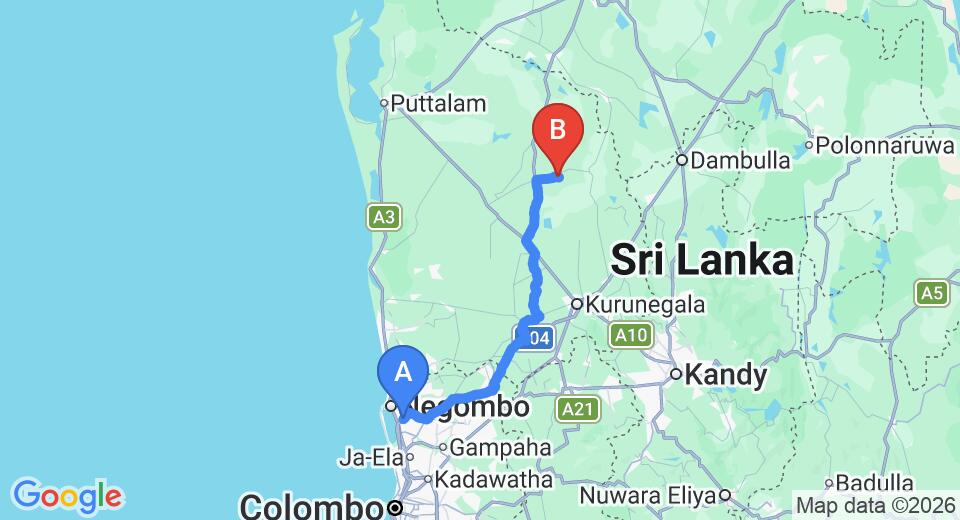
Tucked into the agricultural heartland of Sri Lanka's North Central Province, Maho sits roughly 25 kilometres southeast of Anuradhapura city. It is a modest, unhurried town where rice paddies stretch to the tree line, Buddhist temple bells mark the hours, and daily life moves at a pace that most travellers rarely encounter. For visitors on the heritage trail between Colombo and the ancient capitals, Maho offers a genuine look at rural Sri Lanka rather than a curated one.
What is Maho known for?
Agriculture defines Maho as much as anything else. The surrounding lowlands are blanketed with paddy fields — known locally as kumbura — that turn a vivid green during the cultivation season and gold at harvest. Rice is the cornerstone crop, grown using a mix of centuries-old irrigation knowledge and contemporary farming methods. Vegetable plots and small fruit orchards fill the gaps between paddies, supplying local markets and passing traders.
Beyond farming, Maho carries a quiet but tangible Buddhist identity. The Maho Rajamaha Viharaya is the town's most significant religious landmark, drawing pilgrims from surrounding villages as well as curious travellers. The temple complex reflects the architectural conventions common to Sri Lanka's North Central Province — whitewashed stupas, a bodhi tree enclosure, and painted shrine rooms — and gives an accessible introduction to the living Buddhist traditions of the region.
How do I get to Maho from Colombo?
Maho lies on the main northern railway line, making it straightforward to reach by train from Colombo Fort station. The journey takes around three to four hours depending on the service. By road, the A12 and A9 highways provide a comfortable drive of roughly 150 kilometres, typically covered in under three hours outside peak traffic. Most visitors arrive as part of a broader North Central Province itinerary that also includes Anuradhapura, Yapahuwa, or Polonnaruwa.
What is the Maho Rajamaha Viharaya?
The Rajamaha Viharaya is a working temple rather than a preserved ruin, which distinguishes it from many heritage sites in the wider Anuradhapura district. Monks reside here year-round, and the temple actively runs a Dhamma school for local children. Visitors are welcome to observe worship quietly and are encouraged to dress modestly — shoulders and knees covered — and to remove footwear before entering shrine areas. Poya (full-moon) days bring noticeably larger gatherings of devotees and are particularly atmospheric.
What is there to do around Maho?
Maho itself is best treated as a base or a considered stop rather than a full-day destination. Its value lies in the texture of everyday life: a morning walk past the paddy fields, a visit to the local market, or a conversation with a farming family about the coming harvest. A tuk-tuk ride through the surrounding countryside reveals a patchwork of small holdings, irrigation tanks, and village temples that rarely feature on standard itineraries.
- Yapahuwa Rock Fortress — approximately 15 kilometres southeast of Maho, this 13th-century citadel built on a dramatic granite outcrop is the most historically significant site in the immediate area. Its ornately carved ceremonial staircase is considered one of the finest examples of medieval Sri Lankan stone craft.
- Ridi Viharaya — a cave temple complex roughly 30 kilometres to the south, notable for its silver ore deposits and Dutch-period tiles alongside far older shrine rooms.
- Wilpattu National Park — Sri Lanka's largest national park lies around 60 kilometres to the west. Wilpattu is famed for its natural lakes, known as villus, and supports healthy populations of leopard, sloth bear, and elephant.
- Anuradhapura Sacred City — the ancient capital, a UNESCO World Heritage Site, is a straightforward drive north and can be paired with a visit to Maho on the same day.
When is the best time to visit Maho?
The North Central Province has a well-defined dry season from roughly May to September, when roads are reliable and the heat is manageable in the mornings and evenings. The paddy fields are particularly photogenic immediately after the rains, when the Maha (main) cultivation season produces a landscape that is intensely green. December through February brings cooler temperatures and the Yala (secondary) harvest season, which is also an excellent window for visiting nearby parks such as Wilpattu. Avoid travelling on the B-roads between Maho and Yapahuwa immediately after heavy rain, as some stretches can become waterlogged.
Where can I stay near Maho?
Accommodation options in Maho are limited but improving. Small guesthouses and homestays in the surrounding villages offer a genuinely local experience. Yapahuwa Paradise Resort is the most established property in the immediate area, catering to travellers who want comfortable facilities without travelling back to Anuradhapura each night. For a more complete range of hotels and services, Anuradhapura city — roughly 25 kilometres north — provides a wider choice across all price ranges.
Is Maho worth visiting for first-time travellers to Sri Lanka?
Maho is unlikely to be the primary reason someone flies to Sri Lanka, but it rewards travellers who are already exploring the Cultural Triangle or the North Central Province and want to venture beyond the headline sites. The town illustrates how rural Sri Lanka functions day-to-day — the social role of the temple, the rhythms of subsistence and smallholder agriculture, and the community structures that have changed relatively little in generations. For travellers with a genuine interest in living culture rather than just monuments, a half-day in Maho can be one of the more memorable parts of a northern itinerary.