Lakpura
Lakpura®

Hanthana Tea Plantations

Draped across the slopes of the Hanthana Mountain Range just south-west of Kandy, the Hanthana Tea Plantations sit at an elevation that produces some of Sri Lanka's most distinctive mid-grown teas. The area is not a single estate but a cluster of working plantations embedded in a landscape of terraced tea bushes, cloud-forest patches, and narrow estate roads that wind between ridges. For travellers already in Kandy, it is a half-day excursion that combines agricultural heritage with genuine highland scenery — no long drives required.

What is the history of Hanthana's tea estates?

Commercial tea cultivation in Sri Lanka took hold in the 1870s after coffee blight wiped out the island's dominant crop, and the Hanthana range was among the first areas converted to tea. The estates here are counted among the oldest continuously operating plantations in the country, supplying leaf to factories whose origins date back to the British colonial period.

The most tangible expression of that history stands nearby at the Ceylon Tea Museum in Hantane — housed in the Hantane Tea Factory, a four-storey building constructed in 1925 and later refurbished as a heritage site. Its machinery halls display withering troughs, rolling machines, and drying chambers that have not been stripped of industrial character. Exhibits trace the lives of pioneering planters and the Tamil estate workers who shaped the industry, making the museum one of the more candid introductions to Sri Lanka's plantation era.

What can you see and do at Hanthana Tea Plantations?

A walk through the estates during the plucking season shows the full rhythm of tea production at ground level. Experienced pluckers move steadily along the rows, selecting the two leaves and a bud that determine final cup quality. Visitors can observe the process without disrupting work schedules, and some estate managers are willing to explain the grading system on request.

  • Factory tours: Several estates in the range operate small processing facilities. A tour typically covers withering, rolling, oxidation, firing, and sorting — the five stages that transform fresh leaf into the black tea familiar to export markets.
  • Tea tasting: Estate bungalows and the Ceylon Tea Museum offer cupped tastings. Mid-grown Kandy-region teas tend toward a full, brisk character with a reddish liquor, quite different from the lighter high-grown teas of Nuwara Eliya.
  • Cycling tours: The estate roads and mountain tracks around Hanthana are well suited to cycling. A guided cycling tour covers gradients and viewpoints that a casual walk would miss, and the physical effort is rewarded by sweeping views across the Mahaweli valley.
  • Hiking: The Hanthana range has marked trails that pass through shade trees, cardamom plots, and forest edges. The terrain is moderate rather than technical, accessible to most fitness levels.
  • Bird-watching: The forest corridors between estates support a range of endemic and migratory species. Early morning walks, before estate activity picks up, give the best chances of sighting birds such as the Sri Lanka white-eye and various flycatcher species.

When is the best time to visit Hanthana Tea Plantations?

The Kandy region receives two monsoon influences, so there is no single dry season. In broad terms, the period from January to April tends to be drier and cooler, making mornings clear and the light on the tea slopes particularly good for photography. The estates remain green and operational year-round because tea requires consistent rainfall to produce flush.

Plucking activity is typically highest during the inter-monsoon periods when the flush — the new growth triggered by rain followed by dry spells — is at its most vigorous. Visiting in late morning on a weekday gives the best chance of watching active harvesting. Weekends can be busier, particularly if the Kandy city tour circuit is in full swing during peak travel months.

How do I get to Hanthana Tea Plantations from Kandy?

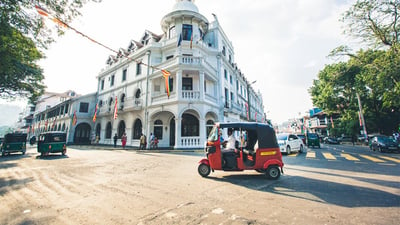
The plantations are roughly 4 to 6 kilometres from Kandy city centre depending on which estate road you take. A three-wheeler (tuk-tuk) from the Kandy bus stand or your hotel is the most practical option for independent travellers and takes around 15 to 20 minutes. Private car hire is equally easy to arrange and allows you to stop at viewpoints along the ascent.

For those combining the visit with a city orientation, the Kandy Tourist Information Center can advise on current road conditions and any estate access restrictions. Some roads narrow considerably near the upper estates and are not suitable for larger vehicles.

How does Hanthana tea compare with other Sri Lankan growing regions?

Sri Lanka's tea classification is largely altitude-driven. High-grown teas (above roughly 1,200 metres) from areas such as Nuwara Eliya and Dimbula are prized for delicacy and light colour. Low-grown teas from Ruhuna in the south produce a bold, dark cup suited to strong milk tea. Hanthana sits in the mid-grown category — elevations that deliver a balance between body and brightness, making the resulting teas versatile for both plain and milk preparations.

Enthusiasts who want to explore the regional character further can compare Hanthana teas against those from Bluefield Tea Gardens in the Kandy district, where guided tastings are also available. Each estate carries distinct flavour notes shaped by soil, micro-climate, and processing house traditions.

Is Hanthana suitable for families and less mobile visitors?

The Ceylon Tea Museum is fully accessible by vehicle and requires only moderate walking on level ground inside the factory building. The estates themselves involve uneven terrain and some gradient, so visitors with limited mobility may prefer to appreciate the landscape from the road or a viewpoint rather than attempting the field trails. Children generally enjoy the novelty of plucking a few leaves and learning where their morning cup originates — most estate managers are tolerant of curious visitors as long as working rows are not disrupted.

What else is near Hanthana worth combining with the visit?

The Hanthana range edges the University of Peradeniya campus, itself set in gardens that include the Royal Botanic Gardens, Peradeniya — one of the finest tropical botanical collections in Asia. Combining a morning at the tea estates with an afternoon at the Botanic Gardens makes for a well-rounded day without covering excessive distance. The Mahaweli River, which sweeps through the valley below, offers a natural counterpoint to the highland landscapes of the estates.

Travellers with more time in the central highlands may want to continue south toward Horton Plains National Park, where the landscape shifts entirely — from manicured tea rows to wild montane grassland and cloud forest at the island's highest plateau.

Book this experience with Lakpura

Curated by our local team. Direct booking, instant confirmation.

Ask Lakpura® Agent