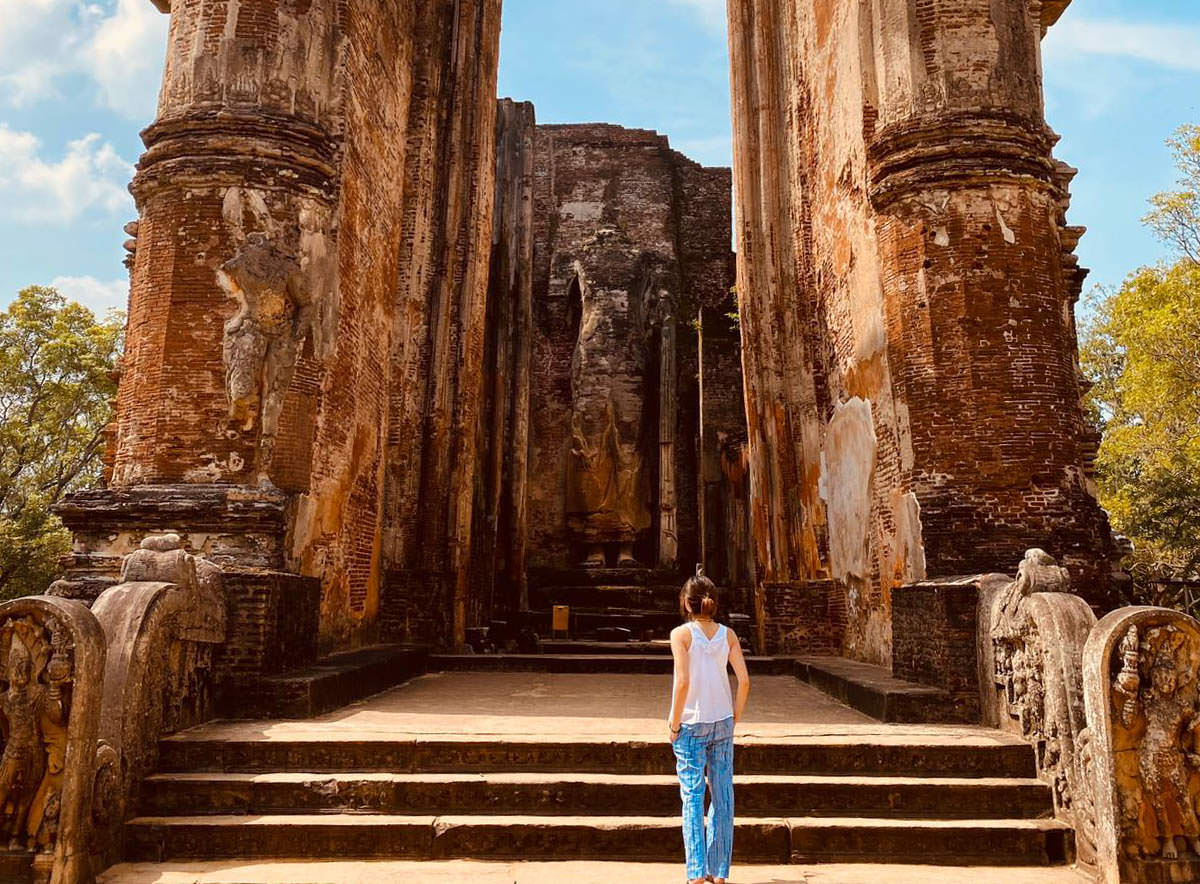
More than two millennia ago, a succession of powerful kingdoms raised cities across the dry plains of north-central Sri Lanka that rivalled the great capitals of Asia and the Mediterranean world. What remains — colossal dagobas, intricately carved stone temples, serene Buddha images, and a network of reservoirs that still irrigates the surrounding farmland — forms one of the most concentrated collections of ancient heritage anywhere on earth. Five of these sites carry UNESCO World Heritage status, and four of them cluster within a single region known as the Cultural Triangle, making Sri Lanka's ancient cities unusually accessible to the traveller.
What is the Cultural Triangle and which cities does it include?
The Cultural Triangle is a roughly triangular area in Sri Lanka's North Central and surrounding provinces, anchored at its three main points by Anuradhapura, Polonnaruwa, and Kandy. Within and around this triangle lie some of the island's most significant ancient sites: the rock fortress of Sigiriya, the cave temple complex of Dambulla, and the medieval capital of Polonnaruwa, among others. Kandy, home to the Temple of the Tooth Relic, completes the southern vertex. Distances between the main sites rarely exceed three hours by road, so most visitors explore the triangle over four to six days.
What makes Anuradhapura significant?
Anuradhapura is the oldest and largest of Sri Lanka's ancient capitals, situated around 205 km north of Colombo in the North Central Province on the banks of the Malwatu Oya. Founded as a royal capital by King Pandukabhaya around 380 BCE, the city grew over the following centuries into a metropolis whose reputation reached the Roman-Hellenistic world of the Mediterranean and established trade links with China by the first century AD.
At its peak, Anuradhapura was the seat of more than 250 Buddhist and Hindu kings and served as the island's political and spiritual centre for roughly 1,400 years. Its skyline was defined by immense dagobas — solid brick-and-earth domes enclosing sacred relics — several of which still rise to heights of over 80 metres, dominating a flat landscape of paddy fields and coconut palms. The Jetavanarama Dagoba, built during the reign of King Mahasena (AD 276–303), was among the largest brick structures in the ancient world.
Buddhism arrived in Anuradhapura in the third century BCE, reportedly brought by Mahinda, son of the Indian emperor Ashoka, and the city became one of the foremost centres of Theravada Buddhism in all of South Asia. That spiritual legacy endures: pilgrims visit the sacred Bodhi Tree — said to be grown from a cutting of the original tree under which the Buddha attained enlightenment — year-round, making Anuradhapura simultaneously an archaeological site and a living place of worship. The city's proximity to southern India, which enriched its culture and trade, ultimately contributed to its downfall when Rajaraja Chola sacked it in the 11th century AD, prompting the Sinhalese court to relocate south-east to Polonnaruwa.
UNESCO inscribed Anuradhapura as a World Heritage Site, recognising its outstanding universal value as both an urban archaeological landscape and a centre of Buddhist heritage. The protected zone covers more than 30 square kilometres of monasteries, shrines, and ancient reservoirs.
What can visitors see at Polonnaruwa?
Polonnaruwa served as Sri Lanka's second great capital from the 11th to the 13th century AD, after Anuradhapura fell to the Chola invaders. Its ruins are generally better preserved and, for many visitors, easier to read as a coherent city. The royal palace complex, audience hall, and the spectacular Gal Vihara — four enormous Buddha figures carved directly into a granite face — are among the most photographed ancient monuments in Sri Lanka.
Unlike Anuradhapura, which is spread across a very large area, Polonnaruwa's main monuments are concentrated enough that a full circuit by bicycle — a popular option among visitors — takes around half a day. The site is also a UNESCO World Heritage Site and remains an active archaeological zone; excavations continue to uncover new structures and artefacts.
What is Sigiriya and why does it matter?
Rising abruptly from the surrounding plains, Sigiriya is a 200-metre volcanic rock column that King Kashyapa I (AD 477–495) transformed into a fortified palace and pleasure garden. Terraced water gardens, lion-paw staircases, and a series of remarkably well-preserved fresco paintings of celestial maidens — known as the Sigiriya Damsels — cling to the rock's sheer faces. Sigiriya is Sri Lanka's only site designated a World Heritage Site specifically as a combined work of urban planning, landscape design, and visual art.
The climb to the summit takes around 45 minutes to an hour depending on fitness and crowd levels, and rewards visitors with sweeping views across the forest canopy of the North Central Province. Early morning ascents, before the midday heat, are generally more comfortable.
Which other UNESCO World Heritage Sites are in or near the Cultural Triangle?
Beyond Anuradhapura, Polonnaruwa, and Sigiriya, the Cultural Triangle also encompasses Dambulla, whose Royal Cave Temple complex of five caves contains Sri Lanka's largest concentration of ancient murals and over 150 Buddha statues. Further south, the Hill Capital of Kandy — home to the Dalada Maligawa, or Temple of the Tooth Relic — holds the fifth Sri Lankan UNESCO designation. Kandy's Esala Perahera Festival, held annually in July or August, is one of Asia's oldest and most elaborate religious processions.
What are the ancient irrigation achievements of Sri Lanka?
No account of Sri Lanka's ancient cities is complete without acknowledging their engineering legacy. The kings of Anuradhapura and Polonnaruwa constructed a network of reservoirs — called tanks or wewas — and inter-connecting canals that turned an arid plain into productive agricultural land. Several of these reservoirs remain in use today, and the scale of the achievement — earthwork dams stretching for kilometres, sluice mechanisms of sophisticated design — continues to impress engineers and historians. The Parakrama Samudra at Polonnaruwa, a vast artificial lake named after King Parakramabahu I, is the most celebrated example.
This mastery of water management also supported large urban populations, including the monks of the great monasteries, whose institutions required reliable food surpluses to function. The symbiosis between royal patronage, Buddhist monasticism, and hydraulic engineering is one of the defining characteristics of Sri Lanka's ancient civilisation.
When is the best time to visit the ancient cities of Sri Lanka?
The North Central Province, where most ancient sites are located, has a dry climate for much of the year, with the main rainy season falling between October and January. The most comfortable months for sightseeing are generally from January through April, when temperatures are lower in the mornings and afternoons. Between May and September the region is dry and hot; visiting early in the morning and resting during midday is advisable. Pilgrimage festivals at Anuradhapura — particularly Poson Poya in June, which commemorates the arrival of Buddhism in Sri Lanka — draw large crowds and are worth witnessing, though accommodation should be booked well in advance.
How do I get to the ancient cities from Colombo?
Anuradhapura lies roughly 205 km north of Colombo, a journey of around four hours by road or approximately five hours by train on the Northern Line. Polonnaruwa is around 215 km from Colombo and accessible by road in roughly five hours or by the Batticaloa train line. Sigiriya has no rail link; the most practical approach is by private vehicle from either Colombo (roughly four hours) or from the nearby town of Dambulla. A private car with a driver-guide remains the most flexible way to move between the Cultural Triangle sites, allowing stops at viewpoints and smaller monuments that public transport cannot reach.
Practical tips for visiting the ancient sites
- Dress modestly — shoulders and knees covered — when entering temples and active religious precincts. This is mandatory at most sacred sites, not merely recommended.
- Remove footwear before entering dagoba precincts and temple interiors. Lightweight slip-on shoes are practical.
- Carry water; the North Central Province is hot and shade is limited at many archaeological zones.
- Combine Anuradhapura and Polonnaruwa into a single overnight itinerary by basing yourself in or near Habarana, which sits between the two.
- Hiring a certified local guide at each site adds significant context; the visual remains alone rarely convey the scale of what once stood.
- Check the UNESCO World Heritage listing for Anuradhapura for background on the site's protected areas and visitor regulations.